Explore jobs
Find specific jobs
Explore careers
Explore professions
Best companies
Explore companies
Job outlook for web content editors in the United States
Are web content editor jobs in demand?
Web content editor job and salary trends over time
Web content editor jobs over time
Web content editor job growth rate over time
| Year | # of jobs | % of population |
|---|---|---|
| 2021 | 3,047 | 0.00% |
| 2020 | 3,158 | 0.00% |
| 2019 | 3,915 | 0.00% |
| 2018 | 3,355 | 0.00% |
| 2017 | 3,382 | 0.00% |
Average web content editor salary over time
Web content editor salary by year
| Year | Avg. salary | Hourly rate | % Change |
|---|---|---|---|
| 2026 | $56,596 | $27.21 | +3.3% |
| 2025 | $54,784 | $26.34 | +3.2% |
| 2024 | $53,097 | $25.53 | +1.2% |
| 2023 | $52,463 | $25.22 | +2.7% |
| 2022 | $51,071 | $24.55 | +2.1% |
Web content editor jobs by state
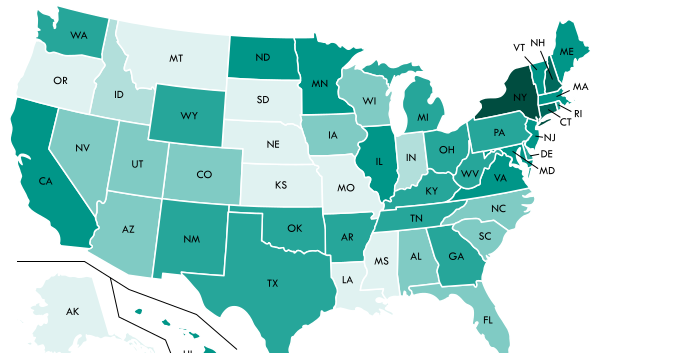
Most common states for web content editors
| Rank | State | Population | # of jobs | Employment/ 1000ppl |
|---|---|---|---|---|
| 1 | District of Columbia | 693,972 | 218 | 31% |
| 2 | Massachusetts | 6,859,819 | 456 | 7% |
| 3 | Virginia | 8,470,020 | 487 | 6% |
| 4 | Rhode Island | 1,059,639 | 68 | 6% |
| 5 | New York | 19,849,399 | 1,047 | 5% |
| 6 | Maryland | 6,052,177 | 284 | 5% |
| 7 | Oregon | 4,142,776 | 223 | 5% |
| 8 | Utah | 3,101,833 | 144 | 5% |
| 9 | Vermont | 623,657 | 32 | 5% |
| 10 | California | 39,536,653 | 1,462 | 4% |
| 11 | New Jersey | 9,005,644 | 332 | 4% |
| 12 | Washington | 7,405,743 | 280 | 4% |
| 13 | Minnesota | 5,576,606 | 196 | 4% |
| 14 | Connecticut | 3,588,184 | 133 | 4% |
| 15 | Nebraska | 1,920,076 | 84 | 4% |
| 16 | New Hampshire | 1,342,795 | 47 | 4% |
| 17 | Montana | 1,050,493 | 41 | 4% |
| 18 | Alaska | 739,795 | 27 | 4% |
| 19 | Illinois | 12,802,023 | 421 | 3% |
| 20 | North Dakota | 755,393 | 24 | 3% |
Most common cities for web content editors
| Rank | City | # of jobs | Employment/ 1000ppl | Avg. salary |
|---|---|---|---|---|
| 1 | Amarillo | 1 | 1% | $50,640 |
| 2 | Aurora | 1 | 0% | $45,674 |
| 3 | San Diego | 1 | 0% | $56,973 |
| 4 | Washington | 1 | 0% | $76,812 |
Web Content Editor job outlook: Expert opinions
Our panel of web content editor experts
California State University - Sacramento
Belmont University
University of Nebraska - Lincoln
Belmont University
Furman University
Truman State University
Miami University
University of South Alabama
Midland College
University of Kentucky

Indiana University - Purdue University Indianapolis
University of Kentucky

California State University, Fresno
University of Pittsburgh

California State Polytechnic University, Pomona
Lincoln University

University of Wisconsin - Madison
University of North Carolina at Greensboro
Viola Ardeni
Assistant Professor & Italian Language Area HeadCalifornia State University - Sacramento
Romance Languages, Literatures, And Linguistics
What general advice would you give to a Web Content Editor?
Viola Ardeni: To recent graduates in any field, I would recommend making sure they are doing two things: 'Ask questions' and 'Show up.' In the Romance languages, literatures, and linguistics field, asking questions may mean asking for a long of informational interviews, even in places where there are no current jobs openings. You never know what you will learn from talking to someone who is working and has your same degree. Asking questions also means to be present, aware, and critical. Showing up may instead mean trying different things. Besides teaching, there is no clear job following degrees in Romance languages etc. (and even 'teaching' includes a variety of jobs), so taking advantage of different opportunities may come in handy.
What Web Content Editor skills would you recommend for someone trying to advance their career?
Viola Ardeni: The editing of texts produced by others, above all. Being good editors will be crucial. In addition, to the ability to summarize in short, easy bit very large and complex amounts of information, possibly coming from different linguistic sources. Diplomacy seems also increasingly useful, however you interpret it and wherever you stand politically. Because of the world's areas where Romance languages are mainly used, the political issues associated with those areas, and the lack of institutional support for studies in Romance languages, literatures, and linguistics in the United States, the ability of being diplomatic in navigating people, committees, donors, stakeholders, speakers, etc. is and will be important.
What will help Web Content Editors increase their earning potential?
Viola Ardeni: Negotiate your job offer, even where your position is represented by a labor union (you may negotiate other perks and benefits). I would also recommend considering extremely carefully whether a higher degree in the field (master's or PhD) would enhance your options for a higher salary. The mental, emotional, and financial cost of graduate studies may not make it worth it, if the primary objective is earning more money.
What will help Web Content Editors increase their earning potential?
K. Megan Hopper Ph.D.: By diversifying your skill set as much as possible. Being able to competently gather facts and organize them effectively, shoot interesting and impactful video, capture effective soundbites, post on the web with supporting hyperlinking, and being accurate, timely, and ethical at all times.
What Web Content Editor skills would you recommend for someone trying to advance their career?
Sara Wigal M.A.: Most entry-level salaries in publishing are non-negotiable-they're based on hardline budgets. If you are looking for wiggle room for that first job in terms of compensation, you should ask, but be prepared to instead look to the benefits package for ensuring you receive the maximum. After 1-2 years you should be able to negotiate a wage increase. This is a bit different from some other entertainment industries, but I don't see it changing particularly soon for most publishing companies. Most people in publishing have a great skill set they can use to freelance even at an earlier stage in their career if they need to.
What will help Web Content Editors increase their earning potential?
Sara Wigal M.A.: Even as we experience a second digital revolution, many of the same skills that publishing professionals have used for decades are pertinent. Developmental editing or keen and creative marketing management have been skills that carry many people through their careers, and that won't change. Being an excellent communicator in both written word (hello, email) and in person is also a way to set yourself apart from your peers, and that's nothing new. Having a growth mindset is vital (and sometimes hard to do, but worth it). Understanding how to collect, analyze and disseminate data is becoming more important in publishing and is requisite in marketing positions. For those who want to work in social media, video production skills are key.
Natalie Becerra
Career Development SpecialistUniversity of Nebraska - Lincoln
Journalism
What Web Content Editor skills would you recommend for someone trying to advance their career?
Natalie Becerra: I think some very important skills that will be important to have are resourcefulness and research skills. Especially in the journalism and media industries everything is very trend driven. That means people need to have better research-backed strategies if they want to see long-term, sustainable success. It will be hard to just rely on clickbait and bandwagoning forever, so people should sharpen their research skills and foster a sense of curiosity and resourcefulness to dig deeper and find information for themselves.
Assistant Professor Dorren Robinson
Assistant Professor of JournalismBelmont University
Journalism
What Web Content Editor skills would you recommend for someone trying to advance their career?
Assistant Professor Dorren Robinson: Now more than ever, we need journalists to hold those in power accountable and write unbiased, ethically sourced stories. Journalists can inform, educate and help create a more informed society that leads to a strong democracy. Journalists can uncover corruption, lift up the marginalized and explain complex international issues as well as telling audiences about their local communities.
What will help Web Content Editors increase their earning potential?
Assistant Professor Dorren Robinson: A journalist, whether print, digital or broadcast tells relevant, important stories happening in his or her community. Journalists strive to be fast, but also must provide accurate, objective, verifiable stories grounded in research and ethical reporting. Journalists should tell you what to think about, but not what to think.
Professor Margaret Oakes
Professor of EnglishFurman University
English Language And Literature
What general advice would you give to a Web Content Editor?
Professor Margaret Oakes: Understand that you should be looking at a salary mid-career, not right now. And look at the possibility for promotion in your place of work - a small family business will not be able to or be interested in promoting you to a leadership position, so think about if you will need to move up or out.
What Web Content Editor skills would you recommend for someone trying to advance their career?
Professor Margaret Oakes: The ability to read carefully and analytically. This is a skill that has declined in the past couple of decades as people obtain more information visually - but a visual presentation cannot carry the amount of detail that written language can, and carelessness in the use of language causes a world of problems in every area of human life (law, medicine, politics, etc.).
What will help Web Content Editors increase their earning potential?
Professor Margaret Oakes: Our graduates have such a variety of careers with an English major that this is hard to answer. But perhaps this is the answer - English majors have such widely applicable skills that they need to be alert to how they can be applied almost anywhere, and be prepared to sell their skills to a potential employer.
What general advice would you give to a Web Content Editor?
Dr. Adam Davis: Some patience. The news gets clicks and eyeballs with doom and gloom, but the fact is, people in fields other than professional credentials (nursing, CPA) have always spent a year or two driving cabs and waiting tables. Be persistent, work networks and connections. An English degree is not a career credential; grads tend to teaching, writing/editing/publishing, but also get hired into a wide variety of firms that have use for people who can think about texts and what they mean and make persuasive cases for how to understand a given fact pattern - that's what makes it such a good preparation for law school.
Rosemary Pennington
Associate Professor & Area Coordinator of Journalism Miami UniversityMiami University
Journalism
What Web Content Editor skills would you recommend for someone trying to advance their career?
Rosemary Pennington: Being data fluent and multimedia adept are of increasing importance in the field. Data has always been important to news, but with both data and tools to crunch it becoming more accessible, it's a good idea that beginning journalists become comfortable working with numbers.
So many news outlets are branching across media that journalists really should also get comfortable working in a variety of media. Specializing in a particular medium will not help you find, and keep, a job the way it once did. That doesn't mean you have to be good at it all, but you should be familiar with how news is reported in a variety of formats.
What general advice would you give to a Web Content Editor?
Doris Frye: Employers consistently tell us that effective communication is both a skill in high demand and one that is often lacking in employees. English majors enter the workforce with exceptional communication and critical thinking skills that are already valued. With the explosion of A.I., these skills will become even more important; English majors' facility with language will become all the more essential. The tools themselves require advanced communication skills; there are already jobs related to A.I. writing. Significantly, while those tools can be useful in a variety of ways, there are limits when it comes to voice, originality, accuracy, and even clarity. The ability to adapt and respond to these AI tools will be essential going forward for those with English degrees.
What Web Content Editor skills would you recommend for someone trying to advance their career?
Doris Frye: Employers consistently tell us that effective communication is both a skill in high demand and one that is often lacking in employees. English majors enter the workforce with exceptional communication and critical thinking skills that are already valued. With the explosion of A.I., these skills will become even more important; English majors' facility with language will become all the more essential. The ability to adapt and respond to A.I. tools will be essential going forward for those with English degrees.
What general advice would you give to a Web Content Editor?
Catherine Wilbur: The best way to maximize salary earnings is to complete the highest level of education in your chosen field. The average salary for someone with a bachelor's degree in English is around $59,124 per year, while someone with a master's degree in English can expect to earn around $69,732 per year.
Stacey Hewitt
Communications CoordinatorMidland College
What skills stand out on Web Content Editor resumes?
Stacey Hewitt: The skill that stands out on Multimedia Journalist's resume is the ability to wear many hats/handle multiple responsibilities. Gone are the days where TV news reporters had photogs that took the video for them, and they just asked the questions. Journalists are doing everything all by themselves. I'm talking - you are responsible for coming up with your own story ideas/pitches, going live on Facebook before news shows, editing a story for news shows, cutting a different version for the web, and maybe even writing a print version for a newspaper partner. Showcase all your experiences, especially web and video editing experience, as everything is becoming more visual on video platforms. Even if you aren't responsible for web or editing in your current job, try to dabble in it so you can put it on your resume. Or go back to school and take a class in video and video editing.
Joshua Abboud Ph.D.
Associate Professor, Director of Bachelor of Liberal StudiesUniversity of Kentucky
Writing, Rhetoric, and Digital Studies
What hard/technical skills are most important for Web Content Editors?
Joshua Abboud Ph.D.: I mentioned developing unique research skills as an important part of your resume, but to me, it is the single most important hard skill for a content writer. You often won't have a lot of time and will have to start a project from scratch. Moving from general information to more specific sources and knowing how and when to do this will make you stand out as a writer who has important things to say. You have to think of your writing as always persuasive, no matter what you are working on. You are telling a story, and you have a specific audience that needs to hear that story. The more specific you can make that story, the better your information and the more unique your approach to the topic will be. Make your writing stand out.
The second is probably the ability to edit your work. I teach many students who tell me they aren't very good at editing their own work. Most likely, it is because they don't like to read their own work. Become a fan of writing; what I mean by that is read writing for the writing itself. Develop a sense for the style of other writers, but most of all, enjoy your own writing. Read your own writing, silently and out loud. Listen to how it sounds, your word choices, your rhythm, the cadence. When something sounds off, you will be able to revise it. Editing does not just mean typos or grammar mechanics (although, it is definitely that as well). This all leads back to developing your own style and brand of writing.
What skills stand out on Web Content Editor resumes?
Joshua Abboud Ph.D.: I think that skills that stand out on resumes are going to be those that make you unique. In other words, skills that you have been able to make your own and that blur the boundary between technical and soft skills. For example, every content writer needs to be able to have solid research abilities. However, the writer who can leverage different research sources will adapt to the various jobs a content writer may be asked to do. So, not only do you have experience with using digital archives to research your topics, but you talk to people or businesses, you go out and show you have an interest in your task beyond getting a job done. Just as the jobs you accept will determine what kind of writing you do, how you approach your jobs will establish your writing brand. That brand is your writing ethos and will give a potential employer an idea of the type of writer you are. That means that originality or creativity might be important, even if they aren't necessarily the kind of skill that immediately comes to mind on resumes. But you should use your resume as a space to tell the story of your writing ethos, your style, your unique approach.
Rodger Johnson
Visiting Lecturer of Practice in Public RelationsIndiana University - Purdue University Indianapolis
Department of Journalism and Public Relations
What hard/technical skills are most important for Web Content Editors?
Rodger Johnson: Writing and photography, or videography, or having all three are important hard skills to have. One's writing needs to be impeccable, not just in mechanics, but in how the journalist writes to objectively inform and to move the emotions of their readers.
Scoobie Ryan
Associate DirectorUniversity of Kentucky
School of Journalism and Media
What skills stand out on Web Content Editor resumes?
Scoobie Ryan: Traditional skills on a journalist's resume are important-writing, editing, and storytelling-but we're seeing demand for things like the ability to fly a drone and use it to gather video. A student who has an FAA drone pilot's license on a resume plus the ability to shoot and edit video shot using a drone stands out. As a result, our Drone Journalism class is very popular.
Students who can use a variety of hardware and software are in demand for MMJ jobs. Our students get experience with Canon DSLRs, Sony Mirrorless, 360 cameras, GoPro Fusions, and more. They learn to use the Adobe Creative Suite. Students also need to be able to shoot, edit and post a story using just a smartphone.
Knowledge of social media is essential-not just how to use it, but its rhythms and pace. Students must understand how to promote a story on Twitter, Instagram, and TikTok, livestream it on Facebook, and post to YouTube.
Producers are in high demand. They must be able to know how a story will develop and stay ahead of it. They need to write well on deadlines, work collaboratively, stay calm, and multi-task.
It helps if they're platform agnostic. We encourage them not to think of themselves as print reporters, broadcasters, or web producers. Journalists who can find the truth, verify it and present it using the platform best suited to reach their audience are in demand.
Betsy Hays
ChairCalifornia State University, Fresno
Department of Media, Communications and Journalism
What Web Content Editor skills would you recommend for someone trying to advance their career?
Betsy Hays: Study the successes and failures of others so you can learn best practices based on real life. And practice being a content creator. Write, take photos, create graphics, produce videos - practice sharing information and telling stories in a myriad of ways. And when you have some good stuff, share it publicly (blog, YouTube channel, social media, podcast, etc.) to learn what people respond to. And monitor trends. There are also a number of free or low-cost certifications that you can obtain as well. And one more - volunteer for a cause you believe in to make the world a better place while learning new skills.
What general advice would you give to a Web Content Editor?
Betsy Hays: Do informational interviews to build your network. Ask folks about their career path, the scope of their jobs, their biggest successes, advice they have for someone just starting out, etc. And then ask if they have ideas for other people that would be good to talk to. And then keep going! Also, be obsessed with thank you notes.
What technical skills for a Web Content Editor stand out to employers?
Gayle Rogers: Many employers tell me that they seek graduates who can bridge the stereotypical-yet very real-divide in the technical world between the more rote elements of coding and the more creative elements of narrative that departments like my own (English) have traditionally taught. Creative coding and the ability to mesh what computer scientists and poets do-employers have consistently told me that there is great promise in that, now and going forward.
Aaron DeRosa Ph.D.
Associate Professor, 20th/21st C. American LiteratureCalifornia State Polytechnic University, Pomona
College of Letters, Arts and Social Sciences
Will there be an enduring impact of the coronavirus pandemic on Web Content Editors?
Aaron DeRosa Ph.D.: Many of our students work and go to school at the same time, so the pandemic's impact is being lived right now. The pandemic only exacerbates problems already embedded in the labor market: a move toward contingent labor and freelance work. This generation of graduates will be asked to continue jumping from job to job, never allowed to settle into a "career." The flip side is that the precarity of these jobs and their ability to move through different work environments will make them more versatile critical thinkers and more compassionate people.
What technical skills for a Web Content Editor stand out to employers?
Aaron DeRosa Ph.D.: English majors find homes in every major industry because they are trained to think about the precision of language and its impact, to critically think through problems and imagine the implications of the projects they work on, and to conduct sound research while being critical of the material they encounter. They do this whether the field is technical writing, advertising, law, journalism, publishing, teaching, retail, or whatever new positions arise in the years to come.
Will there be an enduring impact of the coronavirus pandemic on Web Content Editors?
Jason Whittaker Ph.D.: With regard to whether there will be an enduring impact of the pandemic on graduates, the glib answer is, of course, it must be. What I would emphasise, however, is that after nearly a year teaching under very constrained conditions the changes are not simply negative ones - or rather, students are already learning to adapt. Among journalists, it's becoming quite clear that what we're witnessing in part is a rapid acceleration of trends that were already beginning to take place, with reporters being expected to be more mobile and work remotely. For those students who are engaging actively, we're seeing a greater takeup of mobile skills and those required for accessing and interviewing sources remotely.
What soft skills should all Web Content Editors possess?
Jason Whittaker Ph.D.: Among the key skills for graduates, some of these remain the same as before, particularly in terms of being able to communicate clearly, analyse information, and engage creatively with problem solving. The past year, however, has really brought to the fore the importance of resilience in our students, especially as they will need to be even more flexible as their careers develop in the future. We spend a considerable amount of time working on building confidence among our students, so that rather than being overwhelmed by rapid change they see this as a challenge and opportunity.
Will there be an enduring impact of the coronavirus pandemic on Web Content Editors?
Patricia Hastings: I think there will be some enduring impacts on graduating journalism students in a number of ways. Right now, there are some obstacles to negotiate. The first is the jobs situation. First, many newsrooms don't have internships right now, and so students can't get that extra experience that will ultimately help them land a job. I see seniors who have some, but not enough experience and they need that last push outside of the classroom and campus media. Without that, it makes job hunting more difficult. Of course, there are the economic issues. So many places have downsized their newsrooms and that is a problem. Graduates have to be nimble, too, in terms of having a good toolbox of skills. Now, if you want a job, go into TV news producing. You can't find enough people to fill what is out there. There are TV news reporting jobs out there as well. It comes down to networking and having a "reel" or examples of your work to show.
And then there are the impacts we don't know. Many staffers are working from home. Will jobs change so more reporters work from home? How do you balance that with the fact that reporters should be out covering stories? The pandemic is causing a rethink on the office of the future-space, risk and other areas that we can only guess at right now.
What type of skills will young Web Content Editors need?
Patricia Hastings: Young graduates will need a few skills outside of the usual ones for a good journalism job. They will have to be able to interview for jobs via Zoom or whatever system is used. That's a different skill set than being in person. I also believe students will have to work harder to "brand" themselves. Why should someone hire you? Do the resume and work examples say "I am the go to person for getting this done?" Make an elevator pitch for yourself and see how hard it is to do. The usual skills still need to be there-video, social, maybe audio-because that's what it takes today.
I also think graduates needs to be aware of the information that's out there, and be suspicious or know enough to check for accuracy. If a photo is digitally manipulated, will you know? How can you tell? In my opinion, this is maybe the biggest skill needed. What is balanced and researched as to what is created to satisfy some agenda? This has and will continue to be an area to watch.
What experience really stands out on Web Content Editor resumes?
Patricia Hastings: The experience I think everyone needs is video, for those who aren't going into that area. Everyone uses video. Having an understanding of how to make your message or story translate to video is important and it's not that easy to do. That, and the ability to enterprise story ideas. Actually taking an idea and turning into a story for online, or broadcast or print is key. You can't tell the story the same way for each one, and so to analyze and then make a good story is important.
Dr. Anthony Cuda Ph.D.
Associate Professor and Associate HeadUniversity of North Carolina at Greensboro
Department of English
What general advice would you give to a Web Content Editor?
Dr. Anthony Cuda Ph.D.: Uncertainty abounds, but society is adapting and learning to live in new ways. You'll make yourself essential by proving your adaptability, your willingness to change gears and try new ways of working, but also by proving that you can be both nimble (quick to adapt and change) and rigorously attentive to detail. Attention to detail-the equivalent of rigorous, thorough proofreading in any profession-will set you apart from your peers and get you noticed.