Explore jobs
Find specific jobs
Explore careers
Explore professions
Best companies
Explore companies
Job outlook for web developer/analysts in the United States
Web developer/analyst job growth summary. After extensive research, interviews, and analysis, Zippia's data science team found that:
The projected web developer/analyst job growth rate is 13% from 2018-2028.
About 20,900 new jobs for web developer/analysts are projected over the next decade.
Web developer/analyst salaries have increased 11% for web developer/analysts in the last 5 years.
There are over 111,782 web developer/analysts currently employed in the United States.
There are 82,297 active web developer/analyst job openings in the US.
The average web developer/analyst salary is $84,195.
Are web developer/analyst jobs in demand?
Web developer/analyst job and salary trends over time
Web developer/analyst jobs over time
Web developer/analyst job growth rate over time
| Year | # of jobs | % of population |
|---|---|---|
| 2021 | 111,782 | 0.03% |
| 2020 | 115,647 | 0.03% |
| 2019 | 25,587 | 0.01% |
| 2018 | 18,316 | 0.01% |
| 2017 | 18,113 | 0.01% |
Average web developer/analyst salary over time
Web developer/analyst salary by year
| Year | Avg. salary | Hourly rate | % Change |
|---|---|---|---|
| 2026 | $84,195 | $40.48 | +3.4% |
| 2025 | $81,420 | $39.14 | +2.3% |
| 2024 | $79,577 | $38.26 | +2.1% |
| 2023 | $77,927 | $37.46 | +2.8% |
| 2022 | $75,795 | $36.44 | +1.8% |
Web developer/analyst jobs by state
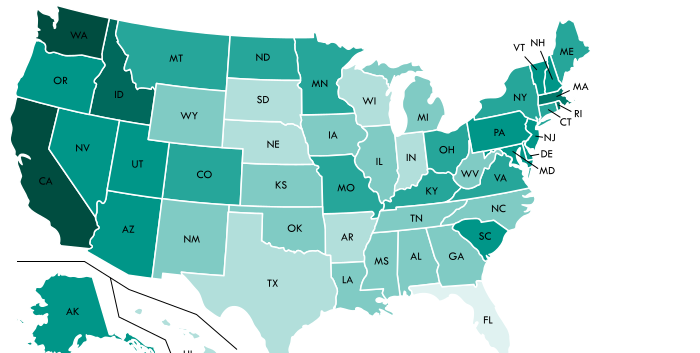
Most common states for web developer/analysts
| Rank | State | Population | # of jobs | Employment/ 1000ppl |
|---|---|---|---|---|
| 1 | District of Columbia | 693,972 | 485 | 70% |
| 2 | Virginia | 8,470,020 | 1,606 | 19% |
| 3 | Vermont | 623,657 | 116 | 19% |
| 4 | Nebraska | 1,920,076 | 345 | 18% |
| 5 | Maryland | 6,052,177 | 1,029 | 17% |
| 6 | Minnesota | 5,576,606 | 939 | 17% |
| 7 | North Dakota | 755,393 | 130 | 17% |
| 8 | Wyoming | 579,315 | 90 | 16% |
| 9 | Colorado | 5,607,154 | 814 | 15% |
| 10 | Massachusetts | 6,859,819 | 945 | 14% |
| 11 | Utah | 3,101,833 | 442 | 14% |
| 12 | Kansas | 2,913,123 | 417 | 14% |
| 13 | New Mexico | 2,088,070 | 300 | 14% |
| 14 | Rhode Island | 1,059,639 | 152 | 14% |
| 15 | Delaware | 961,939 | 139 | 14% |
| 16 | Georgia | 10,429,379 | 1,333 | 13% |
| 17 | Washington | 7,405,743 | 997 | 13% |
| 18 | New Hampshire | 1,342,795 | 169 | 13% |
| 19 | Montana | 1,050,493 | 137 | 13% |
| 20 | New Jersey | 9,005,644 | 1,111 | 12% |
Most common cities for web developer/analysts
| Rank | City | # of jobs | Employment/ 1000ppl | Avg. salary |
|---|---|---|---|---|
| 1 | Frankfort | 1 | 4% | $81,453 |
| 2 | Annapolis | 1 | 3% | $90,102 |
| 3 | Dover | 1 | 3% | $91,675 |
| 4 | Juneau | 1 | 3% | $96,576 |
| 5 | Mountain View | 2 | 2% | $121,788 |
| 6 | Hartford | 1 | 1% | $86,769 |
| 7 | Lansing | 1 | 1% | $74,602 |
| 8 | Little Rock | 1 | 1% | $66,107 |
| 9 | Springfield | 1 | 1% | $74,559 |
| 10 | Atlanta | 1 | 0% | $78,802 |
| 11 | Baton Rouge | 1 | 0% | $76,021 |
| 12 | Boston | 1 | 0% | $102,279 |
| 13 | Denver | 1 | 0% | $81,934 |
| 14 | Des Moines | 1 | 0% | $76,374 |
| 15 | Indianapolis | 1 | 0% | $69,229 |
| 16 | Montgomery | 1 | 0% | $75,458 |
| 17 | Phoenix | 1 | 0% | $92,799 |
| 18 | Sacramento | 1 | 0% | $122,918 |
Web Developer/Analyst job outlook: Expert opinions
Our panel of web developer/analyst experts
Mount St. Joseph University

Wright State University

University of California, Irvine
Southeastern Louisiana University
University of Tulsa

Adelphi University
Xavier University of Louisiana
Keiser University Latin American Campus.

University of New Haven

Murray State University

University of Pittsburgh - Bradford
North Dakota State University

Indiana University South Bend

Pennsylvania State University - Erie (The Behrend College)

Illinois Wesleyan University

New Mexico State University

Ohio State University

Our Lady of the Lake University

Pomona College

Indiana University Northwest
Rebecca Allen
Mount St. Joseph University
Special Education And Teaching
What general advice would you give to a Web Developer/Analyst?
Rebecca Allen: AI, for sure. I have heard it said that AI might not replace humans, rather humans who know how to use AI well may replace humans who don't.
Daniel Asamoah Ph.D.
Associate Professor and Interim ChairWright State University
Information Systems and Supply Chain Management Department
What skills stand out on Web Developer/Analyst resumes?
Daniel Asamoah Ph.D.: Web Developer: JavaScript, HTML5, CSS, PHP, Python, APIs, Web user interface design.
What skills will help Web Developer/Analysts earn the most?
Daniel Asamoah Ph.D.: Particularly for a web developer, HTML/CSS skills, scripting langue competency, communication skills.
David Feldman Ph.D.
Professor of Urban Planning and Public Policy and Political Science, Director, Water UCI, Director, MPP ProgramUniversity of California, Irvine
Urban Planning and Public Policy
What skills stand out on Web Developer/Analyst resumes?
David Feldman Ph.D.: Succinct writing, critical thinking, strong quantitative analytical skills.
Dr. Ghanssan Alkadi Ph.D.
Professor of Computer ScienceSoutheastern Louisiana University
Department of Computer Science
What hard/technical skills are most important for Web Developer/Analysts?
Dr. Ghanssan Alkadi Ph.D.: Analytical and programming skills to solve problems at hand.
What skills will help Web Developer/Analysts earn the most?
Dr. Ghanssan Alkadi Ph.D.: Web and Mobile App development will help you earn the most.
Sal Aurigemma Ph.D.
Associate Professor of CIS, J. Bradley Oxley Professor of Computer Information SystemsUniversity of Tulsa
School of Accounting and CIS at the Collins College of Business
What soft skills should all Web Developer/Analysts possess?
Sal Aurigemma Ph.D.: All the soft skills are important, but a few are absolutely critical in today's hybrid workforce. With the uncertainty of COVID delaying the return to the office, many companies are embracing hybrid work and/or 100% remote for some or all of their employees. Today's employees must be able to effectively communicate over a range of different modalities, both synchronously and asynchronously, while still being able to actively build and maintain relationships as they participate in one or more teams of coworkers, customers, and other stakeholders. Today's IT workers need to be honest with themselves on the work environments they can and cannot succeed within.
Hanna Kim Ph.D.
Associate Professor, ChairAdelphi University
Anthropology, College of Arts and Sciences
What skills stand out on Web Developer/Analyst resumes?
Hanna Kim Ph.D.: Considering the undergraduate anthropology curriculum, many colleges and universities try to cover at least 2-3 of the 4 major subfields of Anthropology in their curriculum.
I say "try to" as the reality is that having faculty in all 4 subfields is not possible for many reasons. (The 4 subfields are cultural anthropology, archeology, biological anthropology (sometimes physical anthropology), and anthropological linguistics. These subfields are mirrored in graduate school where students going for PhDs will be focused on 1 subfield.)
For undergraduates with an anthropology degree seeking employment, I can speak only from the faculty side, not the employer side. My students report these factors as relevant to their being hired (and accepted into competitive schools in museum studies, social work, law school, etc.:
Analytical skills; clear writing; ability to synthesize large amounts of reading and data into well-supported arguments and interpretations; open-mindedness toward different identities and ways of being.
A hugely important skill that anthropology graduates have is the ability to be presented with a complex situation or problem, and to be able to chart a plan on how to approach the problem, gather data and other necessary information to solve the problem, and then to come up with a solution or possible strategies. Too often, particularly in situations involving human behavior, what is needed is a stronger grasp of social and cultural factors that could impede the desired outcome. Students of anthropology know that ways of doing things, and even seeing and thinking, are profoundly influenced by categories of thought that are culturally situated. This means that problem solving has to consider a network of variables that have an impact on behavior. Anthropology students, I would argue, would embrace this complexity rather than be hesitant to acknowledge it in favor of a more expedient and, in the long run, less successful solution.
Ashwith Chilvery Ph.D.
Director, Dual-Degree Engineering Program, Assistant Professor of PhysicsXavier University of Louisiana
Department of Physics and Computer Science
Will there be an enduring impact of the coronavirus pandemic on Web Developer/Analysts?
Ashwith Chilvery Ph.D.: The coronavirus pandemic has made a substantial impact on every industry across latitude and longitude. It adapted us to the new normal, which some industries see as a boon and others as bane. HigherEd, which happens to be the oldest and mature industry, is no exception. The cohort of graduates who are very special because they are flexible, comprehend concepts via simulations, videos and peer mentoring. The benefits of these pedagogies are unique, thought provoking and content rich. Subsequently, our conventional methods to calibrate or gauge student's learning outcomes were fine-tuned to current circumstances. Moreover, the prominence of online learning has also enabled us to bridge the gap. So, the repercussions of pandemic on current graduates would be narrow and low-gravity.
What's a good job out of college for Web Developer/Analysts?
Ashwith Chilvery Ph.D.: With increasing unemployment rates, it would be challenging for most of the graduates to find suitable and relevant jobs. More precisely, the pandemic has increased the competition by reducing the number of job vacancies. However, the students with prior internships and research experiences have an advantage to be absorbed quickly but the majority would still be on a hunt mode. In this perspective, they may want to be strategic and pursue jobs that are at a junior level but aligned with their strengths and passion. Self-employment could be other means where they could be on the learning curve and hone skills that are desired. Volunteering has always rewarded those who have embraced it. In short, graduates have to digest the current scenario and strategize their skill sets to land in their dream job.
What technical skills for a Web Developer/Analyst stand out to employers?
Ashwith Chilvery Ph.D.: In any job market, employers always desire graduates with sound technical skills that complement their teams. For instance, graduates may want to be cognizant of disruptive technologies in their fields such as software programming, coding, designing, 3d printing, project management, digital marketing, technical writing, data analytics and etc. In addition, employers have special fondness for graduates with multidisciplinary capabilities and skills. Having such sound skills would enable them to evolve as an independent thinker and thrive as a team player.
Elio Rivas
Department Chair – Software Engineering & MIS Keiser University Latin American CampusKeiser University Latin American Campus.
Software Engineering and Management Information Systems (MIS) Department
Will there be an enduring impact of the coronavirus pandemic on Web Developer/Analysts?
Elio Rivas: Of course, due to the pandemic impact, a lot of companies have been forced to downsize. Nowadays the companies are looking for highly experienced professionals instead of new graduates. Even though the working modality has changed to remote, the exigencies/requirements for job applications are getting harder for new graduates.
What's a good job out of college for Web Developer/Analysts?
Christopher Martinez Ph.D.: The best job you can have out of college is a job you have passion for and will set you up to advance your career. If you have always wanted to work in aerospace, then you should seek out that field from the start. I hate to see students settle for a job because of pay or because they feel they can move to their dream field later.
What are the biggest trends we'll see in the Web Developer/Analyst job market given the pandemic?
Christopher Martinez Ph.D.: I always tell students to practice for an interview by thinking about how they will answer behavior questions such as how to do your work on a team, how you lead a team, how you learn from a failure, etc. This year I would add a new question to this list, and that is how you work remotely. Students should consider how they work with classmates to find a remote work style that works for them. They should explore how to work with Slack or Microsoft Teams to communicate and organize their team. I think we will see that remote work is a trend that will remain with us for the foreseeable future so students should work to become more comfortable with this new work style.
Dr. Matthew Tennyson Ph.D.
Associate Professor of Computer ScienceMurray State University
Computer Science and Information Systems
What certifications/licenses/courses can have the biggest impact for Web Developer/Analysts?
Dr. Matthew Tennyson Ph.D.: A bachelor's degree in computer science is extremely valuable. It has been and continues to be one of the most valuable college degrees a student can pursue. I really think all areas of computing are in demand, but web and mobile computing might be one of the strongest. Some employers do like to see extra certifications in addition to the bachelor's degree. There are literally hundreds of certifications available in the computing industry. They all vary in the required amount of time, effort, and money. I think anything that can set a candidate apart from other candidates is valuable, and that includes any certification. I would not recommend investing thousands of dollars into additional certifications after completing a bachelor's degree, but I don't think it's a bad idea for students to pursue one of the free or lower-cost certifications that are available - especially those students who might not have strong internship experience, extracurricular activities, projects, etc. to put on their resumes. I think anything DevOps related or cloud-based like Amazon's AWS or Microsoft's Azure are especially valuable right now.
Are there any particularly good places in the United States for Web Developer/Analysts to find work opportunities?
Dr. Y. Ken Wang: Other than San Francisco Bay, Seattle, New York, Boston, DC, we found Pittsburgh is a popular place for our students as well.
What experience really stands out on Web Developer/Analyst resumes?
Dr. Simone Ludwig: Capstone experience, Internship or Co-op experience, and working on a research project will stand out on a resume.
Will there be an enduring impact of the coronavirus pandemic on Web Developer/Analysts?
Hang Dinh Ph.D.: I don't think there will be an enduring impact from the coronavirus on graduates of mathematics and computer science. The Internet and technology industries are booming during the pandemic, which needs graduates in math and computer science.
What type of skills will young Web Developer/Analysts need?
Hang Dinh Ph.D.: In the coming years, when life is still being impacted by the pandemic in some way, graduates who enter the workforce may need skills that help them work efficiently from home. Those skills would include time management, self-motivation, and the ability to use technology. Of course, they still need the skills that are usually needed for their jobs, such as communication skills, teamwork, etc.
What experience really stands out on Web Developer/Analyst resumes?
Hang Dinh Ph.D.: Determining which experiences stand out on resumes depends on the position. For example, when we look for developers for ExtentWorld, we would love someone with experience in building complex or large scale systems and in designing advanced algorithms. The experience of simple coding would not stand out for such a position. At ExtentWorld, we have code-generating tools that help us build a complex one-stop social media platform at Extentworld with just two developers. This means the simple coding tasks can be automated. Graduates of computer science should have more than just coding experience.
Will there be an enduring impact of the coronavirus pandemic on Web Developer/Analysts?
Elisa Beshero-Bondar Ph.D.: Yes, there certainly will. My digital project design course this fall involved seniors working entirely remotely on teams, and learning to work with GitHub, as well as Slack and Discord to coordinate together. Everything was more virtual than ever this year, and I know that these students learned more than ever before the pandemic about virtual task management and teamwork, because they relied on it more than ever to be connected with each other. They're marked by that awareness, and my colleagues indicate that those who graduate will be more resourceful and productive than before, and ready to work at a distance as needed.
What type of skills will young Web Developer/Analysts need?
Elisa Beshero-Bondar Ph.D.: Our graduates will need the vital skill of "looking stuff up" to find the most reliable and cost-efficient technological tools for a task. They need strong virtual as well as in-person communication skills, and they need experience with careful data and file curation. They need to be good at debugging problems and finding solutions, rather than presuming that the tech a company relies on will "just work." These things will help our students find good jobs and become indispensable employees.
What experience really stands out on Web Developer/Analyst resumes?
Elisa Beshero-Bondar Ph.D.: Designing and developing a whole project from plan to completion, whether solo or on a team. A student with coursework involving coding won't stand out as much as a student who has applied what they have learned to a project they made themselves or with a clearly defined role on a team. A student who successfully leads a project team (during a pandemic!) clearly has much to offer the workforce.
Brian Law
Assistant Professor of Computer ScienceIllinois Wesleyan University
Computer Science Department
What are the biggest trends we'll see in the Web Developer/Analyst job market given the pandemic?
Brian Law: I'm not sure the pandemic has really changed anything, so much as it's accelerated existing trends. Large firms are still expanding their IT workforces - or planning to when the economy recovers - with increased interest in data science, artificial intelligence, and systems, especially with an eye towards contracting IT infrastructure and services, and moving towards decentralized work, whether that be in the form of remote work, "smart" technology, and/or the cloud.
All of these were happening already pre-pandemic as the various technologies matured, but the pandemic seems to have accelerated those trends as companies are both tightening their belts in the short-term and planning ahead for the long-term. Smaller firms may be struggling to survive, but technological progress has not stopped, so while overall job numbers may be down in any given month, that just means there's a lot of pent-up demand for when the economy recovers.
For example, the pandemic has pushed a lot of small businesses and restaurants to adopt online ordering and shopping systems; those systems aren't just going away when the pandemic ends, and new post-pandemic businesses will have to compete against incumbents with significant technology investments.
What Web Developer/Analyst skills would you recommend for someone trying to advance their career?
Brian Law: There are several areas that are "hot" right now, such as the previously-mentioned data science, artificial intelligence, and systems, but also cybersecurity and databases/data warehousing. That being said, the most important thing for a new graduate seeking employment to do is just to do anything, produce something. Tech employers don't and have never trusted computer science credentialing; that mistrust is the origin of the infamous "tech interview," used to verify whether a candidate actually has the technical skills to back up their piece of paper.
So to preemptively answer that question and get a leg up on other candidates, graduates should be sure to generate some artifact(s) that demonstrate(s) their technical and organizational skills. Show them that you can plan a project, design it, see it through in programming it, and do so in a responsible, organized manner (good coding style, readable code, well-documented, and using proper version control), and you'll have addressed your future employer's greatest worries right off the bat.
If it's a project in one of these "hot" areas or specifically tuned for the work the employer does, all the better, but anything the employer is doing is probably leagues beyond what a fresh graduate can do by themselves in a few months, so ultimately they're not going to be that impressed with your domain-specific technical knowledge. Instead treat it more as an opportunity to show off your "soft" skills, your programming maturity, and your ability to actually produce a product rather than just answer exam questions. And while you're at it, you might as well make it something fun for yourself so you'll be driven to finish it.
What general advice would you give to a Web Developer/Analyst?
Brian Law: i) Explore your options thoroughly. Too many students get bewitched by Big Tech companies, with their bold promises, their fancy campuses, their big recruitment events, and their nice swag. Nowadays, this also happens to students with start-ups. But those jobs are not only highly competitive, but they also have very similarly exacting work cultures and very little work-life balance. These are cutthroat environments that are, frankly, not suited for everyone. Instead, many graduates would probably be happier working at, say, medium or small-size companies where they can find a workplace culture that fits them rather than the other way around, or non-tech companies where the pressure is lower because the goal is more stability and support rather than rapid innovation. Of course, this is the exact same dynamic that plays out with young consultants, accountants, lawyers, and doctors, who are also often initially attracted to high-powered, high-pressure environments but often end up deciding it's not for them, especially as they get older and start thinking about families.
ii) Specialize. There's no job out there with the title, "Computer Scientist." Employers are looking to hire you for a specific set of skills and knowledge. If you can identify the area of Computer Science you're interested in and the work you want to do in that area, you can again get a big leg up over your competition if you can demonstrate that you actually want to do what your future employer wants you to and that you're good at it. If you want to work with databases, then take those extra database electives and learn some other database technologies on your own time, and your resume will stand out amongst all the others for any DBA job.
iii) Don't sweat it too much. You've probably been alive for 22 years or so, so you'll probably be in the labor force for 50+ years. Your first job is not going to be your last job, and you may easily find your career path taking unexpected turns that you never even knew existed. Just like you didn't know what the areas of computer science were as a freshman, there are many many CS-related job types out there that you're not even aware of, and 50 years from now, there will probably be even more. While it may seem like your first job will set you on one path for the rest of your life, really it starts you towards 5000 possible paths out of millions in total. No, you don't get the stability of a "job for life" anymore, but that can also be freeing in a way. Don't worry about finding that "perfect" job; even if you did find it, you and the world around you will change over time anyway, so just take your first step confidently and always keep an eye out for your next one.
Will there be an enduring impact of the coronavirus pandemic on Web Developer/Analysts?
Dr. Shaun Cooper Ph.D.: For most graduates, no. Most employers have their own platforms, so the effects from the pandemic are not in play as the employer; the investment into the new graduate would be similar with or without the pandemic. The new graduate may have a more difficult time catching up from the loss of some educational experiences from the pandemic, but I think it will even out in twelve to eighteen months. Some examples of the biggest challenges for new graduates are the transitions to working with others and being in offices. The past eighteen months has allowed all of us to enhance our bad personal habits; the new graduate is likely to bring these to work and expect that this is normal (e.g., bathing, eating at the desk, playing games during work time).
What type of skills will young Web Developer/Analysts need?
Dr. Shaun Cooper Ph.D.: Most young graduates want to be game developers. Frankly, there are too few jobs in game development for students to find a reasonable change. The skills employers want are in using SQL with relational databases, and they want the ability to work in a full stack development environment and the willingness to learn new platforms and programming environments. The employer has a huge investment in their development stack, and the new employee has to learn that stack. Also, they want employees with the ability to communicate with management and, most importantly, the ability to work with others. The graduate should be solid in basic data structures and how they are applied to solutions. Additionally dynamic HTML web services are welcome.
What experience really stands out on Web Developer/Analyst resumes?
Dr. Shaun Cooper Ph.D.: The most important experience on a graduate's resume is the fact that they worked during their undergraduate years. Employers certainly prefer a student who has had a computer science-related internship, but regular employment experience is equally important. The recruiters want to see a person who has been in the employment system. A student who has never had any job is more of a gamble to an employer.
As for internships, one internship is good. A second one is even better. Preferably doing a different activity and maybe at a different employer.
As the Chief Information Officer at NMSU (now retired), I oversaw 100-plus regular employees. When we interviewed new graduates, it was very important to me to see that the applicant had consistent, continuous (part-time) employment.
Trey Billing Ph.D.
Post-Doctoral Research FellowOhio State University
Mershon Center for International Security Studies
How do you envision technology impacting Web Developer/Analysts in the next 5 years?
Trey Billing Ph.D.: Technological progress in recent years has dramatically increased the availability of data across the board. While STEM fields have the technical skills to work with this data, STEM graduates often lack the contextual, theoretical, and ethical training standard in social science programs. Therefore, I envision a growing demand for international relations graduates with skills usually associated with STEM programs (e.g., statistics, programming) that are also well-versed in classic social-scientific issues.
What technology do you think will become more important and prevalent for Web Developer/Analysts in the next 3-5 years?
A.J. Arreguin: This question is callous to answer only because we, at Our Lady of the Lake University, are technically preparing these students for jobs that do not exist yet! Crazy to think, but the public relations field is an ever-growing area that students and professionals must adjust to the media platforms. If I could narrow down what technology would be vital in three to five years, I'd have to say virtual reality and how we use that platform to communicate to audiences. I still think social media is growing and will become more integrated into our lives moving forward. Students who enroll at Our Lady of the Lake University are taught the fundamentals of social media and media literacy (understanding the role media plays in the life of its audiences).
How do you envision technology impacting Web Developer/Analysts in the next 5 years?
Lise Abrams Ph.D.: I suppose if I knew that, I could make a lot of money. The technology to research cognition has continually evolved in the past 50 years. We have computers whose "artificial intelligence" can be used to simulate complex human emotions. We have brain imaging machines that can answer difficult questions, such as whether patients in a vegetative state have consciousness. Whatever the next five years bring specifically, graduates need to stay on top of the ever-changing hardware and software to help scientists understand the human mind.
What technology do you think will become more important and prevalent for Web Developer/Analysts in the next 3-5 years?
Surekha Rao: It would be almost essential that fresh graduates have some computer skills and do fundamental data analysis, even if using Excel. Without this skill, it would be limited job possibilities.
As remote working is catching up, everyone needs to be moderately tech-savvy to use it.