Explore jobs
Find specific jobs
Explore careers
Explore professions
Best companies
Explore companies
Job outlook for writing tutors in the United States
Writing tutor job growth summary. After extensive research, interviews, and analysis, Zippia's data science team found that:
The projected writing tutor job growth rate is 4% from 2018-2028.
About 55,400 new jobs for writing tutors are projected over the next decade.
Writing tutor salaries have increased 6% for writing tutors in the last 5 years.
There are over 4,001 writing tutors currently employed in the United States.
There are 16,653 active writing tutor job openings in the US.
The average writing tutor salary is $25,557.
Are writing tutor jobs in demand?
Writing tutor job and salary trends over time
Writing tutor jobs over time
Writing tutor job growth rate over time
| Year | # of jobs | % of population |
|---|---|---|
| 2021 | 4,001 | 0.00% |
| 2020 | 19,781 | 0.01% |
| 2019 | 20,801 | 0.01% |
| 2018 | 12,535 | 0.00% |
| 2017 | 12,516 | 0.00% |
Average writing tutor salary over time
Writing tutor salary by year
| Year | Avg. salary | Hourly rate | % Change |
|---|---|---|---|
| 2025 | $25,557 | $12.29 | +2.5% |
| 2024 | $24,932 | $11.99 | +0.3% |
| 2023 | $24,864 | $11.95 | +1.8% |
| 2022 | $24,421 | $11.74 | +1.7% |
| 2021 | $24,007 | $11.54 | +3.7% |
Writing tutor jobs by state
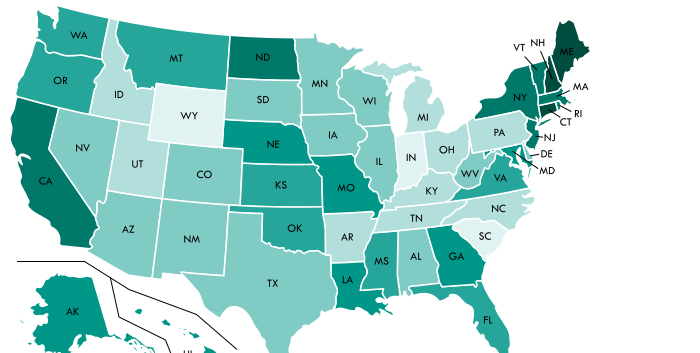
Most common states for writing tutors
| Rank | State | Population | # of jobs | Employment/ 1000ppl |
|---|---|---|---|---|
| 1 | Vermont | 623,657 | 109 | 17% |
| 2 | Minnesota | 5,576,606 | 859 | 15% |
| 3 | Delaware | 961,939 | 146 | 15% |
| 4 | Wyoming | 579,315 | 84 | 14% |
| 5 | Idaho | 1,716,943 | 183 | 11% |
| 6 | South Dakota | 869,666 | 97 | 11% |
| 7 | Maine | 1,335,907 | 138 | 10% |
| 8 | New Hampshire | 1,342,795 | 132 | 10% |
| 9 | Rhode Island | 1,059,639 | 103 | 10% |
| 10 | Alaska | 739,795 | 77 | 10% |
| 11 | Montana | 1,050,493 | 96 | 9% |
| 12 | North Dakota | 755,393 | 70 | 9% |
| 13 | Nebraska | 1,920,076 | 139 | 7% |
| 14 | Connecticut | 3,588,184 | 217 | 6% |
| 15 | West Virginia | 1,815,857 | 104 | 6% |
| 16 | Hawaii | 1,427,538 | 83 | 6% |
| 17 | Maryland | 6,052,177 | 299 | 5% |
| 18 | Kansas | 2,913,123 | 158 | 5% |
| 19 | Mississippi | 2,984,100 | 144 | 5% |
| 20 | New Mexico | 2,088,070 | 113 | 5% |
Most common cities for writing tutors
| Rank | City | # of jobs | Employment/ 1000ppl | Avg. salary |
|---|---|---|---|---|
| 1 | Columbia | 1 | 1% | $27,269 |
| 2 | Nampa | 1 | 1% | $23,708 |
| 3 | Stamford | 1 | 1% | $32,227 |
| 4 | Baltimore | 1 | 0% | $27,417 |
| 5 | San Francisco | 1 | 0% | $30,582 |
Writing Tutor job outlook: Expert opinions
Our panel of writing tutor experts

Northern Arizona University
Louisiana State University
Davidson College
University of San Francisco
Arkansas Tech University

University of Michigan

University of Louisville

King’s College
Purdue University
Pepperdine University
Southern Oregon University
Texas State University
Pennsylvania State University, the Behrend College.

Seattle Pacific University

California State University - Fresno

Minnesota State University, Mankato
University of Tennessee-Knoxville

Oakland University

Point Loma Nazarene University
Bryant University
Lawrence Lenhart
Associate Chair nd Associate ProfessorNorthern Arizona University
Department of English
What skills stand out on Writing Tutor resumes?
Lawrence Lenhart: Ability to help writers across the disciplines
What soft skills should all Writing Tutors possess?
Lawrence Lenhart: Clear/logical/organized communication (written and oral), empathic listening
What hard/technical skills are most important for Writing Tutors?
Lawrence Lenhart: Understanding of writing conventions in different contexts: professional versus academic versus creative versus analytical versus business versus scientific versus legal versus journalism
What skills will help Writing Tutors earn the most?
Lawrence Lenhart: For someone working for themselves (e.g., tutor, freelance writer/editor, etc.): initiative, career self-management, innovative thinking / for someone working for a company (e.g., teacher, journalist, ): ability to leverage their strengths to support not just themselves, but entire departments; understanding/willingness to contribute to leadership's vision
Jonathan Osborne Ph.D.
Assistant Professor of RhetoricLouisiana State University
English Department
What skills stand out on Writing Tutor resumes?
Jonathan Osborne Ph.D.: Classroom management and proficiency with digital platforms hold an increasingly important role for writing instructors. Before the pandemic, many colleges and universities were gradually expanding online course offerings to accommodate the varied lives of their students. However, after COVID-19, online classrooms have become ubiquitous within academia, so writing instructors need to demonstrate skills with managing physical and virtual classrooms. Knowledge and expertise with digital platforms go together with classroom management as universities expect writing instructors to prepare incoming and current students to communicate effectively - whether in-person or online.
What soft skills should all Writing Tutors possess?
Jonathan Osborne Ph.D.: The ability to clearly communicate ideas, theories, expectations, assignments, etc., stands as a paramount soft skill needed for writing instructors. Students already come into the classroom with high expectations concerning the level of attention they will receive in terms of instruction, so writing instructors need to develop methods to deliver information to students in a clear and easily understood manner. Clear communication also contributes to better engagement with course material. When students know what the instructor expects and what they must do, they typically engage more fully in their work. Additionally, listening to students is a second crucial soft skill writing instructors should develop. Including students in the learning process by listening to their perspectives and making small adjustments to accommodate their learning needs shows an attention to detail necessary in the modern writing classroom.
What hard/technical skills are most important for Writing Tutors?
Jonathan Osborne Ph.D.: Writing instructors must know how to use multiple computer programs proficiently and at times use them simultaneously. Long gone are the days where all you needed to know were the basics of Microsoft Word and Excel. In addition to the learning platform used by the university (Blackboard, Canvas, Moodle, Google Classroom, etc.), writing instructors must know how to use Zoom or other online video conference platforms to ensure smooth experiences for students who cannot come to the physical classroom.
What skills will help Writing Tutors earn the most?
Jonathan Osborne Ph.D.: Considering the competitive state of the job market, writing instructor applicants need to exhibit as many soft and hard skills as possible to make themselves more visible to the places they apply.
What soft skills should all Writing Tutors possess?
Cynthia Lewis Ph.D.: The willingness to be supportive and encouraging without exaggerating the tutee's accomplishments; a gift for explaining writing mechanics.
What hard/technical skills are most important for Writing Tutors?
Cynthia Lewis Ph.D.: Experience at writing for publication or being recognized for writing (as by winning a contest); a solid grasp of English grammar and the ability to explain grammatical principles; the willingness to engage with students' writing, review it carefully, and give constructive responses and suggestions to it.
What skills will help Writing Tutors earn the most?
Cynthia Lewis Ph.D.: I would say not so many skills as demonstrated experience and having testimonials from students, the tutor has helped successfully.
What skills stand out on Writing Tutor resumes?
Cynthia Lewis Ph.D.: Demonstrated facility with language; the ability to tap into how the tutor learned what the tutee needs to know and to use that knowledge in tutoring; the ability to interest students in both reading and writing accomplished prose; a command of the vocabulary of English grammar and an ability to explain good grammatical practices; a grasp of the elements of composition and style.
(Some of these skills would come out in a cover letter versus a resume.)
Brandi Lawless Ph.D.
Department Chair & Associate ProfessorUniversity of San Francisco
Department of Communication Studies
What soft skills should all Writing Tutors possess?
Brandi Lawless Ph.D.: Employers of our alums consistently comment on their ability to work in groups--team building, interpersonal communication, and conflict alleviation are important skills at any workplace.
What hard/technical skills are most important for Writing Tutors?
Brandi Lawless Ph.D.: Learning proper citation guidelines (AP, APA, MLA) is like learning a language. It has to be exact and ends up being an important skill. Research skills (quantitative and qualitative) can also be useful in finding and citing evidence for any type of writing. Students who take my qualitative methods class often comment on how interviewing skills translate into various job skills--talking with clients, writing narratives, etc.
What skills will help Writing Tutors earn the most?
Brandi Lawless Ph.D.: Written and oral communication are the most transferable skills for any job path. They are the most sought-after skills and help to land a job and also move up the ladder. Strong communication skills also lead to self-promotion and advocacy, which help you earn more and advance over time.
What skills stand out on Writing Tutor resumes?
Lyn Brands: -Problem-solve their own situations
-Foreign language fluency
What soft skills should all Writing Tutors possess?
Lyn Brands: -Open to constructive criticism
-Adaptive to change
-Take oral instructions well/attentive
-Self-motivated
-Willingness to learn
-Ability to get along with others
What hard/technical skills are most important for Writing Tutors?
Lyn Brands: -Multiple computer platform skills
-Software proficiency
What skills will help Writing Tutors earn the most?
Lyn Brands: -Able to clearly explain, talk about a topic
-Willingness to learn
-Adaptive to change
-Visionary
Laura Aull
Associate Professor and Writing Program DirectorUniversity of Michigan
English Language & Literature Department
What skills stand out on Writing Tutor resumes?
Laura Aull: Ability to:
- conduct research to compile information,
- ability to synthesize information, including identifying connections and implications,
- strong formal written and oral communication,
- organizational skills
- communication and project management experience, especially in educational settings or community organization settings
What soft skills should all Writing Tutors possess?
Laura Aull: - formal oral and written communication skills
- interpersonal engagement
- ability to identify what is needed and break up information well to communicate with different stakeholders (e.g., administrators, staff, students, parents, faculty, donors, etc.)
What hard/technical skills are most important for Writing Tutors?
Laura Aull: - navigating institutional and academic databases
- identifying and summarizing best practices and research
- website oversight, visualization, and management
What skills will help Writing Tutors earn the most?
Laura Aull: The best is a combination of the above skills, including strong writing skills and strong digital communication and oversight skills.
Will there be an enduring impact of the coronavirus pandemic on Writing Tutors?
Karen Chandler Ph.D.: One enduring impact of the pandemic may be that students will realize they have the ability to adjust to disruptive circumstances and find ways to carry on their work and fulfill their responsibilities and goals. I've been impressed by the English department's interns, majors and minors not only learning how to navigate the challenges of remote, distance ed and hybrid courses, but also to make the best of circumstances. I see them learning how to use teleconferencing platforms, coming up with ways to connect and do their work, etc.
What's a day at work look like for a Writing Tutor?
Karen Chandler Ph.D.: I don't assume that there will be one paradigm, but I suppose many recent graduates' work will include more remote work than before the pandemic. Their academic work in virtual classrooms, while different, may help prepare them to do individual tasks and collaborative work remotely.
What will help Writing Tutors increase their earning potential?
Karen Chandler Ph.D.: Interest in graduate programs seems to indicate that more students are considering returning to university to pursue higher degrees. For those in the workplace outside higher ed, an environment, whether actual or virtual, that fosters recent graduates' development would be important. This would involve clear communication and trust.
What certifications/licenses/courses can have the biggest impact for Writing Tutors?
Dr. Robin Field Ph.D.: Employers appreciate excellent communication skills-from the written to the oral, from strong interpersonal skills to leadership experiences. Prospective employees may demonstrate these skills in a variety of ways. Internships offer invaluable workplace experiences that help to develop these skills, so undergraduate students should try to complete at least one internship, if not more, in fields such as nonprofits, marketing and public relations, and research/editing fields. Working with on-campus publications, such as a newspaper, literary magazine, or radio station, also develops these integral skills, as well as offers opportunities to showcase creativity-another key skill employers are looking for. While graduate degrees may be important in certain fields, they certainly need not be pursued immediately upon graduation.
Will there be an enduring impact of the coronavirus pandemic on Writing Tutors?
Dr. Robin Field Ph.D.: The COVID-19 pandemic has demonstrated that many jobs traditionally set in offices may be done remotely with great success. While freelance writers, editors, and designers have worked remotely for years, today's graduates in English, Professional Writing, and Literature will have greater opportunities to work from home at full-time positions across the country. The pivot to online education in early 2020 also demonstrated the technical savvy of English and Professional Writing majors. These graduates are adaptable to new workplace conditions, in addition to their strengths in critical thinking, analysis, information literacy, and writing. English majors today are excited about the flexibility that their careers will hold.
What will help Writing Tutors increase their earning potential?
Dr. Robin Field Ph.D.: To move up in certain fields does require graduate credentials, and some employers will pay for their employees' master's degrees. Many graduate programs have some or all of their programs online or in a weekend/summer format in order to accommodate workers. All employees should consider their options carefully to minimize student loan debt while also earning their next credential.
Derek Pacheco Ph.D.
Associate Professor and Director of Undergraduate Studies in EnglishPurdue University
English Department
What general advice would you give to a Writing Tutor?
Derek Pacheco Ph.D.: When talking about job prospects for English majors, I always recommend George Anders' You Can Do Anything (2017). In it, he argues that there are enormous possibilities for humanities and liberal arts graduates in "tech-adjacent" careers-not Big Tech or Silicon Valley per se, but a wide swath of industries (that is to say most of them) transformed by the major digital innovations of the last couple of decades, especially as the cost of technological literacy has come down and the need for human-centered skills has gone up. So, even in a world where STEM and engineers seem to reign, the biggest opportunities tend to be in careers that emphasize time-honored skills like curiosity, creativity, clear writing, deep reading, empathy, racial and cultural sensitivities, and collaboration. A long perspective, the ability to understand and learn from the past as well as to anticipate trends in the future, is also helpful. The great thing about studying English is that these essential career skills are embedded in the activities our students love to do: reading great books, learning about different cultures, times, and places, and crafting persuasive, emotionally-affecting arguments or stories.
What skills stand out on Writing Tutor resumes?
Derek Pacheco Ph.D.: Recent studies demonstrate that employers continue to rank these sorts of humanities-friendly skills ahead of specific technical competencies (which go out of fashion much faster) when seeking job candidates. Even in highly technical fields like engineering, employers see people skills as important indicators of long-term employee potential. (So, if you want to be an engineer, you'd be smart to consider minoring in English or a foreign language as a way to differentiate yourself in an increasingly competitive market!) Anders' book was written a few years ago, but, if the pandemic has taught us anything, it's that virtually all "white collar" careers are now tech-adjacent, increasingly characterized by Slack chats, Zoom meetings, working from home. I expect that this trend will accelerate, and along with it the importance of the people skills needed to thrive in this twenty-first-century workplace.
I also see more and more students in English double majoring or minoring in other programs as they explore their intellectual interests, professional abilities, and personal aspirations for life and work after college. This is a good thing, and true to the Liberal Arts spirit. Here at Purdue University, for example, our slimmed down English major (10 or 11 classes, depending on the track) is designed for flexibility, readily stacking with other plans of study across the college and campus. I always say that, basically, we're the department of storytelling-and storytelling is essential in any profession, whether told through language, images, or data. By the time they graduate, our students should have a story to share about themselves, their experiences, their education, their passions, their goals. A Literature major with a double minor in Management and Spanish, or a Creative Writing major with a double major in Physics (real examples), is going to have a much more interesting story to tell about themselves than otherwise.
What are the biggest trends we'll see in the Writing Tutor job market given the pandemic?
Stewart Davenport Ph.D.: Even more emphasis on computer science, technological competency, and the ability to conduct business and provide services via cyberspace
Amy Belcastro Ph.D.
Professor of EducationSouthern Oregon University
Educational Administration And Supervision
What general advice would you give to a Writing Tutor?
Amy Belcastro Ph.D.: First is to take the time to know what are your strengths and areas for improvement. You are intentionally crafting your professional reputation. Next, consider where you want to be in five years and what steps are needed to get there. It is the balancing act of long-term goals and short-time needs. Being intentional is key. Every step matters so step with intention. That said, there are many roads to Rome so explore, take risks, but be aware that you are crafting your professional reputation and self.
What Writing Tutor skills would you recommend for someone trying to advance their career?
Amy Belcastro Ph.D.: First, focus on updating your current resume to clearly communicate and provide evidence of your transferable skills and cognitive competencies such as strong communication and technology skills; the ability to work well with others who may be different in backgrounds, beliefs, etc.; leadership skills, and problem solving and complex thinking. After you have done this, assess where you are lacking and create a plan to strengthen your resume by seeking experiences. A very popular method of doing this is by completing a digital badge or micro-credential at an institute of higher education. It is a way of acknowledging competencies and skills in much less time than a college degree would take. Some may only be a few credits. This is becoming very popular for the workforce and therefore more institutions of higher education are offering these, some in partnership with companies.
What are the biggest trends we'll see in the Writing Tutor job market given the pandemic?
Dr. Yasmine Beale-Rivaya Ph.D.: This is a difficult question as we don't know what permanent changes the pandemic will produce. However, current literature on jobs and consumer interest has to do with providing a customized experience. Customers are no longer satisfied being treated as a number. They want to consume products and services that they can identify with, that make them feel as if they were produced or created with them in mind. To this point, customers want to be talked to and marketed to in their preferred language. I believe that the most successful companies will be those that can market and communicate with their customers on their level. They will want to employ people who can address multiple markets. In a highly-competitive globalized market, the higher-level language skills one has, the more versatile and valuable one becomes to an employer.
What skills stand out on Writing Tutor resumes?
Dr. Yasmine Beale-Rivaya Ph.D.: Job candidates whose resumes indicate advanced foreign language skills and international sophistication generally receive greater consideration from potential employers.
The skills that I think will be the most important are demonstrating that one has the ability to respond to customers in a way that resonates personally with them. In terms of language, that means being able to communicate with customers in their language, and especially, in their dialect. It won’t be enough to just be able to speak the language. Employees will need those unquantifiable skills and a deep knowledgebase that only comes through a sustained and broad knowledge of the culture and literature. This level of cultural sophistication is in demand across various professional fields, such as journalism, international relations, translation, interpretation, publishing, higher education, global business, health care, and customer service.
I believe employers are going to look for employees who can produce professional material in the target language at a high skill level and also produce material that is targeted to their different customer markets. Content will need to be creative and reference all those items that form part of a person’s cultural memory and traditions. Thus, companies will not be able to rely on auto-translations.
Among our language offerings at Texas State are Chinese, Japanese, Arabic, Russian, and Portuguese, which are all designated as Critical Languages by the U.S. Department of State. Academic programs that enable students to acquire foreign language skills while acquiring intercultural competency in critical languages help prepare them to meet the specific demand for specialists in global communications and international affairs.
Advanced language study in the form of minors or second majors complements the skills of graduates in other academic majors such as International Relations, International Studies, History, Political Science, Psychology, English, Anthropology, Philosophy, Religious Studies, Economics, Mass Communication, Communication Studies, Journalism and Mass Communication, Criminal Justice, and Computer Science, providing students the opportunity to enhance their professional career opportunities.
What are the biggest trends we'll see in the Writing Tutor job market given the pandemic?
Dr. Amy Carney Ph.D.: I think one of the biggest trends we are going to continue to see in the job market is also a valuable skill for college grads and soon-to-be college grads: flexibility. This has always been a minor trend for many jobs - for example, are you willing to move to another part of the state or country for a job? But flexibility is a much more prominent trend now - are you capable of quickly learning the necessary skills to do your job in different formats? In this regard, someone with a history degree, or another humanities or liberal arts degree, will be in a very strong position to apply for a wide range of jobs because of the diverse portfolio of transferable skills students learn in these majors, not the least of which are communication skills.
Are there any particularly good places in the United States for Writing Tutors to find work opportunities?
Dr. Amy Carney Ph.D.: We need great teachers, lawyers, archivists, librarians, analysts, et cetera, everywhere in the country. There are often opportunities at think tanks, research institutes, publishers, and government agencies around the country. History is also a viable route for people interested in management and leadership positions in business, and such jobs are likewise available around the country.
Christopher Hanson
Assistant Professor of Music, Director of Music Education and Orchestral ActivitiesSeattle Pacific University
Music Department
What are the biggest trends we'll see in the Writing Tutor job market given the pandemic?
Christopher Hanson: I think we will see an amplified debate on school choice and school funding, which will directly affect the hiring and sustainability of school administrators, leaders, and teachers. The pandemic has exposed already obvious inequities to school access and the quality of education in different arenas, e.g., homeschool, charter school, private school, public school, etc. Students and schools in more affluent communities have the infrastructure (or the means to establish the infrastructure) to support online learning and have arguably not experienced any real setbacks in the progress of their learning (specifically in terms of content, whereas I believe everyone has been affected in terms of social and emotional learning).
Many private schools have offered in-person or hybrid instruction before the states have recommended since they are not dependent on tax dollars and not required to adhere to the same guidelines as the public and some charter schools that depend on government funding. With all of this, I believe we will see a somewhat superficial, and what I believe is misguided, shift to technology. This is reactionary rather than responsive. Many districts have already begun to hire staff, faculty, and administration that are more comfortable or experienced with Title IV funding and programming and the use of technology in teaching and learning (in school and at home).
"One-to-one" initiatives have been pushed to the top of budgetary requirements and instructional expectations and overshadowed other needs. This is not to say that technology isn't important, particularly in the extraordinary time we are living through. However, if we do not build and redesign all of our systems, conflating only one aspect of education will create a severe imbalance and perpetuate problems of equity, access, retention, and sustainability.
What Writing Tutor skills would you recommend for someone trying to advance their career?
Christopher Hanson: Without hesitation, educators and administrators should be investing in a continued and evolving understanding of human learning and technology! There is a sincere need for balance. It is not just a priority to familiarize oneself with the new software and hardware that are enhancing teaching and learning but to employ a critical lens to such innovation rooted in cognitive science and human psychology. Pre-service educators and administrators need to focus on what serves their community best, not just "what is new".
It is easy to become overwhelmed with the growing number of resources and innovative approaches to teaching and learning that are being birthed, almost by the hour, in this extraordinary time. But we must always contextualize their creation and application. I would strongly advise recent graduates who are waiting to enter the field to focus their attention on case studies and action research that does not simply promote a product, but chronicles exactly how, when, and with whom educational technology is being used to support and enhance teaching and learning. In the hiring process (and in the evaluation and retention of educators and administrators) it is a distraction to simply know what educational technologies are en vogue. I hope that everyone entering the fields will be challenged to speak critically about how they will teach and lead, understanding that technology is no longer an option for our educational experiences, but it is also not a silver bullet.
Technology is, and always will be, a tool. A remarkable and life-changing tool, in so many ways, but a tool nonetheless. A tool is only as useful as the individual that yields it and uses it appropriately to complete its designed and assigned tasks. I do not want to be misunderstood, as I have genuine hope for the incredible changes and developments we will see in education after the pandemic, but we must always focus on the human aspects of teaching and learning and never forget our greater calling to serve humanity through the desire and need to question and learn as we propel one another forward through curiosity, imagination, and creativity.
What general advice would you give to a Writing Tutor?
Christopher Hanson: Keep asking questions and look for opportunities to engage in teaching and learning wherever you can. Connect with peers and future colleagues. Do not just wait. Now is the time to create and sustain dialog on educational change. Although there are endless numbers of variables to how, when, what, and with whom we learn, our genuine curiosity and sincere desire to engage others in the educative process is our greatest hope to see education in a better place than it was before the pandemic.
We must heed the call of innovation and encourage a transition from our current state of triage and survival. You, as a recent graduate, are the future of what education will be. Ask yourself, what will the world look like that you will help create? Is this a world that you and others can learn in? What more can you do to secure the possibilities and promise of education for all? These are the questions that will fuel change and secure growth through the inevitable vicissitudes of education.
Cheryl McDonald
Faculty & Coordinator, Education Specialist and Dual Credential programsCalifornia State University - Fresno
Literacy, Early, Bilingual and Special Education Department
What are the biggest trends we'll see in the Writing Tutor job market given the pandemic?
Cheryl McDonald: One of biggest trends in the job market, pandemic or not, is in education. There is real shortage of qualified educators, service providers and educational leaders, despite the incentives, stipends, or bonus monies that districts and universities use to attract candidates to the field. There is a shortage of qualified credentialed teachers in many teaching disciplines across most of the United States. The most severe shortages are in special education, mathematics, science, bilingual/dual immersion, and early childhood education. There is also a need for qualified school administrators, school psychologists, school social workers, school nurses, and school counselors.
All of these areas require specialized knowledge and specialized certification, in addition to a passion and dedication for the discipline. In California, for example, earning a teaching credential requires a Bachelor's degree, fingerprint clearance from local, state and federal law enforcement agencies, completion of the U.S. Constitution, basics skills, subject matter and literacy instruction requirements, typically through costly and rigorous tests, current certification in CPR for infants, children and adults, and completion of a teacher preparation program in the area of the credential. In special education, a candidate would need to complete a teacher preparation program in a specialty area: mild/moderate disabilities, moderate/severe disabilities, physical, visual, or health impairments, deaf and hard of hearing, or speech and language development.
Each day spent with students is unique and exciting. Teachers, service providers and leaders not only need to be qualified, they also need to be compassionate, collaborative, adaptable, flexible, and effective, especially when the unexpected arises. Virtual/online teaching skills are a plus. Teachers and educational leaders also need to be prepared to work with culturally- and linguistically-diverse student and family populations, with students who are gifted and talented, and students experiencing risk factors such as homelessness, poverty, drug or alcohol dependency, frequent absences or bullying.
Are there any particularly good places in the United States for Writing Tutors to find work opportunities?
Cheryl McDonald: After graduation, candidates should begin their search for available education positions, whether teaching or leadership in universities or preschool-12 schools, in populous states like California, Texas and New York or in rural and suburban high-poverty areas. There the needs are greatest and positions are more likely to be available and advertised. I would also ask friends, colleagues and professionals I knew to keep an eye open for available positions. You never know when an unexpected lead will pop up.
Aaron Hoy Ph.D.
Assistant Professor of SociologyMinnesota State University, Mankato
Sociology Department
Will there be an enduring impact of the coronavirus pandemic on Writing Tutors?
Aaron Hoy Ph.D.: At this point, I think it is safe to say that the coronavirus pandemic will have an enduring impact on many different aspects of our society in ways that, yes, will likely be relevant for college graduates, including sociology majors. If nothing else, work may become increasingly remote over the next several years, even once the coronavirus is under control, and this could reshape everything from how prospective employees interview for a job to the day-to-day nature of the work itself. Sociology majors, and others, should pay attention to the economy and the job market to see what changes do unfold and, like any good professional, acquire new skills as they become necessary.
For instance, if work does become increasingly remote, they should figure out how they can stay focused and productive in a non-office setting, or how they can effectively communicate and collaborate with others using technologies like Zoom. I think the coronavirus pandemic may also lead to long-term changes in the types of jobs that are available to sociology majors. For instance, the pandemic has exacerbated many significant social inequalities, especially in terms of race, sex and gender, and socioeconomic status. This has led many to realize that we need to expand the social services we offer in this society, and if we do, that may well lead to more job opportunities in that area, which is already an area where sociology majors tend to thrive.
What type of skills will young Writing Tutors need?
Aaron Hoy Ph.D.: It is good news for our society and for sociology majors that employers have already put an increased emphasis on hiring and retaining employees who have a solid understanding of issues of diversity and inclusion. This emphasis will likely continue for the foreseeable future, which is a good opportunity for sociology majors who are comfortable working in diverse environments and really understand and appreciate human diversity in terms of race, ethnicity, socioeconomic status, sex, gender identity or expression, and sexuality, among others. In fact, right now, diversity-related skills are those that recent sociology graduates say they are most likely to use and benefit from in the workplace, according to a 2015 report from the American Sociological Association.
I would also encourage sociology majors to prioritize rigorous methodological training to the extent that they can within their specific program. There are already many, many jobs available for college graduates with research skills, including in the private sector, and these are likely to grow in the coming years. However, sociology majors sometimes overlook these jobs or opt not to apply for them. As an advisor myself, I suspect that this is often because students do not feel confident in their research skills or because they assume that, say, a psychology or an economics major would be a better fit. But these are good-paying jobs with above-average levels of employee satisfaction, and sociology majors should not take themselves out of the running for them.
Although it may be scary or uncomfortable for some students, taking an extra research design or statistics class might be a good idea. And of course, writing up research results and presenting them in clear, logical ways is a key part of the research process, so as always, students should make a very concerted effort to improve their written and verbal communication skills as best they can. That may mean taking an extra composition or public speaking class if necessary.
What experience really stands out on Writing Tutor resumes?
Aaron Hoy Ph.D.: Increasingly, I hear employers say that they look to see if recent college graduates, sociology majors included, have relevant "real-world" experience, especially internships. For this reason, many sociology programs (including my own) have recently moved to make internships a required component of the major. Sociology majors who are not required to complete an internship may consider doing one anyway. But given the specific industries that sociology majors typically work in, volunteering should not be discounted altogether.
For instance, the American Sociological Association's data has consistently shown that "Social Services/Counselor" is the job category sociology majors are most likely to work in immediately following graduation. And the specific places they work often include various non-profit organizations like shelters for victims of domestic violence or homeless youth, all of which rely on volunteers. Sociology majors who do volunteer work in college not only benefit their communities; they also show at least some potential employers that they understand why they do the work they do and what it looks like on the ground.
Lisa King Ph.D.
Associate ProfessorUniversity of Tennessee-Knoxville
Department of English
What Writing Tutor skills would you recommend for someone trying to advance their career?
Lisa King Ph.D.: For English majors, this means several things. First, while English degrees have always set up our majors well in fields where communication skills are a priority, now more than ever those skills are necessary for analyzing, teaching, marketing, and translating scientific or political knowledge to the public. Second, it's not just about writing or language: it's also about using visuals and sound in accessible, attention-catching, and clear ways on digital platforms. This means developing multimodal skills with some basic software and apps. And finally, all those research skills that our majors have honed to find reliable and verifiable evidence need to be kept sharp, especially during an era of "alternative facts." For a gap year, I'd suggest that a graduate keep an open mind and take the opportunities they can to develop these skills.
Dr. Cynthia Carver
Associate Professor & ChairOakland University
Department of Organizational Leadership
What Writing Tutor skills would you recommend for someone trying to advance their career?
Dr. Cynthia Carver: Hone your teaching skills! Schools will continue to need substitute teachers and para-professionals. Child care facilitates and after-school programs will still need teachers. And it's likely that many families will be seeking tutors as their children catch up. To gain experience and build your resume, seek opportunities that mirror the work you do as a classroom teacher.
What experience really stands out on Writing Tutor resumes?
Dr. Jennifer Lineback Ph.D.: Practical experience working with real learners/students! Whether that experience be through formal academic programs (i.e., through volunteering in a classroom or being hired as an academic tutor or aid), or informal programming (i.e., working with children during after school care, Sunday School, or summer camps), the more experience graduates have with children, the better!
What type of skills will young Writing Tutors need?
Dr. Jennifer Lineback Ph.D.: Graduates will need to be comfortable adapting to evolving conditions. More than ever, we have collectively learned that situations can change, quickly. To be successful in education during this time and in the coming years, educators will need to be patient, flexible, and willing to modify their approach to teaching/learning when situations change. Having knowledge and understanding of a wide variety of instructional strategies, both for in-person and remote learning, will be critical, as will the ability to know when and how to implement these different strategies. Furthermore, our students will need strategies to support students' socio-emotional learning and cultural competency, in addition to those focused on developing content knowledge.
What Writing Tutor skills would you recommend for someone trying to advance their career?
Dr. Ronald Bobroff Ph.D.: Too many students graduate from college with mediocre writing skills. Reading well-written stories, articles, and books, and at the same time writing a lot for practice will burnish graduates' skills in this area. While consuming those quality texts, graduates should hone their critical reading skills that were developed in their History, Literature, and Political Science classes, among others.