Find a Job You Really Want In
In recent years, the landscape of motherhood and employment has evolved significantly. As of 2026, a notable number of mothers are choosing to remain at home, reflecting broader societal shifts and changes in labor market dynamics.
Recent data indicates that the proportion of mothers who do not engage in work outside the home has increased. While the trends show a complex interplay of factors—including economic conditions, childcare availability, and individual family choices—the role of stay-at-home mothers remains vital to understanding current workforce dynamics.
According to the Pew Research Center, the percentage of stay-at-home mothers has seen fluctuations over the past decade. In 2022, 29% of mothers with children under 18 did not participate in the workforce, a slight increase from 23% in 1999. While the numbers have changed, the reasons behind these choices include the rising costs of childcare and the increasing flexibility of remote work options.
Notably, stay-at-home mothers are often more diverse than their working counterparts, with varying educational backgrounds and demographics. For instance, the research shows that a significant percentage of these mothers are immigrants and come from various racial and ethnic backgrounds.
To better understand the educational backgrounds of stay-at-home mothers, we analyzed data from the Public Use Microdata Sample (PUMS), focusing on the majors that these women pursued during their college years. Below is a summary of our findings regarding the distribution of majors among stay-at-home moms.

Summary of Findings
- Electrical Engineering Technology (36.6%) ranks as the major with the highest percentage of stay-at-home moms.
- Four majors have a stay-at-home mom rate exceeding 30%:
- Electrical Engineering Technology – 36.6%
- Other Foreign Languages – 36.5%
- Botany – 32.4%
- Petroleum Engineering – 30.3%
- Six out of the top eleven majors with the highest percentage of stay-at-home moms are related to engineering.
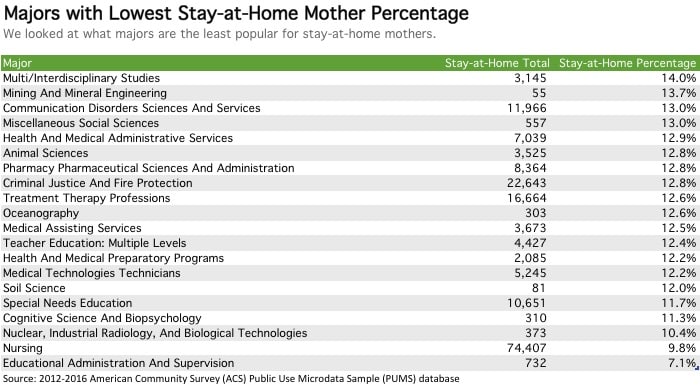
- Educational Administration and Supervision has the lowest percentage of stay-at-home moms at just 7%.
- Nursing follows closely, with nearly 10% of nursing graduates being stay-at-home mothers.
How We Conducted Our Analysis
Our analysis involved comparing the percentage of women who identify as stay-at-home mothers to those who are working. For this study, “stay-at-home” is defined as individuals who have not participated in the workforce in the last calendar year, irrespective of their reasons.
For example, in the field of accounting, we found that there were 386,572 working women of relevant age, while 83,300 women with the same degree identified as stay-at-home moms.
To calculate the percentage, we summed the two populations and divided the number of stay-at-home mothers by the total number of women in that major.
Accounting: 386,572 + 83,300 = 469,872
Then: 83,300 / 469,872 = 17.7%
This indicates that 17.7% of women who majored in accounting are stay-at-home mothers.
As the roles of stay-at-home moms continue to evolve, understanding their educational backgrounds can provide valuable insights into the changing dynamics of the labor market. These insights can help inform policies and programs aimed at supporting families and promoting workforce participation.

Author

McLeod Brown is a former writer and researcher for the Zippia Career Advice blog. His work at Zippia focused on understanding the relationship between colleges, debt, and jobs. A graduate of the University of North Carolina at Wilmington with a BA in Business Administrator, he is now pursuing a masters of science in analytics from the Institute of Advanced Analytics.