-
Tobacco manufacturing remains the fastest shrinking job in the US, projected to decline by -51% by 2031.
-
Nurse practitioners continue to be the fastest growing job in the US, expected to expand at a rate of 46%.
-
Tank & Armored Vehicle Manufacturing is projected to shrink at a staggering rate of -49.1%.
Are you concerned about the sustainability of your current job or the industry you aspire to join in today’s rapidly evolving job market? At Zippia, we understand these concerns.
With advancements in artificial intelligence and automation reshaping various sectors, it’s essential to be aware of which jobs are becoming obsolete. Many industries are also seeing a shift towards outsourcing, as companies seek cost-effective solutions.
In an economy where labor costs can vary dramatically, it’s critical to consider the long-term viability of your career path.
While sectors like healthcare, technology, and logistics are on the rise, traditional roles in manufacturing and other declining industries face uncertain futures. To help you navigate this landscape, we’ve analyzed the data to identify the industries projected to shrink the most rapidly over the coming years. Below, we present our top 10 list of the fastest shrinking jobs in America:
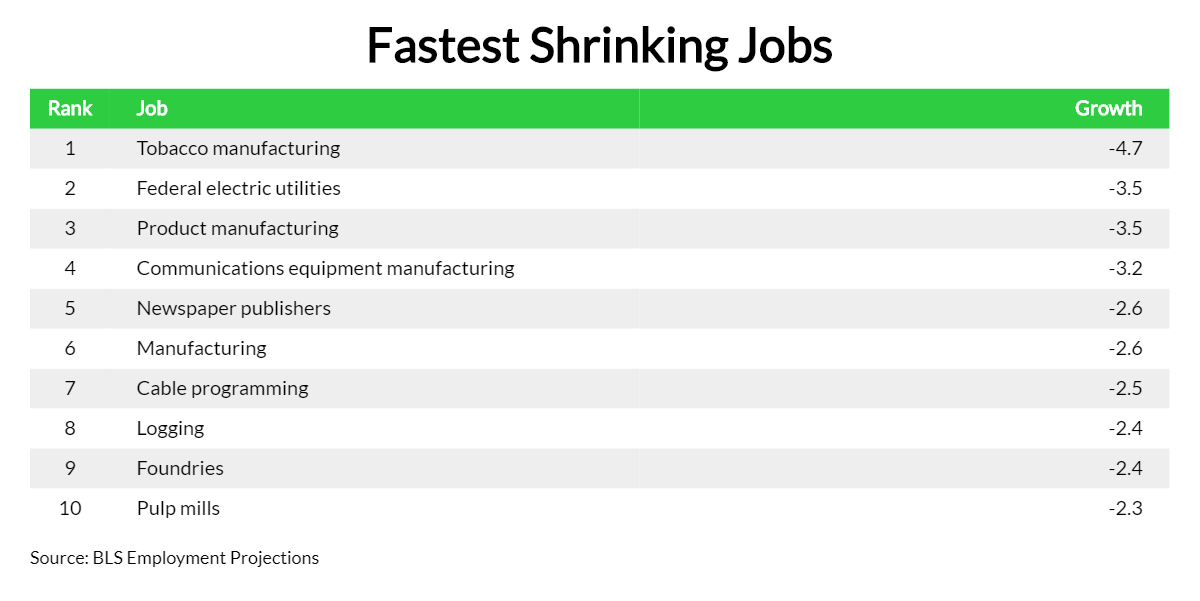
Surprised by these findings? It’s no secret that many products and services are increasingly sourced from overseas, with countries like China and India dominating certain markets.
Additionally, the jobs on our list often relate to industries that are being phased out in favor of more innovative technologies. For example, as digital media becomes more prevalent, traditional print formats are losing their appeal.
Streaming services have transformed how we consume entertainment, leaving conventional cable subscriptions in a state of decline. If you’re interested in exploring our detailed analysis of the fastest shrinking industries, read on.
How We Identified the Fastest Shrinking Jobs
To determine which industries are experiencing the steepest decline in the U.S., we consulted data from the U.S. Department of Labor. The Bureau of Labor Statistics regularly publishes employment projections, and the most recent set provides insights into trends from 2022 through 2032.
We analyzed these projections to identify the industries anticipated to experience the most significant job losses over the next decade, curating our top 10 list of the fastest shrinking industries in America.
For further details or to explore additional sectors expected to decline, visit the full projections.
-
Tobacco Manufacturing
While this projection may concern those in the tobacco manufacturing sector, the decline reflects positive public health trends and the effectiveness of anti-smoking campaigns. Interestingly, the e-cigarette manufacturing industry is projected to grow as consumers seek alternatives to traditional tobacco products. Nonetheless, tobacco manufacturing remains at the top of our list of fastest shrinking industries. -
Federal Electric Utilities
It may seem counterintuitive, but the second position on our list highlights a surprising trend. Despite increasing energy consumption, the utility sector is seeing a decline due to technological advancements that reduce the workforce required for efficient operation. Automation continues to reshape this industry. -
Apparel, Leather, and Allied Product Manufacturing
Historically, clothing production relied heavily on manual labor, but automation and outsourcing have transformed this landscape. Today, machines dominate textile production, leading to significant job losses within the sector. -
Communications Equipment Manufacturing
The evolution of navigation technology has rendered traditional devices like GPS units less essential, as smartphones have taken over. Additionally, the rise of podcasts and streaming services has diminished the relevance of traditional broadcasting mediums, impacting companies in this industry. -
Newspaper, Periodical, Book, and Directory Publishers
The steady decline of print media comes as no surprise, as more consumers opt for digital formats and real-time information through online platforms. The shift towards electronic media has drastically reduced the demand for traditional publishing. -
Manufacturing and Reproducing Magnetic and Optical Media
As digital storage solutions like cloud services gain popularity, traditional data storage methods such as CDs and DVDs are becoming increasingly obsolete. This sector is experiencing a rapid decline as a result. -
Cable and Other Subscription Programming
With streaming giants like Netflix, Hulu, and Amazon Prime dominating the entertainment landscape, traditional cable subscriptions are becoming less appealing, particularly among younger generations. Many consumers are opting for more flexible viewing options, leading to a decline in the cable industry. -
Logging
The logging industry faces challenges from international competition, the increasing use of alternative materials, and a general downturn in demand for traditional paper products. As digital alternatives continue to replace print, the sector is experiencing a significant contraction. -
Foundries
Foundries, which specialize in metal casting for various industries, are also facing a decline. The combination of mechanization and foreign competition is contributing to the shrinking workforce in this field. -
Pulp, Paper, and Paperboard Mills
With the rise of e-readers and digital content consumption, the demand for printed materials has sharply decreased. As a result, mills producing paper products are struggling to maintain viability in an increasingly digital world.
Conclusion: Rethinking Your Career Path
If you are looking to support workers in these dwindling industries, consider purchasing physical copies of books or supporting local artisans.
While some roles may be on the brink of extinction, emerging opportunities in tech and engineering are creating new pathways for career growth. Staying informed and adaptable will be crucial for navigating the evolving job landscape.

Author

Hope Stebbins is an experienced writer and editor within the field of finance and contracts, sales, and business operations. She combines operational analysis with creativity to develop compelling written content. She received her Bachelor of Arts degree in English from Eastern University.