Find a Job You Really Want In
If you’ve ever set a new year’s resolution to learn a new language, chances are you’ve come across Duolingo. This innovative language-learning app combines gamification with user-friendly features, making it a popular choice worldwide. But how does Duolingo generate revenue while offering its services for free?
In this article, we’ll explore Duolingo’s operational model, revenue streams, and how it compares to its competitors in the language-learning market.
Key Takeaways
-
Duolingo generates revenue through paid subscriptions, advertising, and monetizing translation data.
-
Initially, Duolingo aimed to assist websites in translating content while providing users with free language lessons.
-
With more languages and a larger user base than both Rosetta Stone and Babbel, Duolingo stands out in the language-learning landscape.

- What Is Duolingo?
- How Does Duolingo Make Money?
- Duolingo’s Business Model: The Brilliance of Crowdsourcing
- How Is Duolingo Funded?
- Why is Duolingo So Successful? The Gamification of Learning
- So, Where Does the Extra Money Come From?
- What Languages Does the App Offer?
- How Does Duolingo Match Up Against the Competition?
- Duolingo for the Greater Good
- Duolingo FAQ
- Sign Up For More Advice and Jobs
What Is Duolingo?
Duolingo is a language-learning platform founded by Luis von Ahn, the creator of CAPTCHA and reCAPTCHA, and his former graduate student Severin Hacker at Carnegie Mellon University. The app has rapidly ascended to become one of the most popular language-learning tools globally, allowing users to learn new languages while contributing to translations that enhance web accessibility.
How Does Duolingo Make Money?
While Duolingo is not yet profitable, it has been cash flow positive in recent years. The company generates income through various channels, including premium subscription services, advertising from its free app version, and selling translation data derived from user interactions.
Duolingo’s Business Model: The Brilliance of Crowdsourcing
Unlike traditional language-learning tools like Rosetta Stone, which often cater to those with disposable income, Duolingo is designed to be accessible to everyone, regardless of socio-economic status. Its core principle is to provide free language education to users around the globe.
The concept of crowdsourcing plays a crucial role in Duolingo’s success. Similar to how reCAPTCHA utilized user input for data verification, Duolingo leverages its user base to translate web content, making the internet more accessible to speakers of various languages.
Users benefit from this model by enhancing their language skills. Research supports the effectiveness of Duolingo’s teaching methodology, allowing users to achieve fluency in their target languages.
How Is Duolingo Funded?
Duolingo has successfully attracted venture capital support, thanks to von Ahn’s previous accomplishments. Notable investors include Ashton Kutcher, Tim Ferriss, Kleiner Perkins, CapitalG, and Union Square Ventures.
Currently, only about 2% of Duolingo’s active users subscribe to its premium services, which cost $84 annually. However, due to the platform’s extensive user base, this translates to approximately $36 million in revenue. As more individuals recognize the app’s value, this figure is expected to grow.
Why is Duolingo So Successful? The Gamification of Learning
Duolingo’s success can be attributed to its gamified approach to learning. Much like popular mobile games, it offers engaging features such as rewards for achievements, notifications to encourage regular practice, and progressively challenging lessons.
So, Where Does the Extra Money Come From?
Duolingo also generates revenue through crowdsourced translations. The platform collects user-generated translations and sells them to media companies seeking to reach a broader audience.
What Languages Does the App Offer?
Duolingo currently offers courses in 36 languages, including popular options like Spanish, French, English, German, Italian, and Portuguese, as well as less common languages, thanks to its crowdsourcing model. Some unique courses available include:
-
Esperanto
-
Klingon
-
Navajo
-
Hungarian
-
Haitian Creole
-
Yiddish
-
Maori
-
Finnish
How Does Duolingo Match Up Against the Competition?
Duolingo faces competition from various language-learning platforms, with Rosetta Stone being one of the most notable. Babbel is another competitor in the mobile language-learning space, charging an annual subscription fee of $85 compared to Rosetta Stone’s $120. With its free access, Duolingo is increasingly attractive to language learners worldwide.
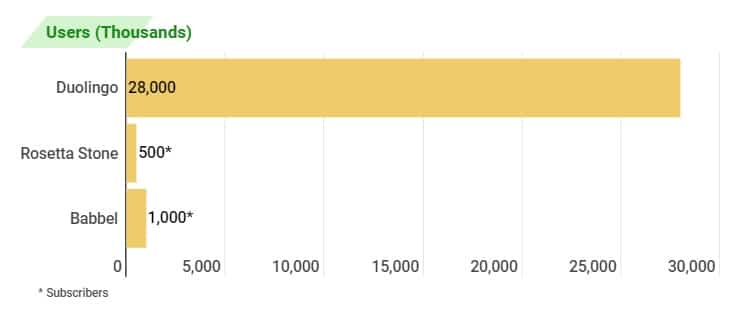
Duolingo’s user base far exceeds that of its competitors, boasting over 38 million active users, while Rosetta Stone has around 500,000 and Babbel approximately 1 million. This significant difference may stem from Duolingo’s free model, its broader language offerings, and its user-friendly interface.
Duolingo for the Greater Good
Duolingo’s mission is rooted in philanthropy, providing free language education that can transform lives. By enhancing global access to the internet, Duolingo plays a vital role in bridging language barriers and fostering communication worldwide.
Duolingo FAQ
-
How much does Duolingo make a year?
Duolingo generates approximately $250 million annually. In 2021, it reported $250.77 million in revenue, a significant increase of 55% from 2019.
-
What percentage of people finish a Duolingo course?
Less than 1% of users complete a Duolingo course. This varies by language, with studies showing that only 0.01% of Spanish learners finish their courses.

Author

Chris Kolmar is a co-founder of Zippia and the editor-in-chief of the Zippia career advice blog. He has hired over 50 people in his career, been hired five times, and wants to help you land your next job. His research has been featured on the New York Times, Thrillist, VOX, The Atlantic, and a host of local news. More recently, he's been quoted on USA Today, BusinessInsider, and CNBC.