- Cover Letter Format
Find a Job You Really Want In
Crafting a compelling cover letter involves more than just strong content. Presenting yourself professionally in both form and function is essential to catch the attention of hiring managers.
Proper spacing, margins, indentation, and length are key components. When done correctly, your cover letter will be organized, clear, and easy to read.
Whether you are submitting a physical cover letter or an email version, we’ll provide guidelines to ensure your cover letter format is impeccable. We will also include sample cover letters for both formats.
Key Takeaways:
-
Margins should be 1 inch on all sides; if your letter exceeds one page, consider slightly reducing the margins.
-
Your cover letter should match your resume’s font and size, ideally no larger than 12-point font.
-
A cover letter should ideally be between 200-300 words, with a preference for the shorter end if possible.

Cover Letter Spacing Guidelines
Let’s begin with cover letter spacing, the first element any hiring manager will notice. Follow these guidelines for a polished appearance.
Spacing may vary slightly depending on whether you are sending a physical or digital cover letter.
Physical Copy Guidelines:
-
Single-space your cover letter.
-
Start with your contact information in this order:
-
Your name
-
Your current address
-
City, state, zip code
-
Phone number
-
Email address
-
-
Add one space.
-
Write the date.
-
Add one space.
-
Add the recipient’s contact information in this order:
-
Hiring manager’s name
-
Company Address
-
Company city, state, zip code
-
Hiring manager’s phone number
-
Hiring manager’s email address
-
-
Add one space.
-
Write your salutation.
-
Add one space.
-
Compose 3-4 paragraphs with one space between each.
-
Add one space after your final paragraph.
-
Write your closing sign-off (e.g., Sincerely).
-
Add three spaces between your closing and your typed name.
-
Insert your signature in the space between your closing and your typed name.
Tip: You can use the same header for your cover letter as your resume.
Email Cover Letter Spacing Guidelines:
-
Single-space your cover letter.
-
Begin with a salutation.
-
Add one space.
-
Write 3-4 paragraphs with one space between each.
-
Add one space after your final paragraph.
-
Write your closing sign-off (e.g., Sincerely).
-
Add two spaces.
-
Include your contact information in this order:
-
Full name
-
Position
-
Phone number
-
Email address
-
If you have a formatted email signature, you may use that for step 8. Additionally, consider including a digital signature between your closing and contact info if it enhances the presentation.
Tip: When emailing a cover letter, keep your subject line clear and professional. Include your name, the position title, and specify that you are submitting application documents. For example, “Donald Duck — Sales Representative Application.”
Proper Cover Letter Length
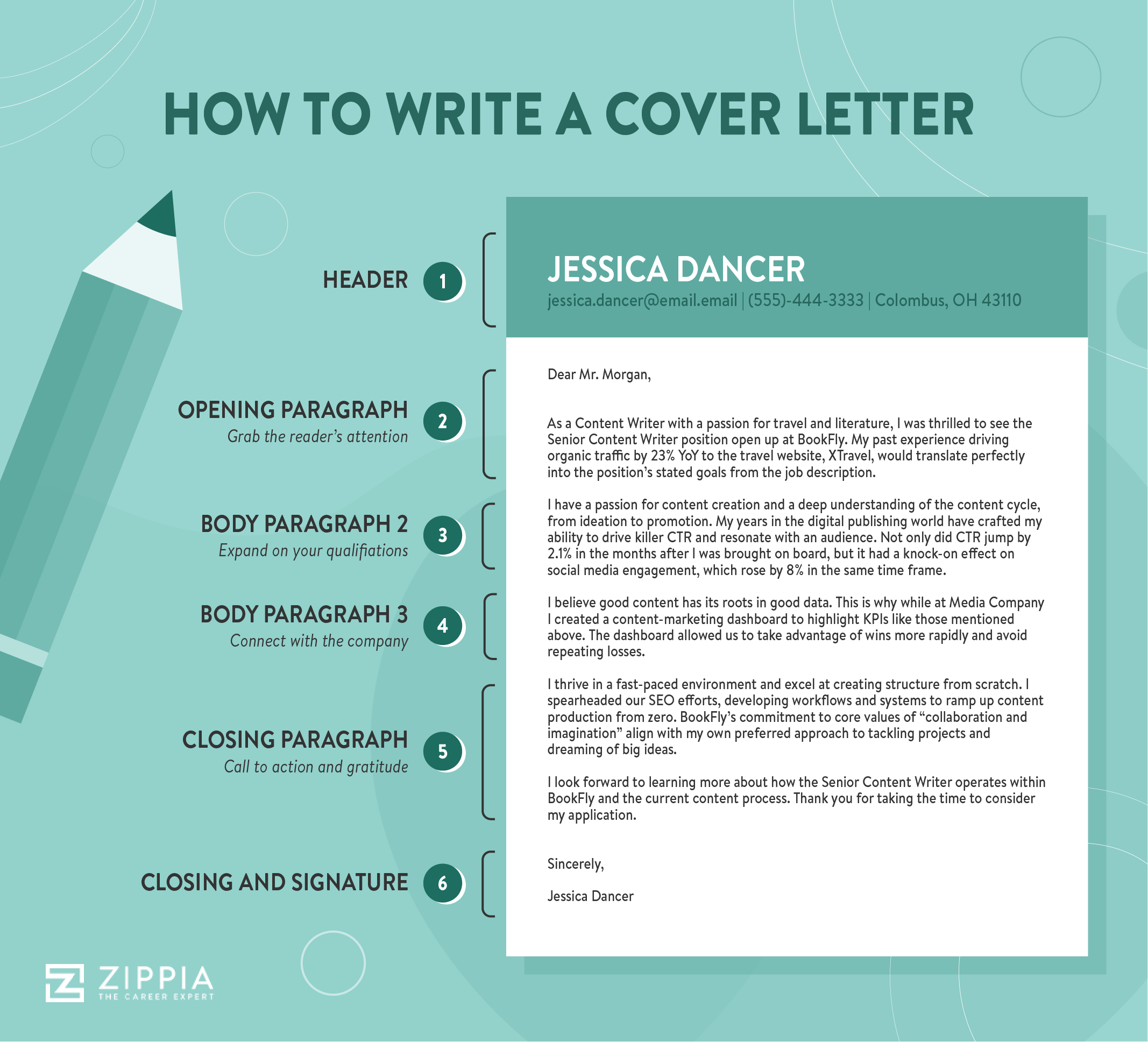
Like your resume, your cover letter should never exceed one page. Aim for the body of your cover letter to be between 200-300 words, with a focus on the lower end to accommodate the busy schedules of hiring managers.
A cover letter should consist of three paragraphs, or at most four.
- Opening paragraph. Your opening paragraph should introduce yourself and your background, captivate the reader with a significant achievement, and explain why you are applying. If you were referred by someone within the company, this is a good opportunity to mention it.
- Body paragraph(s). Your middle paragraph(s) should emphasize your relevant professional qualities and experiences related to the position. Avoid repeating credentials from your resume, as the hiring manager is likely already familiar with them. Instead, highlight why you are the perfect fit for the role. Revisit the job description to identify key qualifications and responsibilities, then reflect on your experiences that demonstrate similar competencies. Quantifying achievements with percentages or dollar figures can significantly enhance your impact.
- Closing paragraph. Your closing paragraph should express gratitude to the employer for considering your application and convey your enthusiasm for learning more about the role and the company.
By eliminating unnecessary information, you should easily adhere to the 300-word limit.
Tip: Avoid addressing your cover letter with “To whom it may concern.” Make an effort to find the name of the person reviewing your cover letter. If unsuccessful, use “Dear Hiring Manager” or one of its alternatives.
Cover Letter Examples
- Physical copy example:
- Email cover letter example:
Jonathan Cash
123 Apple Street
Anywhere, CO 12345
(999) 765-4321
Jonathon.Cash@gmail.comAugust 22, 2026
Phyllis Vance
789 Company Lane
Somewhere, CO 56789
(543) 210-9876
Phyllis.Vance@gmail.comDear Ms. Vance,
I was thrilled to discover the job posting for the Sales Representative position on NextCompany.com. I have been immersed in sales since childhood, starting with a lemonade stand, and I possess over 6 years of formal sales experience.
At CurComp, I honed my knowledge of marketing strategies and my ability to generate interest in new products while maintaining strong customer satisfaction. My proudest accomplishments include consistently exceeding sales quotas by 10% or more each quarter, closing $900,000 in 2018 (25% above goal), and ranking as the top salesperson in the company in Q2 of 2026.
Helping customers recognize the value of products I genuinely believe in is my greatest professional satisfaction. I would be excited to implement my proven sales strategies to promote NextCompany’s renowned products, which have long captivated industry experts.
Thank you for considering my application for the Sales Representative position. I look forward to discussing how my approach to sales can contribute to NextCompany’s ongoing success.
Sincerely,
Jonathan Cash
Dear Pat Murphy,
ABC Inc. seeks an Accountant who is determined, organized, and experienced in maintaining financial records. I believe I meet all these criteria.
After earning an MBA with a specialization in Accounting from the University of Florida, I have spent over six years in the financial sector, assisting companies with financial record-keeping, risk assessments, and payroll management. I also dedicate my Saturdays to providing pro bono accounting consultation for a local food bank. I was pleased to see that ABC is similarly committed to supporting underprivileged communities, further motivating my application for this role.
In my current role at XYZ Corp., I lead a team of 12 junior accountants managing over $10M in assets. By implementing a new invoicing system for contractors, I reduced overhead by 8% and improved project efficiency by 6%. My most significant achievement at XYZ was identifying a budgetary error costing the company over $15,000 monthly. Correcting this issue earned me the “Top Performer of the Month” award in January 2026.
With me, you get more than just a CPA; you gain a skilled presenter who thrives in collaborative, deadline-driven environments. I look forward to discussing how I can help ABC achieve its goals in the upcoming years.
Sincerely,
Joanne Diggerly
Johnston, HI 54321
(555) 432-1098
J.Diggerly@gmail.com
Margins and Alignment in a Cover Letter
Your cover letter should be left-aligned, with standard 1-inch margins on all sides. If your letter exceeds one page, you may consider slightly smaller margins. However, adhering to our length guidelines should prevent you from needing to adjust standard margins.
Do not indent any paragraphs, and avoid margins larger than 1 inch, as this could give the impression that you are trying to artificially inflate the content.
In Microsoft Word, change margins by selecting Page Layout and then Margins. In Google Docs, navigate to File and then Page Setup.
Guidelines for Cover Letter Font
To maintain consistency, make your cover letter visually similar to your resume. Use basic fonts like Times New Roman, Arial, Helvetica, or Calibri.
Font size should generally be 12-point. If you need to fit more content, you might consider reducing it to 10-point, but ensure that the letter remains visually appealing by adjusting margins as needed.
Avoid underlining, highlighting, colored text, and excessive capitalization. You may use bold or italicized text sparingly to emphasize key points, but do not use both styles simultaneously.
Tip: Observe whether your prospective company uses “serif fonts” (with tails, like Times New Roman) or “sans serif” fonts (without tails, like Arial). Match the font style in your resume and cover letter accordingly.
Sending Your Cover Letter
When submitting your cover letter as a file, use an appropriate file name. For example, “John-Doe-Cover-Letter” clearly indicates the file’s content.
Many companies utilize an applicant tracking system to review resumes and cover letters, so opt for compatible file formats like PDF or .doc.
Sending application documents as PDFs ensures consistent formatting across various devices and operating systems. Unless an employer specifies otherwise, PDFs are generally the preferred format for submissions.
Final Thoughts
While cover letter spacing and margins may seem trivial, they are the first elements a hiring manager or recruiter will notice. Creativity is welcome during your job search, but certain standards exist for a reason.
By adhering to 1-inch margins and single-spaced, unindented paragraphs, you will create a strong first impression.
References
-
Careerservices.illinoisstate.edu. “PDF.”
-
Owl.purdue.edu. “Quick Formatting Tips // Purdue Writing Lab.”
- Cover Letter Format

Author

Matthew Zane is the lead editor of Zippia's How To Get A Job Guides. He is a teacher, writer, and world-traveler that wants to help people at every stage of the career life cycle. He completed his masters in American Literature from Trinity College Dublin and BA in English from the University of Connecticut.
Expert
Matt Warzel a President of a resume writing firm (MJW Careers, LLC) with 15+ years of recruitment, outplacement, career coaching and resume writing experience. Matt is also a Certified Professional Resume Writer (CPRW) and Certified Internet Recruiter (CIR) with a Bachelor of Science in Business Administration (Marketing Focus) from John Carroll University.