Trade School Vs College: Choosing the Right Career Path for You in 2026
Choosing between trade school and college is one of the most significant educational decisions you will face. Each path offers unique advantages and prepares you for different career opportunities.
For many professions, a college degree is essential, particularly for white-collar jobs. Conversely, numerous trades demand specific training and practical skills that a traditional four-year degree does not provide.
This guide outlines the key differences between trade schools and colleges, the benefits of each, and additional factors to consider when selecting the right career path for you.
Key Takeaways:
-
Trade schools equip students for immediate entry into the workforce with a strong focus on practical skills.
-
Colleges provide academic degrees that emphasize both soft and hard skills.
-
When determining the best career for you, consider taking a career assessment, analyzing your strengths and weaknesses, and researching various options.

Trade School vs. College
-
What is Trade School? Trade schools prepare students to enter the workforce immediately upon graduation, specializing in specific job types. They offer hands-on training for careers in healthcare, manufacturing, technology, construction, and other in-demand fields.
Trade schools typically focus on practical skills rather than liberal arts education. For instance, an ultrasound technician student would engage in classes focused on technical skills and complete clinical hours to gain hands-on experience. In contrast, they are unlikely to study subjects like Greek Mythology that do not relate to their future careers.
Upon completion, students may receive a diploma or an industry-recognized certificate.
-
What is College? Colleges offer academic degrees that foster both soft and hard skills. Students select a major, yet they also study a diverse range of subjects during their education.
Graduates typically complete their degree in four years, earning a Bachelor’s degree in disciplines such as business, communications, education, liberal arts, natural sciences, or computer sciences. Many graduates opt for further education by pursuing advanced degrees beyond their Bachelor’s.
The Difference Between Trade School and College
-
Trade School:
-
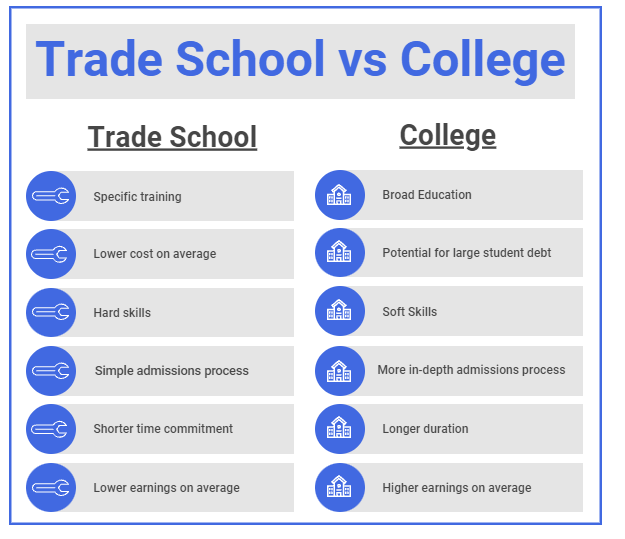
Shorter Completion Time: On average, trade school programs take less time to complete than four-year college degrees, typically lasting around two years, with some certificates requiring even less time. This allows graduates to enter the workforce sooner and begin earning.
-
Lower Cost: Trade schools are generally much more affordable than four-year institutions, allowing graduates to leave with little to no debt.
-
Simplified Admissions Process: Trade schools usually have a less complicated admissions process, enabling quicker enrollment with fewer barriers.
-
Career-Specific Training: Trade schools focus on equipping students with the specific skills needed for their chosen field, ensuring they are career-ready upon graduation.
-
-
College:
-
Degree Completion: College graduates earn bachelor’s degrees, which are increasingly required for many white-collar positions, broadening career possibilities.
-
General Education: College education provides a broader knowledge base and the development of soft skills alongside hard skills.
-
More Educational Options: Colleges offer a varied education, allowing graduates to pivot to different careers if their initial field of study does not meet their interests.
-
Opportunities for Continued Education: A bachelor’s degree is typically a prerequisite for pursuing master’s, doctorate, or other professional degrees.
-
Cost Difference of Trade School vs. College
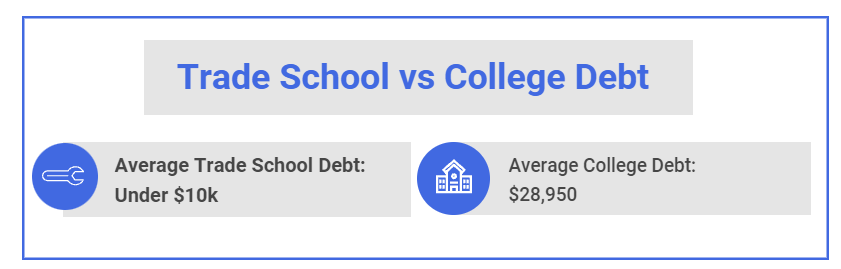
One of the significant drawbacks of a college education is the debt incurred by students, regardless of degree completion. Average student loan debt for graduates hovers around $28,950.
While some high-paying majors can accommodate this debt, others in lower-paying fields can leave graduates struggling to repay their loans.
In contrast, trade school costs are often significantly lower, with average tuition ranging from $3,600 to $14,500 per year, making it a more affordable option than a four-year degree.
As reported by Simple Dollar, the average trade school graduate with student debt owes less than $10,000.
Earning Difference of Trade School vs. College: Which Pays More?
Ultimately, whether a trade school graduate will earn more than a college graduate varies by individual case.
While college graduates tend to earn more on average, certain lucrative trades can surpass the salaries of some college degrees. For instance, the average teacher earns around $46,618, while a skilled plumber can make an average of $56,696 annually. To accurately assess your earning potential, it’s essential to research specific careers instead of relying on generalizations.
Additionally, these figures do not account for loan payments. According to the Federal Reserve, the average graduate with student loan debt pays approximately $393 per month. Since trade school certifications are more affordable than bachelor’s degrees, trade workers often have lower debt repayment burdens, which can help bridge the income gap.
Choosing the Right Career for You
Your primary deciding factor will likely be the type of job you envision for yourself and the skills required to attain it. Both trade schools and colleges can pave the way for successful careers, but they prepare graduates for different job markets.
While some individuals discover their passion for fields like carpentry or science early on, most people require time and thought to determine their future career paths. Here are some useful tips for exploring career options:
-
Take a Career Assessment Test: Career assessments evaluate your preferences and aversions to suggest suitable careers. Common assessments include:
-
123 Career Test: This popular aptitude test provides insights into careers that align with your personality and preferred work environments.
-
O*NET Interests Profiler: Administered by the U.S. Department of Labor, this 60-question inventory reveals your interest tendencies across six categories: Realistic, Investigative, Social, Enterprising, Conventional, and Artistic.
-
CareerOneStop Interest Assessment: This quick 30-question test offers insight into potential career paths.
-
Skills Matcher: Developed by the Department of Labor, this tool helps users assess the skills they wish to incorporate into their careers.
-
Truity: Truity offers various tests to explore your personality and career interests, providing both free and paid reports.
-
CareerExplorer: A free platform that evaluates interests, personality types, abilities, career values, and preferred work environments to help find suitable careers.
-
CareerOneStop Work Values Matcher: This tool helps you discover your ideal work environment based on your job preferences.
-
Keirsey Temperament Sorter: Understand your personality type (Artisan, Guardian, Rational, or Idealist) and potential career matches.
-
Human Metrics: Answer questions to identify your personality type and its relation to potential career paths.
-
-
Consider Your Strengths and Weaknesses: Reflect on whether you prefer hands-on work or academic pursuits. While you can develop new skills, aligning your career with your existing strengths and interests is often beneficial.
-
Research Career Options: Investigate appealing careers identified in your assessments or those that have always interested you. Zippia provides insights on career trajectories, job responsibilities, and average salaries to assist your research.
-
What Do You Need Out of a Job?: Consider key questions such as your desired schedule, salary requirements, and other factors that will influence your career choice. This reflection can help narrow down your options and eliminate roles that do not align with your needs.
Final Thoughts
While the information provided here offers valuable insights, your decision between trade school and college should encompass more than just numbers and statistics.
You will spend a significant portion of your day working, and job satisfaction is vital. Choosing a career solely based on salary or the time it takes to achieve a degree may lead to dissatisfaction in the long run.
Ultimately, only you can determine the factors that will make a job fulfilling for you.
Both trade schools and colleges offer excellent pathways to launch your career; the key is finding the right fit for your aspirations and lifestyle.

Author

Kathy is the head of content at Zippia with a knack for engaging audiences. Prior to joining Zippia, Kathy worked at Gateway Blend growing audiences across diverse brands. She graduated from Troy University with a degree in Social Science Education.