Mentoring Research Summary (2026). Mentoring has become increasingly vital in today’s evolving workplace, offering both mentees and mentors significant advantages. As organizations adapt to remote and hybrid work structures, mentorship remains a cornerstone for enhancing career development and employee satisfaction. According to our comprehensive research:
-
97% of professionals with a mentor view the relationship as beneficial.
-
Only 37% of professionals currently have a mentor.
-
84% of Fortune 500 companies have established mentorship programs.
-
Employees engaged in mentoring have a retention rate of 72%, significantly higher than the 49% retention rate for those without a mentor.
For a deeper analysis, we categorized the data into the following sections: Employee Benefits | Employer Benefits | Demographics
Employee Perspectives on Mentorship
Mentors play a crucial role in guiding and advancing employees, which has clear benefits. Here are some insights into how employees perceive mentorship programs:
-
91% of employees with a mentor report job satisfaction.
This is notably higher than the average 65% of American workers who express job satisfaction.
-
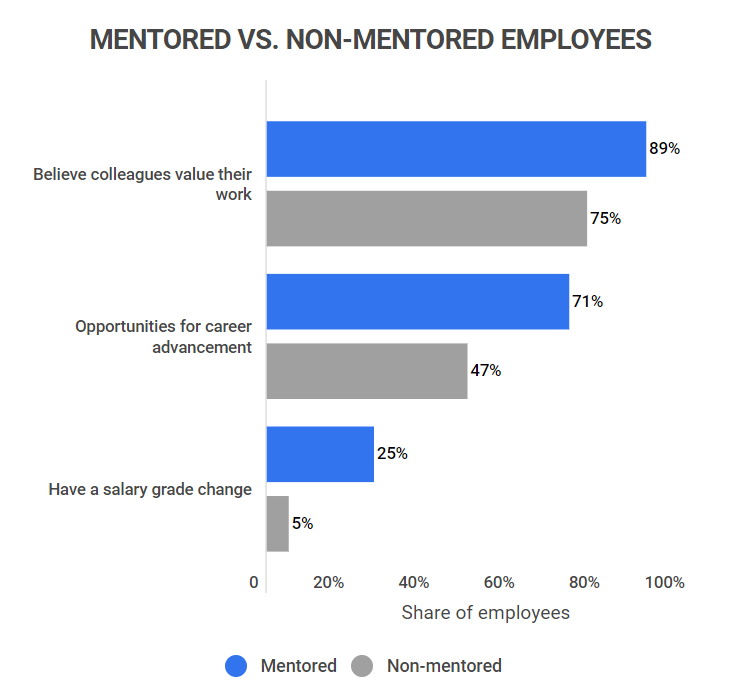
71% of mentored employees believe their company offers strong career advancement opportunities.
In contrast, only 47% of those without a mentor feel the same, underscoring the advantages of mentorship.
-
87% of individuals with mentoring relationships feel empowered and more confident.
This confidence extends to their interactions with colleagues, with 89% of mentored employees believing their work is valued, compared to 75% of non-mentored peers.
-
94% of professionals assert that having a mentor is crucial for their decision to remain with their organization.
The combination of increased confidence and career opportunities makes mentorship a key factor in employee retention.
-
76% of employees consider mentors to be important.
Despite this high regard, many companies still lack structured mentorship programs.
Benefits of Mentorship for Employees
Mentorship programs provide numerous advantages for employees, including the following:
-
25% of employees in mentoring programs experience a salary grade change.
This is four times more likely than the 5% of employees without a mentor who see a salary grade change, and those with mentors are five times more likely to receive promotions.
-
Mentors are six times more likely to be promoted.
Mentors themselves reap substantial benefits, making them prime candidates for promotions and salary increases.
-
89% of mentored individuals go on to mentor others.
This cyclical benefit ensures that those who receive mentorship often become mentors, facilitating a culture of continuous learning and support.
-
Employees with sponsors earn 11.6% more than those without.
Mentors can act as effective sponsors, enhancing their mentees’ competitiveness in the job market and increasing their earning potential.
Benefits of Mentorship for Employers
Employers also gain significant advantages from mentorship programs, ranging from improved retention rates to heightened productivity. Here are key benefits for employers:
-
67% of businesses report increased productivity due to mentorship programs.
Mentorship can lead to an average productivity boost of 20% compared to organizations without such programs.
-
Companies with mentorship programs experience 50% higher retention rates.
This is crucial as low retention costs U.S. businesses approximately $1.8 trillion annually.
-
55% of employees believe mentoring positively impacts company profits.
Organizations with mentorship programs see profits that are on average 18% higher.
-
Fortune 500 companies with mentorship programs have profits three times greater than those without.
This demonstrates why most Fortune 500 firms prioritize mentorship: it significantly enhances profitability.
Mentoring Demographics
While mentorship offers numerous benefits, demographic disparities persist. Here are some critical insights into mentoring demographics in the U.S.:
-
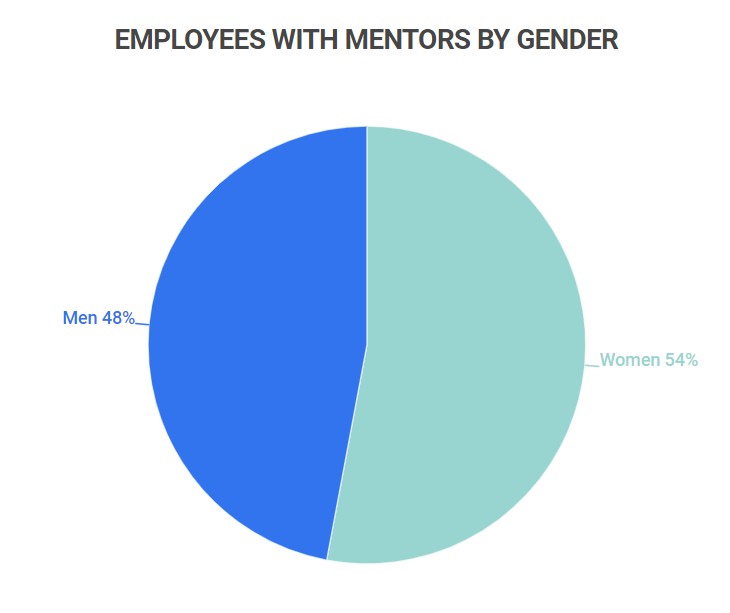
Women are 12.5% more likely to have a mentor.
A total of 54% of women have had a mentor, compared to 48% of men. This trend is also reflected in mentorship roles, with 59% of mentors identifying as women and 41% as men.
Mentors and Mentees by Gender
Status Women Men Has had a mentor 54% 48% Is a mentor 59% 41% -
79% of millennials consider mentorship essential for career success.
However, 63% of millennials report a lack of development in their leadership skills, indicating a gap between their desire for mentorship and company investment in such programs.
-
24% of individuals aged 46-64 would return to the office solely for in-person mentorship.
This highlights mentorship as a powerful incentive for attracting experienced employees back to the workplace.
-
56.9% of mentors are White.
The majority of mentors are White, followed by 16.4% Latino, 10.7% Black, and 9.6% Asian.

Share of Mentors by Race
Race Share of Mentors White 56.9% Latino 16.4% Black 10.7% Asian 9.6% Other 6.4%
Mentoring FAQ
-
What is mentoring?
Mentoring is a relationship where a more experienced individual (mentor) guides the professional development of a less experienced employee (mentee). In the workplace, mentors are typically more seasoned employees who provide insights to newer team members.
The aim of mentoring is to enhance the skills and performance of less experienced employees.
-
Why is mentorship important?
Mentorship is crucial for various reasons, including boosting productivity and profitability for employers, as well as facilitating salary increases for employees. Mentors offer support, guidance, constructive feedback, and insights into their field and career aspirations.
This support helps employees enhance their productivity and pursue promotions more effectively.
For employers, mentorship fosters a positive cycle that reduces turnover and develops a more skilled workforce over time. Additionally, former mentees are likely to become mentors themselves in the future.
-
What are the 3 C’s of effective mentoring?
The 3 Cs of effective mentoring are communication, clarity, and commitment. Here’s a breakdown of each:
-
Communication. Effective communication is vital in mentoring; mentors must provide constructive feedback and encouragement while actively listening to their mentees.
-
Clarity. Clarity is essential in mentorship programs, ensuring that both mentors and mentees have a clear understanding of goals, expectations, and direction.
-
Commitment. Commitment from both mentors and mentees is crucial for the success of the program. This dedication enables both parties to navigate challenges effectively.
-
-
How successful is mentoring?
Mentoring has demonstrated significant success across multiple metrics. Some notable examples include:
-
Retention rates can increase by up to 50%
-
Average profits can be 18% higher
-
Average productivity can be 20% higher
-
87% of mentored employees report feeling empowered and confident
-
Mentored employees are four times more likely to experience a positive salary grade change
-
Mentored employees are five times more likely to receive promotions
-
-
How do you measure the effectiveness of mentoring?
Effectiveness can be assessed by analyzing profits, productivity, and retention following the implementation of a mentorship program. To evaluate the program itself, consider:
-
The number of sign-ups and active mentorships
-
The frequency of mentoring sessions
-
The total hours dedicated to mentoring
-
The proportion of mentees who take notes and demonstrate progress
-
-
What causes mentorships to fail?
Lack of competence is the primary reason mentorships fail. Ineffectively structured programs and inexperienced mentors can hinder the learning process, preventing mentees from achieving their goals.
Conclusion
Mentorship is an invaluable resource that offers mutual benefits for employees and employers alike. Despite 84% of Fortune 500 companies implementing mentorship programs, only 37% of all organizations do so.
For employers considering establishing a mentorship program, the potential benefits are significant, including an average increase in productivity of 20% and profits that are 18% higher. Mentorship programs not only enhance workplace culture but also foster talent development.
For employees aiming to advance their careers, participating in a mentorship program can greatly enhance your prospects; you are four times more likely to receive a salary increase and five times more likely to be promoted.
References
-
Forbes – 76% Of People Think Mentors Are Important, But Only 37% Have One
-
UMG – Exploring the Mutual Benefits of Mentoring in the Workplace
-
CNBC – Nine in 10 Workers Who Have a Career Mentor Say They Are Happy in Their Jobs

Author

Jack Flynn is a writer for Zippia. In his professional career he’s written over 100 research papers, articles and blog posts. Some of his most popular published works include his writing about economic terms and research into job classifications. Jack received his BS from Hampshire College.