- HR Statistics
- Average Labor Cost Percent Of Sales
- Average Time to Reach Profitability At A Startup
- Office Space Per Employee
- Recruitment Statistics
- Employee Engagement Statistics
- Work-Life Balance Statistics
- BYOD Statistics
- Paternity Leave Statistics
- Onboarding Statistics
- Average Paid Maternity Leave In Us
- Average Cost Of A Bad Hire
- Employee Theft Statistics
- Paid Family Leave Statistics
- Cost Of Hiring Statistics
- Employee Turnover Statistics
- Average Cost Of Employer Sponsored Health Insurance Statistics
- Sexual Harassment In The Workplace Statistics
- HR Statistics
- PTO Statistics
- Social Media Recruitment Statistics
- Hiring Statistics
- Out Of Prison Employment Statistics
The Cost of a Bad Hire [2026]: How Bad Hires Impact Business
Research Summary. Hiring the right employee is crucial for any business, as the costs associated with a bad hire can be substantial. Investing time and resources in an effective hiring process pays off in the long run. Here are some key statistics on the costs of a bad hire:
-
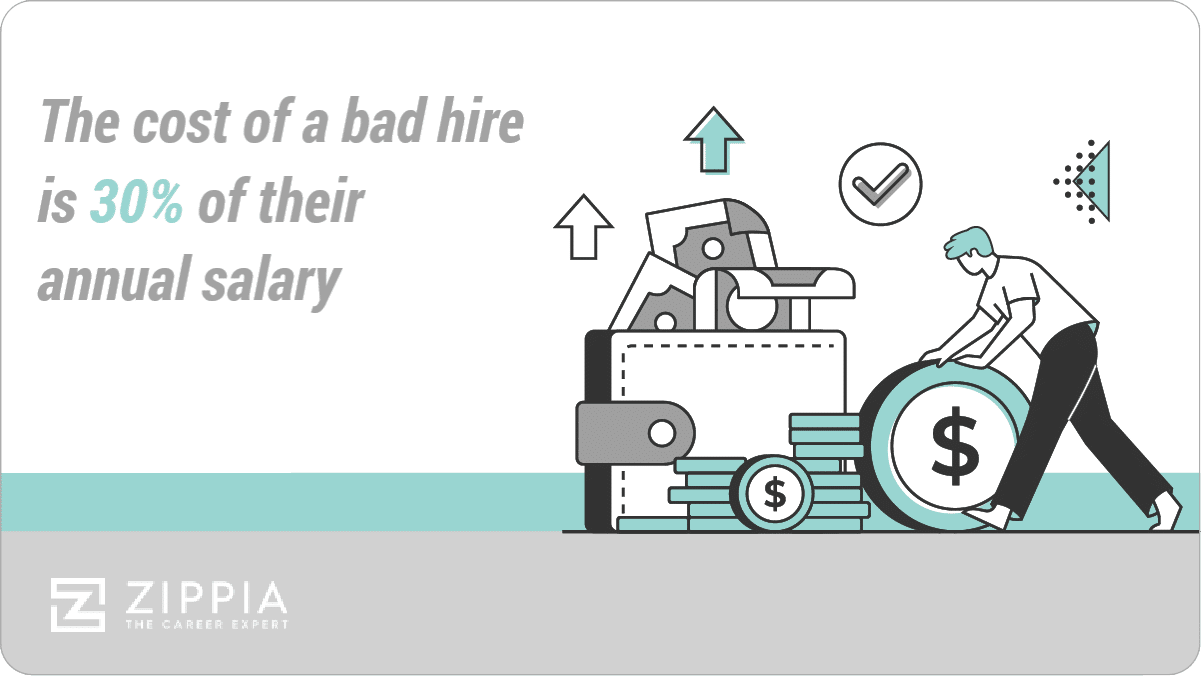
The average cost of a bad hire is 30% of that hire’s annual salary.
-
A single bad hire costs companies an average of $14,900.
-
For some companies, the cost of a bad hire can be as high as $240,000.
-
The average cost to hire an employee is $4,425.
-
It generally takes at least six months for companies to break even on new hires.
For further analysis, we broke down the data in the following ways:
Company Size | Job Level | Other Costs | Bad Hire Prevention
Hiring Cost Statistics
-
It can cost more than $3,500 to recruit and hire a new employee.
This figure excludes onboarding costs; it only accounts for job advertising and the time spent reviewing resumes, screening applicants, conducting interviews, and performing background checks.
This estimate is based on an employee earning $8 an hour, so costs will increase for mid- and high-level positions.
Experts suggest that recruitment costs can reach about 15% of a position’s annual salary. For a $50,000 position, this amounts to $7,500.
-
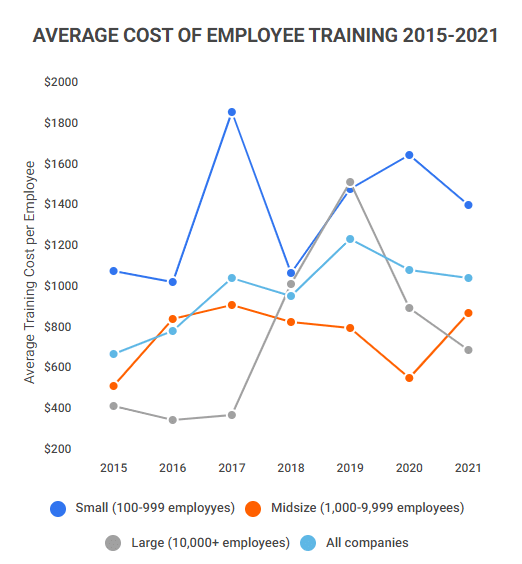
Companies spend an average of $1,286 per year on training for each employee.
This average encompasses seasoned employees attending annual training and new hires requiring initial training. Thus, the cost for training new employees is likely higher than $1,286.
-
It takes an average of 42 days to fill a position.
This figure reflects the time needed for recruiting, interviewing, screening, and hiring, not including onboarding.
This duration results in lost productivity as other employees allocate time to assist with the hiring process and cover responsibilities.
-
It can take over six months for a company to break even on hiring a new employee.
This timeline applies to mid-level managers and varies depending on the position level.
-
76% of surveyed senior managers admit to making a bad hire.
Furthermore, 64% of these senior managers report that the negative impact of a bad hire has increased since 2020.
This survey included over 2,800 senior managers from companies across the U.S. with at least 20 employees.
-
Companies lost an average of $14,900 from each bad hire, according to a 2017 survey.
Additionally, losing a good hire cost these companies an average of $29,600.
Cost of a Bad Hire by Company Size
-
Large companies with 10,000 or more employees paid an average of $722 to train each new employee.
-
Midsize companies with 1,000 to 9,999 employees paid an average of $902 per new hire in training costs.
-
Small companies with fewer than 1,000 employees paid an average of $1,433 to train each new hire.
Cost of a Bad Hire by Job Level
-
Turnover in an entry-level position can cost a company 50% of the position’s salary.
Along with productivity loss, the costs associated with team morale dips and project disruptions contribute to this expense.
-
Turnover in a professional, technical, or supervisory role can cost 75-150% of the position’s salary.
This includes separation, recruitment, and productivity costs incurred by both the departing employee and the remaining staff who must cover additional responsibilities.
-
Turnover in an executive role can cost up to 213% of the position’s salary.
The higher costs stem from stricter experience and education requirements, and the broader impact on company productivity and morale when a leadership position is vacated.
Other Costs of a Bad Hire
-
CFOs estimated that an average of 10 hours out of a manager’s 40-hour workweek is spent coaching underperforming employees, based on a 2018 survey.
This translates to approximately 26% of a manager’s time spent on tasks other than direct supervision.
-
44% of CFOs indicated that a bad hire significantly affects team morale.
In contrast, 47% of respondents felt that a poor hiring decision somewhat affects morale, while only 9% believed it had no impact.
-
Surveyed senior managers estimated that making a single bad hire can cost companies an average of 16 weeks or four months.
This includes about 10 weeks to recognize the employee’s inadequacy and six weeks to find a replacement. During this period, the bad hire does not contribute productively, draining company resources.

How to Prevent the Costs of a Bad Hire
-
Almost one in ten bad hires either quit or are let go due to misalignment with company culture.
Therefore, effectively communicating your company culture to candidates is a valuable investment.
-
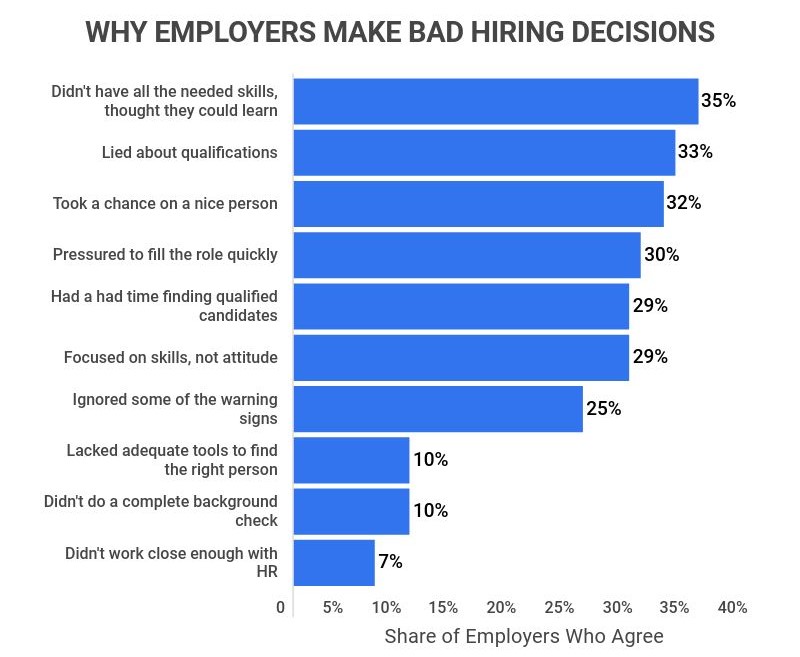
35% of employers who made a bad hire believed the candidate could learn quickly despite lacking necessary skills.
Moreover, 33% reported that candidates misrepresented their qualifications, while 32% took a chance on candidates with pleasant personalities rather than the required skills. Additionally, 29% found it challenging to identify qualified candidates.
This indicates the need to prioritize testing skills and focusing on qualified candidates during the hiring process.
-
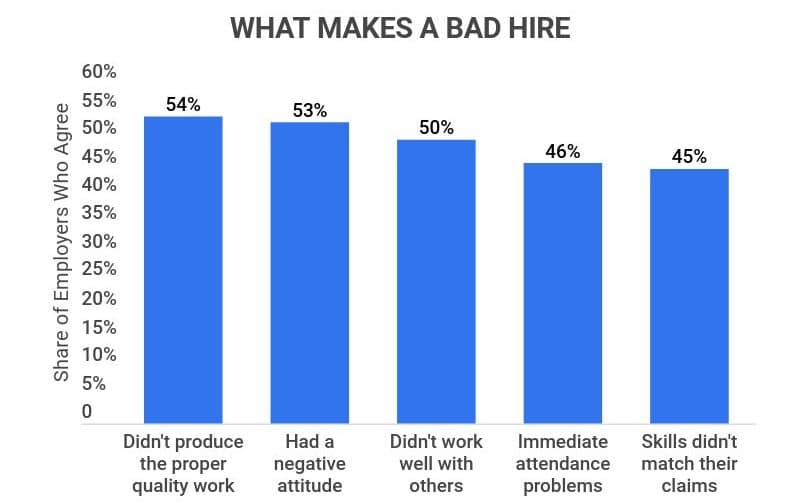
29% of managers who have made a bad hire focused more on skills than attitude.
In comparison, 53% of employers attribute a bad hire to a negative attitude, while 50% identify poor collaboration with other employees as a key factor. Conversely, 54% point to poor work quality as the primary reason for a bad hire, highlighting the importance of attitude alongside skills.
Employers should find ways to assess candidates’ attitudes during interviews or assessments to reduce the risk of poor hiring decisions.
Cost of a Bad Hire FAQ
-
How much does a bad hire cost?
A bad hire costs an average of $14,900, but this amount can vary significantly based on the company and specific position.
This cost encompasses salary, benefits, severance pay, recruitment costs for a replacement, and lost productivity and morale due to the bad hire’s performance.
-
What is the average cost per hire?
The average cost per hire is $4,425, excluding onboarding and training costs, which average around $1,286 per year per employee.
These figures can vary widely depending on the company and role.
-
What is the average time it takes to hire a new employee?
The average time to hire a new employee is 42 days. This includes recruiting, screening applications, and conducting interviews. Onboarding and training can extend this timeline significantly.
-
How do you calculate the cost of a bad hire?
To calculate the cost of a bad hire, consider salary, time-to-fill the position, hours spent screening and interviewing candidates, job advertisement costs, background checks, and lost productivity.
A simplified estimate is approximately 30% of an employee’s annual salary. For instance, a bad hire for a $100,000 salary could cost your company about $30,000.
-
What is the impact of a bad hire?
The impact of a bad hire includes wasted resources, decreased employee morale, reduced productivity, and increased turnover. While the financial implications are significant, the effect on team morale can be even more damaging, as productivity declines when a position is inadequately filled.
Job satisfaction may also suffer as employees lose confidence in the hiring decisions made by management.
Conclusion
Making well-informed hiring decisions is essential for organizational success. The hiring process can be complex, involving creating accurate job descriptions, screening applications, and conducting interviews.
Investing the time to thoroughly vet candidates is worthwhile, as a bad hire can cost your company an additional 30% of the position’s salary and potentially up to 215% for executive roles.
Moreover, a poor hiring decision can diminish team morale, as colleagues may need to shoulder additional responsibilities, ultimately affecting productivity and the organization’s overall performance.
Thus, it is crucial to implement a comprehensive screening process to ensure candidates possess the necessary skills, a positive attitude, and the ability to integrate into your company culture.
References
-
Investopedia. “The Cost of Hiring a New Employee.” Accessed in 2023.
-
ERE. “The Business Cost and Impact of Employee Turnover.” Accessed in 2021.
-
SHRM. “Average Cost-per-Hire for Companies is $4,129, SHRM Survey Finds.” Accessed in 2021.
-
Robert Half. “Hiring Mistakes Come at a Higher Price Amid Pandemic.” Accessed in 2021.
-
CareerBuilder. “Nearly Three in Four Employers Affected by a Bad Hire, According to a Recent CareerBuilder Survey.” Accessed in 2021.
-
Training. “2017 Training Industry Report.” Accessed in 2021.
-
Amesite. “Recruit for Potential Not Experience for Entry Level Jobs.” Accessed in 2021.
-
GA Partners. “Calculating the Cost of Employee Turnover.” Accessed in 2021.
-
Center for American Progress. “There are Significant Business Costs to Replacing Employees.” Accessed in 2021.
-
Robert Half. “The High Price of a Low Performer.” Accessed in 2021.
- HR Statistics
- Average Labor Cost Percent Of Sales
- Average Time to Reach Profitability At A Startup
- Office Space Per Employee
- Recruitment Statistics
- Employee Engagement Statistics
- Work-Life Balance Statistics
- BYOD Statistics
- Paternity Leave Statistics
- Onboarding Statistics
- Average Paid Maternity Leave In Us
- Average Cost Of A Bad Hire
- Employee Theft Statistics
- Paid Family Leave Statistics
- Cost Of Hiring Statistics
- Employee Turnover Statistics
- Average Cost Of Employer Sponsored Health Insurance Statistics
- Sexual Harassment In The Workplace Statistics
- HR Statistics
- PTO Statistics
- Social Media Recruitment Statistics
- Hiring Statistics
- Out Of Prison Employment Statistics

Author

Chris Kolmar is a co-founder of Zippia and the editor-in-chief of the Zippia career advice blog. He has hired over 50 people in his career, been hired five times, and wants to help you land your next job. His research has been featured on the New York Times, Thrillist, VOX, The Atlantic, and a host of local news. More recently, he's been quoted on USA Today, BusinessInsider, and CNBC.