- HR Statistics
- Average Labor Cost Percent Of Sales
- Average Time to Reach Profitability At A Startup
- Office Space Per Employee
- Recruitment Statistics
- Employee Engagement Statistics
- Work-Life Balance Statistics
- BYOD Statistics
- Paternity Leave Statistics
- Onboarding Statistics
- Average Paid Maternity Leave In Us
- Average Cost Of A Bad Hire
- Employee Theft Statistics
- Paid Family Leave Statistics
- Cost Of Hiring Statistics
- Employee Turnover Statistics
- Average Cost Of Employer Sponsored Health Insurance Statistics
- Sexual Harassment In The Workplace Statistics
- HR Statistics
- PTO Statistics
- Social Media Recruitment Statistics
- Hiring Statistics
- Out Of Prison Employment Statistics
Research Summary. The affordability of employer-sponsored health insurance remains a crucial issue for both businesses and employees in 2026. Health insurance premiums have continued to rise significantly, outpacing salary growth. While larger firms generally provide health insurance, only about half of small-to-medium-sized businesses offer coverage to their employees.
To better understand the average costs of employer-sponsored health insurance, we’ve compiled essential facts and trends. As of our latest research:
-
In 2025, the average health insurance premium through employers was $8,045 for single coverage and $23,345 for family coverage.
-
Employers cover 77% of single coverage employee health insurance plans and 65% of family coverage plans, on average.
-
Approximately 150 million individuals have employer-based coverage as of 2025.
-
Health care remains one of the most significant expenses for employers, representing 8.2% of total compensation for civilian workers in September 2025.
-
The average premium for family coverage has surged 20% over the last five years and 50% over the last decade.
-
38% of non-elderly adults reported difficulties affording employer-based health insurance or health care, or managing medical bills.
-
Medium-to-large firms are more likely to include additional health care services, such as telemedicine, while smaller firms may offer benefits like dental, vision, 401(k), life insurance, and paid family leave.
For a deeper analysis, we have organized the data as follows:
Average Cost | Affordability | HMOs, PPOs, and Other Plans | Coverage
General Employer-Sponsored Health Insurance Statistics
Employer-sponsored healthcare coverage continues to be a vital benefit for employees, influencing their job choices. Companies offer it not only to attract talent but also to enhance productivity and enjoy tax benefits.
However, the availability of employer-sponsored health insurance varies significantly by company size, with smaller businesses less likely to provide coverage compared to larger firms.
-
Employer-sponsored, or employer-provided health insurance, is coverage offered through a job to eligible employees.
Typically, employers present various group health plans, with employees covering a portion of the premium cost. This remains the most prevalent form of health coverage in the U.S.
-
Approximately 150 million individuals have employer-based coverage as of 2025.
-
During WWII, companies began offering health care as a strategy to attract talent, particularly women.
-
Providing health insurance can distinguish a company from competitors and strengthen its recruitment strategy and employee benefits package.
-
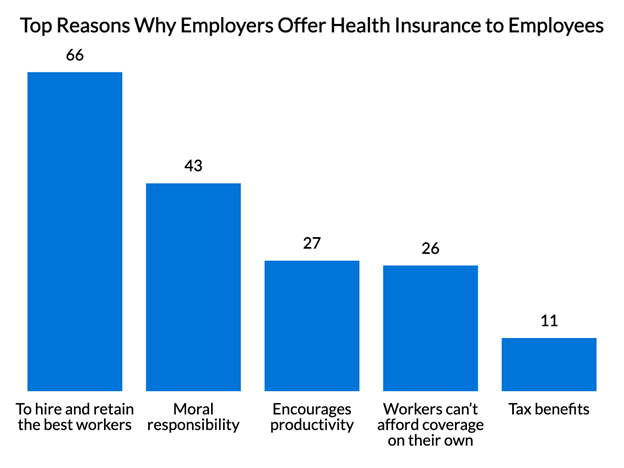
Primary reasons employers offer health insurance include:
-
To attract and retain top talent (68%)
-
Ethical responsibility (45%)
-
Enhances productivity (30%)
-
Workers cannot afford coverage independently (28%)
-
Tax advantages (12%)
-
-
90% of workers are employed by firms that provide health benefits to at least some employees.
-
58% of firms offer health benefits to a portion of their workforce.
-
Small businesses with fewer than 50 full-time employees are not mandated to offer group health insurance. However, if they do provide it, they generally need to cover at least 50% of employee premiums.
Average Cost of Company Health Insurance Statistics
Employer-sponsored health insurance remains the priciest benefit businesses provide to employees. Coverage costs are also significant for employees, as premiums, deductibles, copays, and coinsurance amounts have risen sharply over the past few years.
Moreover, most plans require employees to pay a substantial portion of their premiums.
-
Health care is typically one of the most expensive benefits for employers, representing 8.2% of total compensation for civilian workers in September 2025.
-
Average employer-provided health insurance costs have experienced a slight increase over the past year. The average single premium rose by 3%, while the average family premium increased by 4%.
-
The average premium for family coverage has risen 20% over the past five years and 50% over the last decade.
-
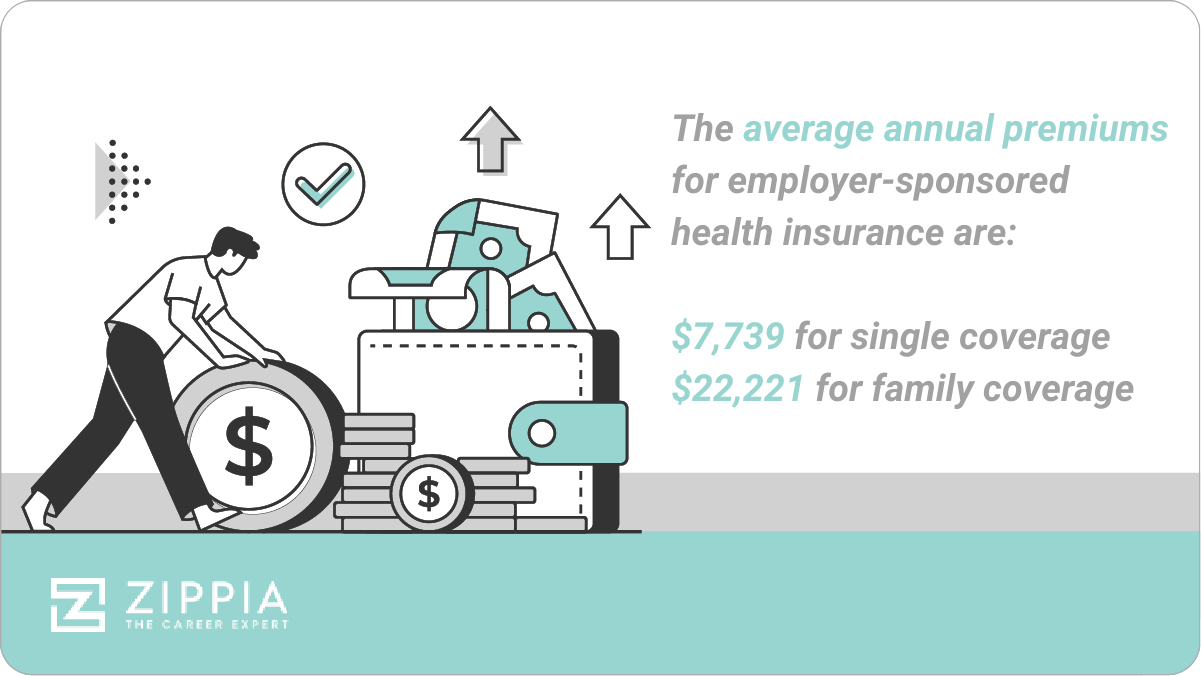
In 2025, the average annual premiums for employer-sponsored health insurance were $8,045 for single coverage and $23,345 for family coverage.
-
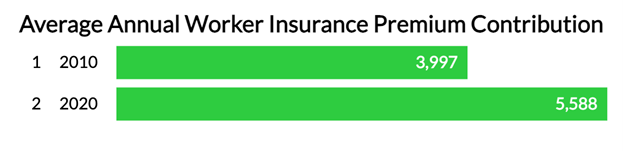
From 2015 to 2025, the average employee contribution to health insurance grew from $4,800 to $6,000 annually, an increase of 25%.
-
During the same period, the average employer contribution rose from $11,000 to $17,000, or about 55%.
-
32% of covered small firm employees had their employer cover the entire premium for their single coverage.
-
36% of covered small firm employees were enrolled in plans where they contribute more than half of the premium for family coverage.
-
82% of covered workers have a general annual deductible for single coverage that must be met before the plan pays for most services.
-
Over the past five years, the percentage of covered workers with a general annual deductible of $2,500 or more for single coverage has increased from 19% to 30%.
-
The average copayment for primary care is $27, while specialty care averages $44.
-
The average coinsurance rate for hospital admission is 20%, with an average copayment of $350 per hospital admission.
-
Average individual deductibles have grown by 30% between 2015 and 2020.
-
The average single coverage annual deductible among covered workers with a deductible has increased 30% over the last five years and 80% over the last decade.
-
The average copayments are $27 for primary care and $44 for specialty care. The average coinsurance rates are 18% for primary care and 20% for specialty care.
-
64% of covered workers have coinsurance, and 12% have a copayment for hospital admissions. The average coinsurance rate for hospital admission is 21%, while the average copayment is $325 per hospital admission.
Employer-Sponsored Health Insurance Affordability Statistics
Due to high— and continuously rising—health insurance premiums, many individuals express concerns about the affordability of coverage in general and prescription medications in particular.
This concern is echoed by employers, nearly half of whom express being “very concerned” about their ongoing ability to provide employee health benefits.
-
95% of civilian workers enrolled in their employer’s medical plans in March 2025 had to contribute to the premium for family coverage.
-
Middle-income workers spent an average of 7.2% of their income on employer premium contributions in 2025.
-
The average premium for family coverage has grown 20% over the past five years and 50% over the previous decade, significantly outpacing wage growth and inflation.
-
62% indicate that an increase of 15% or less in monthly premiums would render their current plan unaffordable.
-
The cost of prescription drugs remains one of the most pressing challenges for both employers and families.
-
Approximately 48% reported having skipped or postponed obtaining health care or prescriptions due to costs in the last year.
-
38% of non-elderly adults indicated difficulties affording employer-based health insurance or health care or managing medical bills.
-
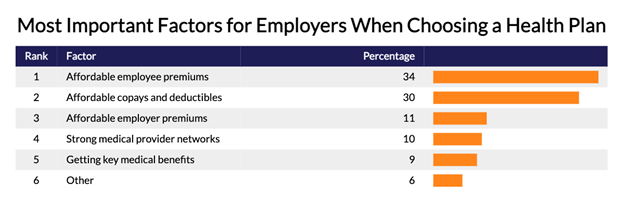
The top two most critical factors for small employers when selecting a group health plan are affordable monthly premiums and out-of-pocket costs.
-
42% of small businesses are “very concerned” about their ability to continue offering employee health benefits, 43% are “somewhat concerned,” and 15% are not concerned.
-
40% of small businesses are “very concerned” about employees’ ability to afford premiums and deductibles, 37% are “somewhat concerned,” and 23% are not concerned.
-
Employers prioritize the following factors when selecting a health plan:
-
Affordable monthly premiums for employees (35%)
-
Affordable copays and deductibles (31%)
-
Affordable monthly premiums for employers (12%)
-
Strong medical provider networks (9%)
-
Securing key medical benefits (8%)
-
Other (5%)
-
-
54% of employers believe that sponsoring a health plan has not hindered their ability to offer raises or hire additional workers. However, 32% report that providing coverage has made it more challenging to increase employee wages or recruit additional staff.
Employer-Sponsored Health Insurance Statistics Related to HMOs, PPOs, and Other Plans
Point of Service (POS) plans remain the most prevalent among employer-sponsored health insurance offerings. However, HMOs tend to require slightly lower contributions from both employers and employees, whether for individual or family plans.
-
For HMOs, the average employer contribution stands at $6,350 for single coverage, with individual employees contributing $1,300 per year. For families, employers contribute $16,500, while employees pay $5,800.
-
For PPOs, employers contribute an average of $6,800, while single employees contribute $1,400 annually. For family coverage, employers cover $17,000 and employees contribute $6,500.
-
POS (Point of Service) plans represent 48% of small business plans, HMO (Health Maintenance Organization) plans account for 26%, PPO (Preferred Provider Organization) plans comprise 15%, and EPO (Exclusive Provider Organization) plans make up 11%.
-
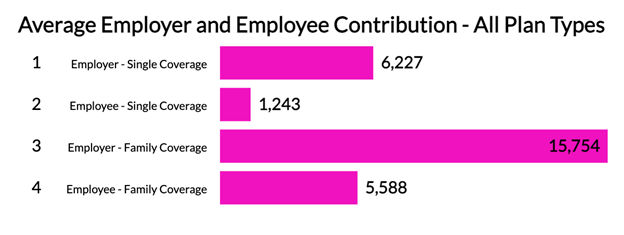
Across all plan types, employers contribute an average of $6,400 for single coverage, while employees pay $1,300. For family coverage, employers contribute $16,500, and employees contribute $5,800.
Employer-Sponsored Health Insurance Coverage Statistics
Most employers express satisfaction with the breadth of their health insurance networks and the variety of provider options available to employees. Both large and small firms typically offer plans that include additional health benefits, such as health risk assessments, smoking cessation programs, weight management, and behavioral or lifestyle coaching.
-
Among employers providing health benefits, 53% report that the network for their most popular plan is ‘very broad,’ 40% say it is ‘somewhat broad,’ and 7% say it is ‘somewhat narrow.’
-
47% of employers offering health benefits express being ‘very satisfied’ with the choice of provider networks available, and 39% report being ‘satisfied.’ However, only 23% of these firms say they are ‘very satisfied’ with the cost of provider networks offered, while 38% report being ‘satisfied.’
-
Among those offering health benefits, 45% of small firms and 62% of large firms provide employees the chance to complete a health risk assessment.
-
56% of small firms and 84% of large firms offer programs in smoking cessation, weight management, or behavioral or lifestyle coaching. Among large firms providing such programs, 46% incentivize employee participation or completion.
-
87% of firms with 50 or more employees that offer health benefits include telemedicine services in their largest health plan.
-
80% of large firms offering health benefits cover services received in retail clinics, such as those located in pharmacies, supermarkets, and retail stores, in their largest health plan.
-
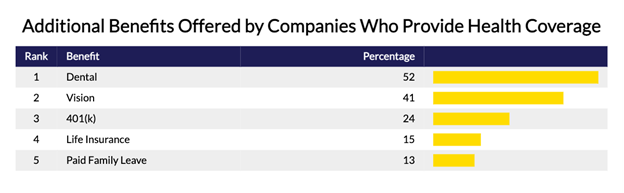
Most small businesses providing employee health coverage also extend additional benefits, including:
-
Dental (54%)
-
Vision (42%)
-
401(k) (26%)
-
Life insurance (15%)
-
Paid family leave (14%)
-
Average Health Insurance Cost Through Employer FAQ
-
What is the average cost of health insurance through an employer?
The average annual cost of health insurance premiums through an employer is $8,045 for single coverage and $23,345 for family coverage. The average employer contributes approximately $6,400 for a single coverage plan and $16,500 for family coverage.
This results in employees paying an average of $1,300 for a year of single coverage or $5,800 for a year of family coverage through their employer-sponsored health insurance.
-
What percentage of health insurance do employers pay?
Employers cover 77% of single coverage employee health insurance plans and 65% of family coverage plans. This translates to employers paying an average of $490 a month per individual employee and $1,283 a month per family.
-
Is employer-sponsored health insurance cheaper?
Yes, employer-sponsored health insurance is typically cheaper. While the plans’ costs might not vary significantly, employers covering around 77% of the premiums generally makes employer-sponsored insurance more affordable than purchasing an individual plan.
The drawback of employer-sponsored health insurance is that employees are limited to specific plan options.
-
Do employees pay for employer-sponsored health insurance?
Yes, employees pay for employer-sponsored health insurance. Although these plans are employer-sponsored, the employer does not usually cover the entire premium. On average, employees pay about 1/5 of the premium costs, which is generally deducted from their paychecks.
Additionally, employees must also cover copayments and meet their deductibles before insurance begins to pay for services.
-
Can I get a premium tax credit if my employer offers insurance?
No, you generally cannot receive a premium tax credit if your employer offers insurance. However, if the employer-sponsored coverage is deemed too expensive or does not meet minimum value standards, you may qualify for a premium tax credit.
“Too expensive” is defined as exceeding a specified percentage of an individual’s household income, while failing to meet the “minimum value standard” indicates that the plan will not cover at least 60% of the total costs of expected benefits.
If either condition applies, you may be eligible for a premium tax credit even when offered health insurance through your job. Consult a certified accountant to explore your options.
Conclusion
While offering health insurance remains a popular strategy for employers to attract top talent, affordability continues to be a significant concern for both employers and employees. This concern extends to overall policy premiums, deductibles, copays, coinsurance, and specific expenses, such as prescription medications.
Given recent trends, the cost of health care coverage is expected to become increasingly burdensome for businesses of all sizes and the employees enrolled in various plans. Fortunately, many plans are evolving, with an increasing number now offering telemedicine and retail health care services as part of their coverage.
Sources
-
eHealth Insurance. Average Cost of Employer-Sponsored Health Insurance. Accessed on 8/9/21.
-
eHealth. Small Businesses Health Insurance: Costs, Trends and Insights 2018 (Published April 2019). Accessed on 8/9/21.
-
Kaiser Family Foundation. 2019 Employer Health Benefits Survey. Accessed on 8/9/21.
-
Kaiser Family Foundation. 2020 Employer Health Benefits Survey – Summary of Findings. Accessed on 8/9/21.
-
U.S. Bureau of Labor Statistics. Average employee medical premium $6,797 for family coverage in 2020. Accessed on 8/9/21.
-
U.S. Bureau of Labor Statistics. Medical care premiums in the United States, March 2020. Accessed on 8/9/21.
-
Harvard Business Review. Are Employer-Sponsored Health Plans on Their Way Out? Accessed on 8/9/21.
-
The Commonwealth Fund. Trends in Employer Health Care Coverage, 2008–2018: Higher Costs for Workers and Their Families. Accessed on 8/10/21.
-
eHealth. Employer-Sponsored Health Insurance Statistics: What The Data Tells Us. Accessed on 2/23/2023.
-
U.S. Bureau of Labor Statistics. Employer Costs for Employee Compensation – September 2022. Accessed on 2/23/2023.
- HR Statistics
- Average Labor Cost Percent Of Sales
- Average Time to Reach Profitability At A Startup
- Office Space Per Employee
- Recruitment Statistics
- Employee Engagement Statistics
- Work-Life Balance Statistics
- BYOD Statistics
- Paternity Leave Statistics
- Onboarding Statistics
- Average Paid Maternity Leave In Us
- Average Cost Of A Bad Hire
- Employee Theft Statistics
- Paid Family Leave Statistics
- Cost Of Hiring Statistics
- Employee Turnover Statistics
- Average Cost Of Employer Sponsored Health Insurance Statistics
- Sexual Harassment In The Workplace Statistics
- HR Statistics
- PTO Statistics
- Social Media Recruitment Statistics
- Hiring Statistics
- Out Of Prison Employment Statistics

Author

Chris Kolmar is a co-founder of Zippia and the editor-in-chief of the Zippia career advice blog. He has hired over 50 people in his career, been hired five times, and wants to help you land your next job. His research has been featured on the New York Times, Thrillist, VOX, The Atlantic, and a host of local news. More recently, he's been quoted on USA Today, BusinessInsider, and CNBC.