- Facts and Figures
- Social Security Statistics
- Social Media Statistics
- Cell Phone Usage Statistics
- Cryptocurrency Statistics
- White Collar Crime Statistics
- Crowdfunding Statistics
- Branding Statistics
- How Many Emails Are Sent Per Day
- Money Laundering Statistics
- Childcare Availability Statistics
- Cold Calling Statistics
- Automation And Job Loss Statistics
- Student Loan Statistics
- Spam Statistics
- Password Statistics
- Ransomware Statistics
- Christmas Spending Statistics
- Average Grocery Cost By State
- Average Screen Time Statistics
- Average Monthly Expenses
- IoT Statistics
- Gen Z Statistics
Research Summary: In today’s competitive landscape, effective branding is crucial for attracting and retaining a loyal customer base. Branding encompasses more elements than many realize. Here are the latest statistics that highlight the importance of branding:
-
It takes five to seven brand impressions for someone to remember a brand.
-
A consistent brand presentation can boost revenue by up to 33%.
-
86% of consumers prefer brands that project an authentic image.
-
Color can enhance brand recognition by up to 80%.
-
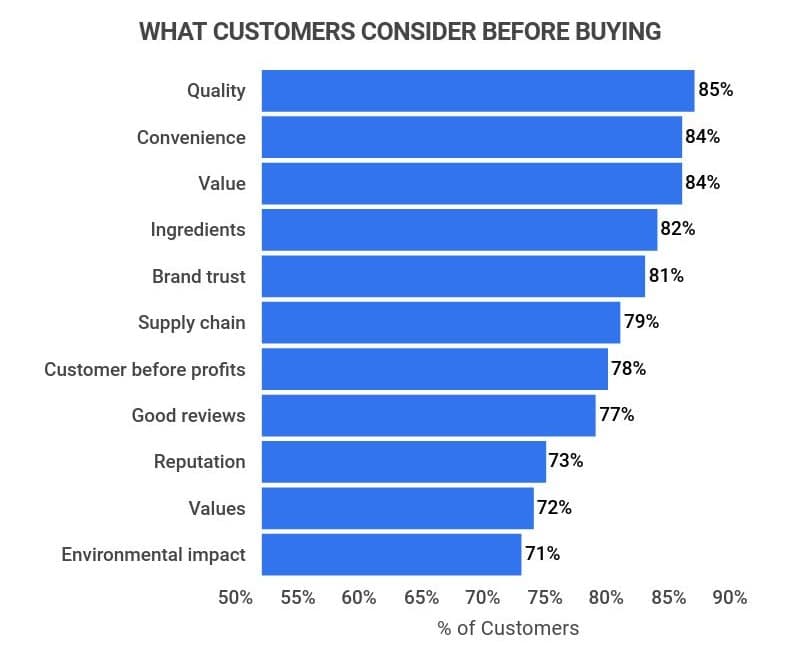
82% of customers prefer shopping with brands that align with their values, and 83% opt for brands they trust.
-
66% of customers regard transparency as a key quality in a brand.
For further insights, we categorized the data into the following sections:
Customer Opinions | Benefits

General Branding Statistics
-
78% of customers feel a connection with companies that use customized content.
This connection fosters increased loyalty and engagement, positively impacting a company’s bottom line. Moreover, while not all customers may feel a personal bond with the organization, 90% find custom content useful, and 82% report feeling more favorably toward a company after engaging with its custom content.
-
78% of customers prefer learning about a company through articles rather than advertisements.
Informative articles provide valuable insights into your company or product, enabling a stronger connection with your brand compared to traditional ads. Furthermore, 61% of online consumers indicated they made purchases after reading product recommendations on blogs.
-
Color can significantly enhance brand recognition by up to 80%.
Selecting a distinctive color or color palette for your brand and consistently integrating it into all marketing materials, online platforms, packaging, and physical locations helps solidify brand identity in customers’ minds. Additionally, color can evoke emotional responses; aligning color choices with desired feelings can amplify the brand’s impact.
-
To remember a brand, people need to see it five to seven times.
This highlights the importance of consistent branding across various channels: the more uniform the branding, the quicker you’ll achieve those five to seven impressions.
-
Nearly 72% of brand names utilize coined terms or acronyms.
This practice stems from the challenge of finding unique existing words or acronyms and the advantage of creating a new term that carries no preconceived notions.
-
As of 2023, Amazon stands as the most valuable brand globally with an estimated value of $299.3 billion.
Apple and Google follow closely, valued at $297.5 billion and $281.4 billion, respectively.
Customer Opinions on Branding
-
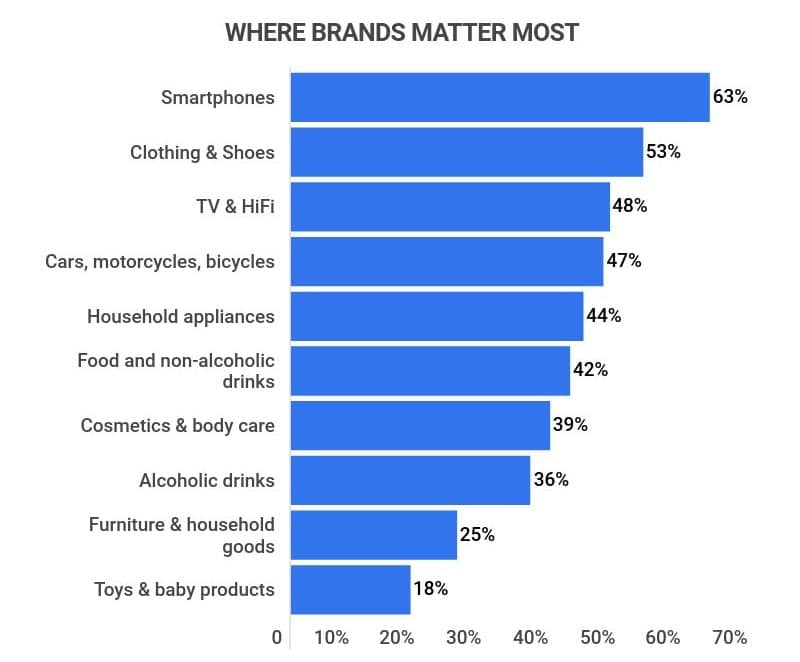
63% of customers focus on brands when shopping for smartphones.
Attention to branding is also notable in clothing and shoes (53%), TVs and sound systems (48%), and vehicles (47%). In contrast, only 42% consider branding when buying food and drink, and a mere 18% pay attention to brands for toys and baby products.
-
64% of customers feel a stronger trust towards brands that share their values.
This doesn’t imply that consumers want to know a company’s stance on every social issue, but they do seek to understand the overall missions and motivations of organizations, especially among younger consumers.
-
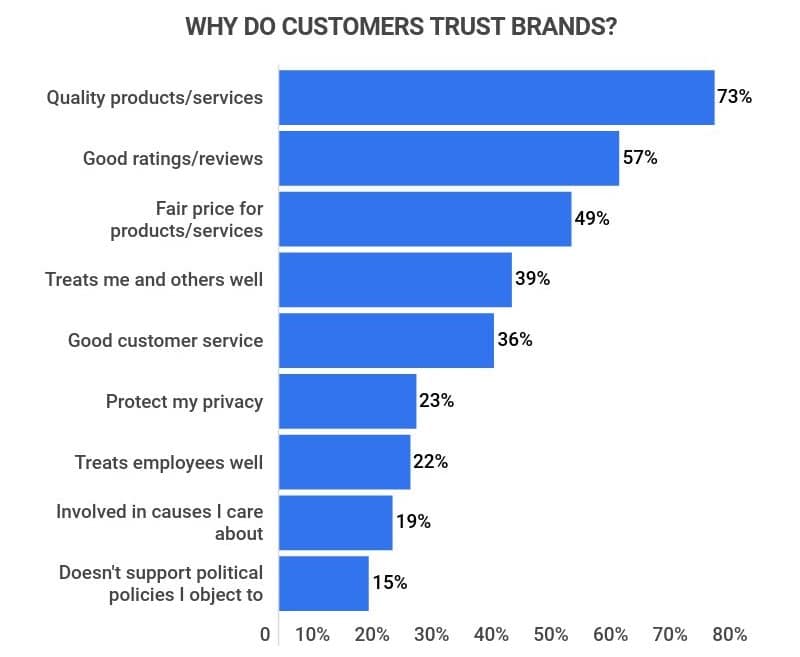
90% of customers are willing to spend more on a brand they trust.
Factors influencing this trust include high-quality products (40%), corporate responsibility (30%), and excellent customer service (16%).
-
83% of customers insist on trust before purchasing.
Many consumers indicated that a lack of trust is a deal-breaker when deciding on a purchase.
-
57% of customers base their trust on the quality of customer experiences.
This includes aspects such as how well customers are treated, how swiftly issues are resolved, and the safeguarding of personal information.
-
86% of consumers consider a brand’s authenticity in their purchasing decisions.
However, 57% feel that less than half of brand content is perceived as authentic.
-
82% of customers prefer purchasing from brands that align with their values.
These values may encompass environmental concerns, social justice, ethical supply chains, community involvement, and even political or religious beliefs. Consequently, brands are increasingly engaging in activism to resonate with their audiences.
-
45% of individuals would unfollow a brand on social media due to excessive self-promotion.
Audiences often find this content unengaging, particularly if they already follow the brand for promotions or new product information. Additionally, over 20% of consumers would unfollow a brand for repetitive content, and more than 15% would do so if a brand posts more than six times daily.
Benefits of Branding: Statistics
-
Customers with strong connections to a brand are 52% more valuable than those without.
A connected customer is satisfied, can distinguish your brand from competitors, and interacts with it via social media and other channels, according to Lyfe Marketing. Conversely, disconnected customers who only make a single purchase can result in a -18% customer value for businesses.
-
Strong branding can reduce hiring and training costs by up to 50%.
A compelling employer brand attracts 50% more qualified applicants, making recruitment easier and minimizing onboarding expenses.
-
Companies with weak employer branding pay at least 10% more in salaries.
A negative reputation as an employer deters candidates, leading to higher recruitment costs as excellent talent is more inclined to join companies with favorable branding.
-
Consistent branding can elevate revenue by up to 33%.
This entails maintaining uniformity in colors, fonts, voice, style, and messaging across various platforms, from social media to product packaging.
-
Companies with consistent branding are three to four times more likely to achieve excellent brand visibility compared to those with inconsistent branding.
Yet, fewer than 10% of studied companies report that their branding is highly consistent. To achieve this, establishing and enforcing branding guidelines across all materials is essential.
Branding FAQ
-
Branding is the visual representation of a company. This includes the company’s name, logo, colors, fonts, tone of voice, graphics, messages, and even store displays. Furthermore, customer service and policies are integral to branding.
Branding encapsulates what customers think of when they hear a company’s name, distinguishing it from competitors. Effective branding enables customers to clearly articulate a company’s mission and associate emotions with it.
-
Branding is crucial because effective branding attracts and retains customers more efficiently. Poor branding can confuse consumers and lead to dissatisfaction.
Customers are more inclined to choose a trustworthy brand over an unfamiliar company, resulting in higher retention rates and benefiting the organization’s financial performance.
-
How much can branding increase sales?
Branding can enhance sales by up to 33%. However, to realize this revenue increase, branding must remain consistent across all platforms, ensuring uniform voice, messaging, and visual design.
Inconsistency can lead to confusion and frustration, preventing a significant revenue boost.
-
How effective is branding?
Branding is highly effective and can lead to revenue increases of up to 33%. Consistent branding fosters recognition and visibility, engaging customers effectively. Satisfied, connected customers are 52% more valuable than those who are not engaged.
Employer branding also plays a significant role, aiding in employee attraction and retention, reducing hiring and training costs by up to 50%, and decreasing salaries by around 10%.
-
What is a good brand recognition percentage?
A good brand recognition percentage is one that is either increasing or remaining stable. While measuring brand recognition precisely can be challenging, observing metrics such as website visits and social media engagement can provide insights into brand awareness.
As long as these numbers are consistently improving, it’s a positive indicator of brand recognition.
-
What is the rule of 7 in marketing?
The rule of 7 in marketing suggests that customers require an average of seven interactions with a brand before making a purchase. This means providing multiple touchpoints for engagement without a purchase.
Social media serves as an effective platform for this, through targeted ads, influencer marketing, and organic content. Email marketing and search ads also play a role.
To ensure these interactions lead to purchases, maintaining consistency and positivity in engagement is crucial. Establishing standards for your marketing materials while understanding customer desires is essential for effective branding.
Conclusion
Effective branding is essential for a company’s success. Specifically, consistent branding that resonates with target audiences can significantly enhance profitability in numerous ways.
Revenue can increase by up to 33% through consistent branding, while hiring and onboarding costs may decrease by 50%. Additionally, companies with strong branding often offer salaries that are 10% lower, as their brand naturally attracts top talent.
Customers exhibit greater satisfaction and loyalty towards companies with solid branding. Notably, 83% insist on trust before making purchases, and 90% are willing to pay a premium for products or services from brands they trust.
This trust is primarily built through high-quality offerings, corporate accountability, and exceptional customer service, all integral components of effective branding.
References
-
Demand Metric. “Content Marketing Infographic.” Accessed on November 4, 2021.
-
Lyfe Marketing. “Why is Content Marketing Important? Learn the Importance of Content Marketing for Your Business.” Accessed on November 4, 2021.
-
Forbes. “10 Marketing, Web Design, and Branding Statistics to Help You Prioritize Business Growth Initiatives.” Accessed on November 4, 2021.
-
Pam Moore. “10 Reasons Why Personal Branding is a Requirement for Marketers and Business Leaders.” Accessed on November 4, 2021.
-
Neil Patel. “How to Decide on a Business Name: Tools, Tips, and Strategies.” Accessed on November 4, 2021.
-
Statista. “Where Brands Matter Most.” Accessed on November 4, 2021.
-
PR Newswire. “Consumers Will Pay a Premium for Brands They Trust, Salsify Finds in New Consumer Research.” Accessed on November 4, 2021.
-
Edelman. “2019 Edelman Trust Barometer Special Report: In Brands We Trust?” Accessed on November 4, 2021.
-
Marketing Charts. “Brand Trust is Becoming More Important: Here are Some Key Stats and Themes.” Accessed on November 4, 2021.
-
Stackla. “The Consumer Content Report: Influence in the Digital Age.” Accessed on November 4, 2021.
-
Havas Group. “Meaningful Brands.” Accessed on November 4, 2021.
-
HubSpot. “Why People Unfollow Your Brand on Social Media [New Data].” Accessed on November 4, 2021.
-
Lyfe Marketing. “25 Benefits of Branding Your Business for the Future.” Accessed on November 4, 2021.
-
LinkedIn. “The Ultimate List of Employer Brand Statistics.” Accessed on November 4, 2021.
-
Harvard Business Review. “A Bad Reputation Costs a Company at Least 10% More Per Hire.” Accessed on November 4, 2021.
-
Demand Metric. “The Impact of Brand Consistency.” Accessed on November 4, 2021.
-
Consumer Goods Technology. “New Research Shows Consumers More Interested in Brands’ Values Than Ever.” Accessed on March 20, 2023.
-
Statista.“Most Valuable Brands Worldwide in 2023.” Accessed on March 20, 2023.
- Facts and Figures
- Social Security Statistics
- Social Media Statistics
- Cell Phone Usage Statistics
- Cryptocurrency Statistics
- White Collar Crime Statistics
- Crowdfunding Statistics
- Branding Statistics
- How Many Emails Are Sent Per Day
- Money Laundering Statistics
- Childcare Availability Statistics
- Cold Calling Statistics
- Automation And Job Loss Statistics
- Student Loan Statistics
- Spam Statistics
- Password Statistics
- Ransomware Statistics
- Christmas Spending Statistics
- Average Grocery Cost By State
- Average Screen Time Statistics
- Average Monthly Expenses
- IoT Statistics
- Gen Z Statistics

Author

Abby is a writer who is passionate about the power of story. Whether it’s communicating complicated topics in a clear way or helping readers connect with another person or place from the comfort of their couch. Abby attended Oral Roberts University in Tulsa, Oklahoma, where she earned a degree in writing with concentrations in journalism and business.