Find a Job You Really Want In
As frustrating as it may be, our analysis indicates that a significant number of traffic tickets are issued during rush hour. This means that your daily commute, which already costs you precious time and mental energy, could also lead to unexpected expenses if you receive a ticket on your way to or from work.
The average American now spends about 52 minutes commuting each workday. This time adds up, not only affecting your mental health and vehicle maintenance but also costing you around $152 on average for a traffic ticket.
So, how can you avoid this financial pit while navigating to and from work?
Interestingly, research shows that there is a demographic that may have a slight advantage when it comes to avoiding tickets. Beyond just adhering to traffic laws, women, in particular, seem to fare better than men in ticketing situations.
Yes, the stereotype holds true: data suggests that women are more likely to receive warnings instead of citations after being pulled over. Let’s dive deeper into the details—there’s more to the story than meets the eye.
The Ticket Study’s Source and Reasoning
Our findings are based on extensive data from Stanford researchers, analyzing over 3.28 million traffic stops across five states. This contrasts with a previous study by the Federal Trade Commission that utilized data from just one state.
This study focuses on ticketing outcomes post-stop rather than the factors leading to traffic stops, such as speed relative to traffic flow or the vehicle’s characteristics. Our aim was to observe the likelihood of receiving a ticket based on the time of day and gender.
Our analysis indicates that women, while experiencing fewer tickets overall, often receive warnings, particularly during specific times of the day—an observation that applies to all genders. Furthermore, men are statistically more likely to receive speeding tickets.
Rush Hours Are the Biggest Ticket Times

As you rush to work in the mornings or hurry home in the evenings, it’s essential to be aware that these peak hours significantly increase your chances of getting a ticket. Police officers are well aware of this trend, and unless you have a unique way to charm your way out of a ticket, you’re more likely to face fines during these busy times.
Our analysis shows that traffic stops during rush hour result in tickets 62.2 percent of the time, compared to 54.3 percent during non-peak hours.
Interestingly, while women still receive fewer tickets than men during these peak times, the differences are smaller:
- For women, 57.8 percent of rush hour stops lead to tickets compared to 52.9 percent during other times, resulting in a 4.9 percentage point difference.
- For men, 59.6 percent of rush hour stops result in tickets versus 55 percent during non-peak times, creating a 4.6 percentage point difference.
Pulled Over at a Similar Rate, Women Escape Tickets More
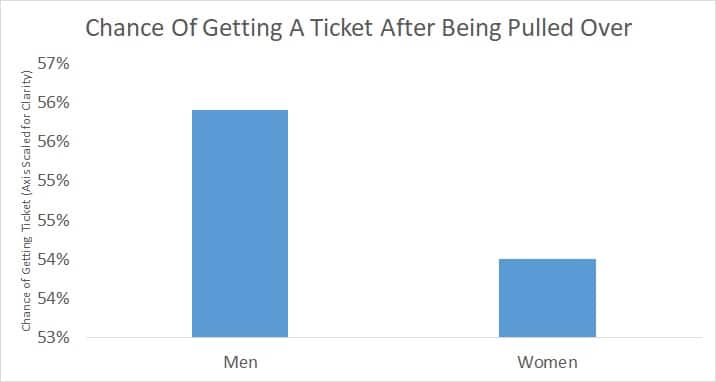
When controlling for location, gender, and time of day, the overall likelihood of receiving a ticket is approximately 56.8 percent after being pulled over.
Men are more frequently pulled over than women; the Bureau of Justice Statistics reported that around 11 million male drivers and 7 million female drivers are stopped by police annually.
This aligns with driving trends, as men drive about 40 percent more miles than women, contributing to the disparity in traffic stops. Our research reveals that while men are pulled over more frequently—59.2 percent of them receive tickets—54.4 percent of women are ticketed, indicating that men account for about 63.4 percent of all traffic tickets issued.
What’s the Explanation?
The disparity in traffic stops can be attributed to the fact that men tend to drive more than women, but behavioral factors also play a significant role.
Despite having similar rates of traffic stops, speeding remains the most common reason for these encounters, as noted in the journal Traffic Psychology and Behaviour:
More than a third of the drivers in the survey believed it was safe to drive 20 mph over the speed limit. Overall, most respondents thought it was safe to speed, with 79 percent saying it was safe to exceed the limit by 10 mph or more.
Men are often perceived to engage in riskier driving behaviors. Data from the Insurance Institute for Highway Safety reveals that men are about 150 percent more likely to die in speeding-related accidents.
And This Means…
Different thresholds for issuing citations exist for both genders. While both may be driving at similar speeds, the severity of men’s speeding infractions often exceeds the thresholds that would cause officers to issue citations.
Interestingly, 8 percent of women admit to flirting to get out of tickets. However, with around 88 percent of police officers being male, the 4 percent of men who have tried this approach are indeed taking a bold step.

Author

David Luther was the Content Marketing Editor for the Zippia Advice blog. He developed partnerships with external reporting agencies in addition to generating original research and reporting for the Zippia Career Advice blog. David obtained his BA from UNC Chapel Hill.