- Workplace Statistics
- Time Management Statistics
- Employee Wellness Statistics
- Employment Discrimination Statistics
- Employee Recognition Statistics
- Employee Referral Statistics
- Workplace Violence Statistics
- Gamification Statistics
- Employee Feedback Statistics
- Agile Statistics
- Productivity Statistics
- Meeting Statistics
- Cell Phones At Work Statistics
- Social Media At Work Statistics
- Workplace Injury Statistics
- Workplace Stress Statistics
- Leadership Statistics
- Workplace Collaboration Statistics
- Job Satisfaction Statistics
- Paid Holiday Statistics
- Communication In The Workplace Statistics
- Wasting Time At Work Statistics
- 4-day Workweek Statistics
Research Summary. Over the past few years, gamification has emerged as a powerful tool in both corporate and educational settings. Businesses are increasingly integrating game-like elements into employee training and daily work activities to enhance productivity and engagement. Our data analysis team conducted extensive research on gamification statistics, and here’s what we found:
-
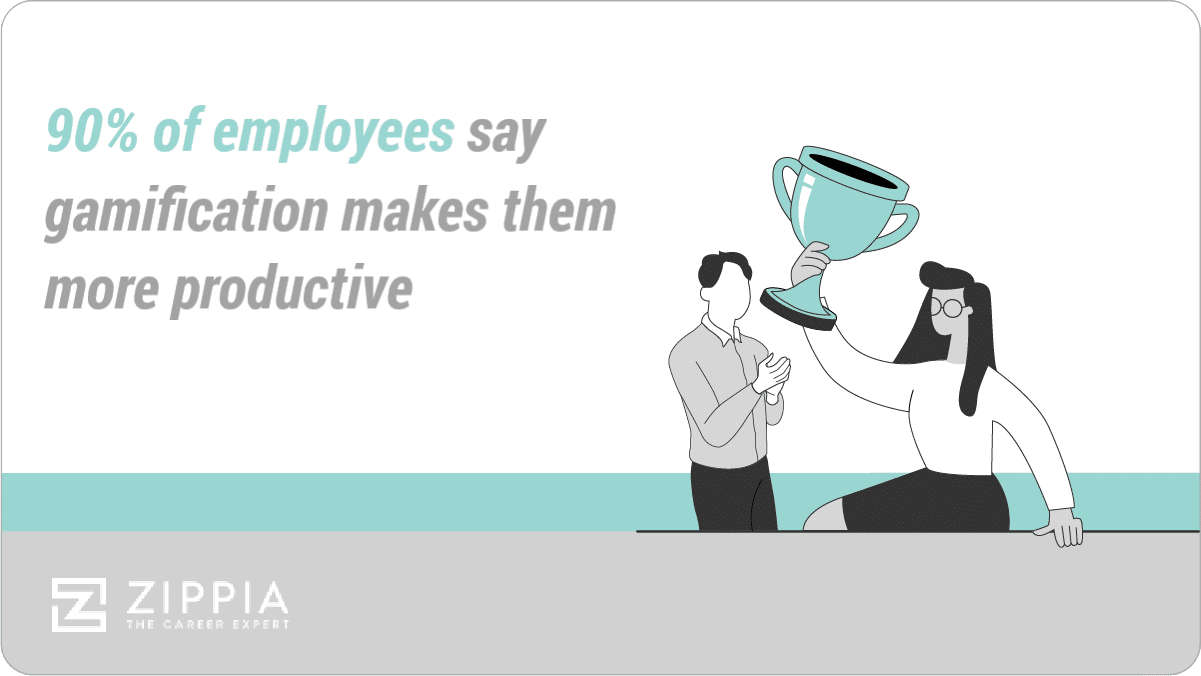
90% of employees believe gamification boosts their productivity.
-
On average, gamified work experiences lead to a 48% increase in engagement.
-
Companies that implement gamification are seven times more profitable than those that do not utilize gamified strategies.
-
The North American gamification industry is valued at $11.94 billion.
-
72% of individuals report that gamification encourages them to work harder and tackle tasks more effectively.
-
67% of students find gamified learning more engaging and motivating compared to traditional education methods.
-
The global market for game-based products and services is projected to grow at a compound annual growth rate of 27.4% from 2026 to 2031.
For more detailed insights, explore the data in the following sections:
Employee Opinions | Company Results | Benefits | Student Usage | Trends + Projections
Gamification Industry Statistics
-
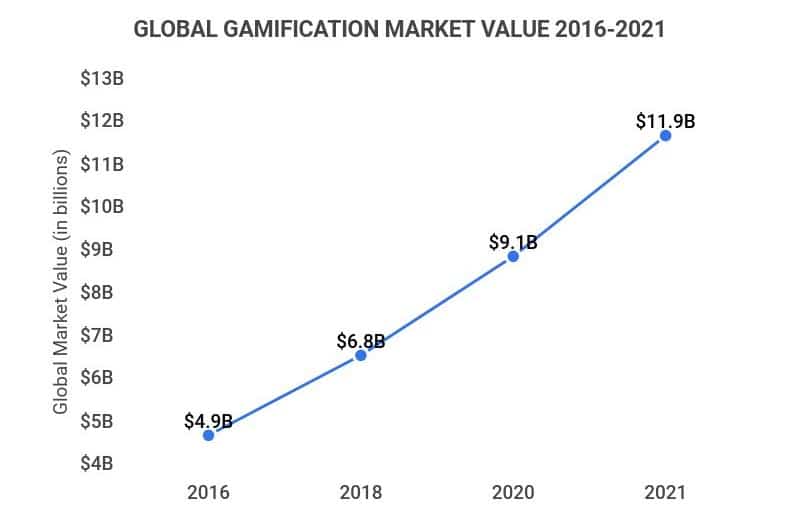
The global gamification market is currently valued at $11.94 billion.
As of 2026, the total value of the global gamification industry reflects a significant rise, increasing from $4.9 billion in 2016 to $11.94 billion today. Experts anticipate that the market will continue to expand by nearly $20 billion, with North America spearheading this growth.
Global Gamification Market Value 2016-2026
Year Total 2016 $4.9B 2018 $6.8B 2020 $9.1B 2021 $11.9B 2026 $11.94B -
70% of Global 2000 companies actively utilize gamification.
As organizations recognize the benefits of gamified environments for boosting employee engagement and productivity, approximately 70% of the Global 2000 companies have integrated gamification into their operations. Companies with highly engaged employees report being 22% more profitable and 21% more productive.
Business Gamification Statistics by Employees
-
A striking 95% of employees favor a gamified work experience.
Almost all surveyed employees appreciate gamified aspects in their workplace. Additionally, many job seekers consider gamification a desirable factor when evaluating potential employers, with 78% indicating that gamification in recruitment makes a company more appealing.
-
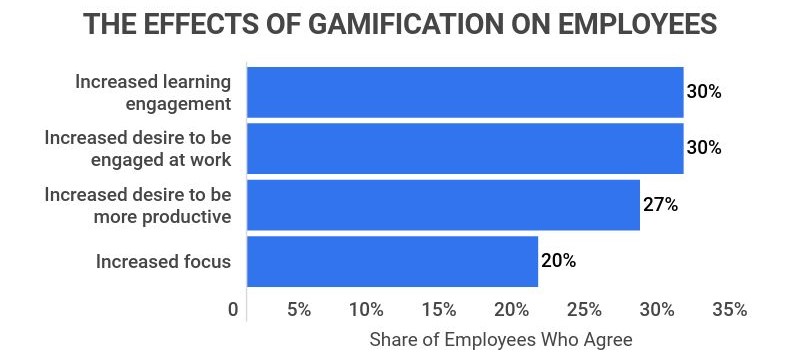
30% of employees find game-based learning more engaging.
While 90% of workers report productivity boosts from gamification, a survey found that 30% of participants expressed that game-based learning significantly enhances their engagement levels. Furthermore, gamification inspires 27% of employees to enhance their productivity and aids 20% in maintaining focus and minimizing distractions.
-
61% of U.S. employees receive gamified training.
A majority of American workers are trained using gamification. Reports indicate that 83% of employees undergoing gamified training feel motivated, whereas 61% of those receiving traditional training feel disengaged.
-
Gamified workplaces increase employee happiness by 89%.
A substantial 89% of surveyed workers reported that gamification contributes to their overall happiness and productivity at work. In comparison, 53% of American workers express dissatisfaction in their jobs. Additionally, 69% of employees indicated they would remain with a company for over three years if gamification were implemented.
-
Half of American workers engage in casual gaming outside of work.
Approximately 80 million white-collar workers in the U.S. are casual gamers. A recent survey revealed that 24% of white-collar employees play casual video games during work hours, and 35% of high-ranking executives are known to engage in gaming while on the job. Among those who play at work, 65% do so at least once a month.
Gamification Statistics by Company Results
-
Gamification improves skill assessment scores by 14%.
Adult learners show considerable benefits in gamified settings, achieving 14% higher scores on skill-based knowledge assessments and 11% higher on factual knowledge tests, according to studies.
-
Poorly executed gamification initiatives often fail to achieve desired results.
Approximately 80% of workplace gamification efforts do not meet objectives due to inadequate planning and design.
-
Gamification enhances employee performance and customer satisfaction.
In a case study, LiveOps, a customer service agency, implemented a gamified employee app and rewards program, resulting in a 23% improvement in call-handling time and a 9% increase in customer satisfaction.
Gamification Benefits Statistics
-
Gamification significantly boosts user engagement.
Recent data indicates that gamification leads to a 48% increase in engagement, with 30% of surveyed employees noting heightened motivation to engage with tasks.
-
Gamification enhances information retention.
Incorporating gamification into training and work processes makes them more enjoyable, increasing retention rates by approximately 40%, as supported by industry experts.
-
The surge in popularity of gamification is attributed to its impact on productivity and employee engagement.
Business leaders and educators favor gamification for its ability to improve knowledge retention, practical problem-solving skills, and provide immediate feedback.
Gamification in Education Statistics
-
Gamification correlates with a 50% increase in student productivity.
With 80% of U.S. workers reporting that gamified learning experiences are more engaging than standard training, it’s unsurprising that gamification can enhance productivity by 50%.
-
Gamification can elevate student test scores by as much as 34%.
A case study showed that a math teacher’s implementation of gamified learning resulted in average test scores rising from 49% to 83% over four months—a 34% improvement.
Due to the success of gamified learning, approximately 75% of K-8 teachers in the U.S. incorporate digital games into their instruction.
-
67% of U.S. students favor gamified learning experiences.
Nearly 70% of students prefer gamified approaches to traditional education, citing increased motivation and engagement as primary factors.
Trends and Predictions in the Gamification Industry
-
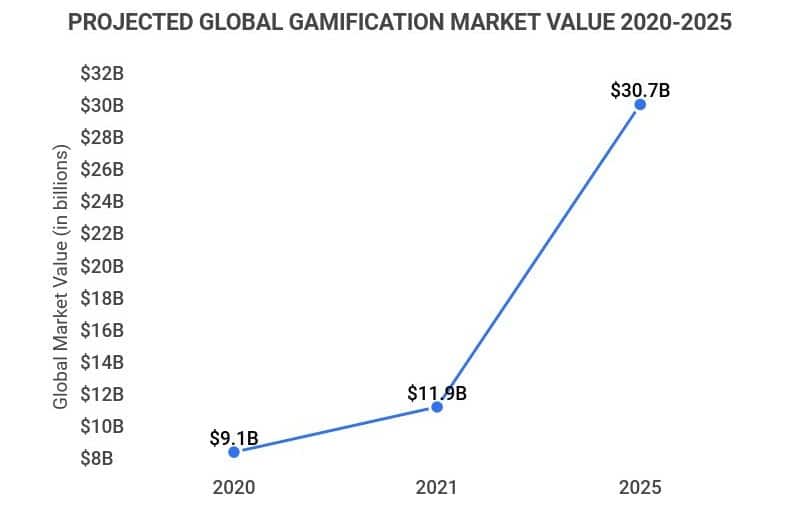
The global gamification industry is expected to grow at a compound annual growth rate of 27.4% in the coming years.
From 2026 to 2031, the global gamification market is projected to expand significantly, increasing from $11.94 billion to an estimated $30.7 billion.
-
Gamified learning is projected to be valued at $25.7 billion by 2025.
This segment is expected to grow at a compound annual growth rate of 14%, reflecting a shift towards more engaging educational approaches.
-
The global gamification market has expanded by $7.03 billion in the last five years.
From $4.91 billion in 2016, the market value has seen a remarkable increase of approximately 143%.
Gamification Statistics FAQ
-
How effective is gamification?
Gamification is highly effective in motivating employees and students, significantly increasing productivity and engagement. In the business context, gamification correlates with enhanced profitability, efficiency, customer, and employee satisfaction.
-
Gamification is among the most sought-after tools in learning and business environments globally. Currently, 70% of Global 2000 companies employ gamification, and 50% of startups in the U.S. have adopted it.
-
How big is the gamification industry?
The gamification industry is thriving. The global market is valued at $11.94 billion, with expectations of significant growth in the coming years.
-
What makes gamification successful?
The success of gamification stems from its ability to enhance motivation, engagement, and productivity. Surveys show that 95% of employees enjoy gamification at work, and 30% find it more engaging, leading to better organizational outcomes.
-
Yes, gamification is poised to be a defining feature of future business and educational environments. As its advantages become clearer, the industry is expected to grow rapidly, with predictions of continued growth in both corporate and educational applications.
-
What problem does gamification solve?
Gamification addresses the issue of disengagement in essential tasks. By making activities more enjoyable, it helps improve productivity and engagement levels, effectively tackling low morale and performance challenges.
-
How is gamification used in HR?
In HR, gamification enhances recruitment, onboarding, and training processes. Gamified elements, such as interactive assessments and engaging onboarding programs, help improve new hire retention and confidence.
-
What are some potential problems with using gamification for training?
Challenges include ineffective incentive structures and potential disengagement from employees who prefer traditional training methods. It’s crucial to balance gamification with conventional approaches to cater to diverse learning preferences.
Conclusion
As gamification continues to reshape the landscapes of work and education, its influence is undeniable. Current data shows that both student and employee success rates, alongside increased profitability, are closely linked to gamified environments. By fostering motivation and engagement, these environments enhance productivity and overall efficiency.
For businesses, gamification presents an appealing market opportunity. With around 90% of employees affirming its positive impact on productivity, companies employing gamification strategies are positioned to achieve up to 7 times greater profitability than those that do not. The future of gamification looks promising, with the global market projected to expand significantly in the coming years.
References
-
Globe Newswire. “Gamification Market To Reach More Than $32 Billion By 2025: Analysis By Size, Revenue, Recent Developments, Opportunities, Key Trends and Business Strategy.” Accessed on November 27, 2021.
-
Statista. “Gamification Market Value Worldwide 2016-2021.” Accessed on November 27, 2021.
-
Markets and Markets. “Gamification Market By Component, Deployment, Organization Size, Application, End-User, Vertical and Region: Global Forecast to 2025.” Accessed on November 27, 2021.
-
Fortune Business Insights. “Gamification Market Size, Share and Industry Analysis.” Accessed on November 29, 2021.
-
Crewhu. “Training With Gamification.” Accessed on November 29, 2021.
-
Medium. “How Gamification In The Workplace Impacts Employee Productivity.” Accessed on November 30, 2021.
-
Imaginovation Insider. “How Workplace Gamification Improves Employee Productivity (With Examples).” Accessed on November 30, 2021.
-
Game Developer. “Survey Finds Execs Gaming On Office Time.” Accessed on November 30, 2021.
-
AnswerHub. “Increase Employee Productivity With Gamification.” Accessed on November 30, 2021.
-
Niel Patel. “How To Use Gamification For Better Business Results.” Accessed on December 1, 2021.
-
Softtek. “70% Of The Companies In The Global 2000 List Already Use Gamification.” Accessed on December 1, 2021.
-
Grand View Research. “Video Game Market Size, Share Trends Analysis Report By Device, By Type, By Region, And Segment Forecasts, 2020-2027.” Accessed on December 1, 2021.
-
Projections. “The Power Of Gamification For Organizational Development.” Accessed on December 2, 2021.
-
My Cred. “The Future Of Gamification In Major Industries For Next Five Years (2020-2025).” Accessed on December 2, 2021.
-
Technology Advice. “The Influence Effectiveness of Gamification in eLearning.” Accessed on December 3, 2021.
-
Bravon. “Benefits Of Gamification In Learning.” Accessed on December 3, 2021.
-
Intuition. “Learning Via Gamification: Latest Data, Stats Trends.” Accessed on December 3, 2021.
-
Education Week. “Do Digital Games Improve Children’s Math Skills?” Accessed on December 3, 2021.
-
Precedence Research. “Gamification Market.” Accessed on February 23, 2023.
- Workplace Statistics
- Time Management Statistics
- Employee Wellness Statistics
- Employment Discrimination Statistics
- Employee Recognition Statistics
- Employee Referral Statistics
- Workplace Violence Statistics
- Gamification Statistics
- Employee Feedback Statistics
- Agile Statistics
- Productivity Statistics
- Meeting Statistics
- Cell Phones At Work Statistics
- Social Media At Work Statistics
- Workplace Injury Statistics
- Workplace Stress Statistics
- Leadership Statistics
- Workplace Collaboration Statistics
- Job Satisfaction Statistics
- Paid Holiday Statistics
- Communication In The Workplace Statistics
- Wasting Time At Work Statistics
- 4-day Workweek Statistics

Author

Elsie is an experienced writer, reporter, and content creator. As a leader in her field, Elsie is best known for her work as a Reporter for The Southampton Press, but she can also be credited with contributions to Long Island Pulse Magazine and Hamptons Online. She holds a Bachelor of Arts degree in journalism from Stony Brook University and currently resides in Franklin, Tennessee.