Find a Job You Really Want In
Slack is a versatile messaging platform that combines elements of email and instant messaging, widely adopted by millions of businesses and teams worldwide. While Slack offers a robust free plan, many users often wonder, “How does Slack generate revenue?”
In this article, you will discover how Slack operates, its various revenue streams, and whether it is the right communication tool for your team or organization in 2026.
Key Takeaways
-
Slack’s primary source of income is through paid subscriptions and investments.
-
Slack features four subscription tiers, with prices starting at $6.67 per user per month and increasing with enterprise-level plans.
-
Slack employs a freemium model, enticing users with its free version until they recognize the need to upgrade to accommodate their growing operational demands.

What is Slack?
Where Work Happens
The Slack app functions as a comprehensive communication hub, allowing teams to collaborate efficiently. As a Software as a Service (SaaS) instant messaging tool, it is highly customizable to meet your team’s communication needs. In recent years, Slack has emerged as a preferred alternative to email, providing users with a quicker and more interactive way to connect.
How Does Slack Generate Revenue?
Slack leverages multiple revenue streams. The primary source is its paid subscription plans, which account for a significant portion of its revenue. With over 100,000 paid subscribers, these subscriptions generated approximately 40% of Slack’s annual revenue, reflecting its growing value in organizational efficiency.
As organizations increasingly recognize the benefits of Slack, converting free users into paid subscribers has become more effective. Slack’s “freemium business model” creates a dedicated user base through its free product, encouraging upgrades when users outgrow the limitations of the free version.
This graphic illustrates the growth of Slack’s paid user base over the past three years:
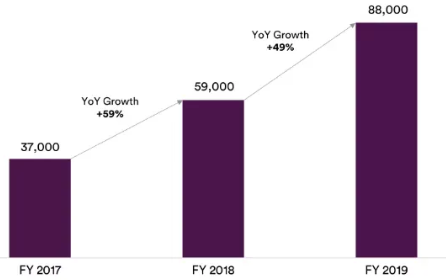
Slack became a publicly traded company in June 2019. Prior to its IPO, it raised an impressive $1.4 billion through multiple funding rounds from leading investment firms. Being publicly traded has bolstered its growth, yet the core revenue stream remains its expanding base of paid users.
Meet the Founders of Slack
Slack was co-founded by Stewart Butterfield and Cal Henderson, both of whom were instrumental in the success of the digital image-sharing platform Flickr. Their experience in building tech companies has been pivotal in Slack’s journey to becoming a major player in the communication space.
How Does a Slack Workspace Function?
Slack aims to simplify collaboration through a user-friendly interface designed to enhance organization and real-time communication. Here are seven key features that facilitate this goal:
-
Organized Conversations: Create unlimited channels tailored to various topics or projects, easily navigable within the intuitive interface.
-
Trackable History: Slack archives all conversations, allowing users to revisit past discussions effortlessly.
-
Secure Working Environment: Two-factor authentication safeguards accounts against potential threats, ensuring data security.
-
Integration: Seamlessly connect with applications like Google Drive, Dropbox, and more, setting Slack apart from other messaging tools.
-
Custom Shortcuts and Commands: Users can create personalized keyboard shortcuts for enhanced efficiency.
-
Audio and Video Calls: Facilitate calls with up to 15 participants, making Slack a central hub for communication.
-
Bots: A variety of bots enhance the user experience by streamlining tasks and providing helpful functions.
Is Slack Worth the Investment?
Deciding whether Slack is worth the investment depends on your usage. For individuals using Slack mainly for casual communication, such as a Fantasy Football League, the free version may suffice. However, teams with extensive collaboration needs, particularly those with 20+ employees, often find the enhanced communication and organizational capabilities invaluable.
Slack offers four subscription tiers:
-
Free
-
Standard
-
Plus
-
Enterprise Grid
This graphic provides an overview of the features included in these plans:

Many businesses start with the free version and later upgrade as their communication needs evolve. This is Slack’s goal: to provide initial tools for growth while offering the resources necessary for continued development.
What Are the Costs Associated with Slack?
To unlock additional features within Slack, here are the current subscription costs. The standard plan, ideal for small and medium-sized businesses, is priced at $6.67 per user per month when billed annually.
For larger organizations requiring advanced administrative tools, the Plus subscription is available at $12.50 per user per month for annual billing, with a monthly payment option of $15 per user. The cost for the Enterprise Grid subscription varies and interested parties should contact Slack’s sales team for details.
Frequently Asked Questions about Slack
-
Why is Slack often preferred over email?
Slack surpasses email by creating secure channels and threads tailored for team collaboration. While email remains suitable for some forms of communication, Slack excels in environments requiring dynamic back-and-forth interaction, offering security, visibility into message threads, and speed, along with audio and video call capabilities.
-
Is Slack owned by Google?
No, Slack is not owned by Google. It was acquired by Salesforce in 2021 for approximately $27.7 billion.
-
Who are Slack’s main competitors?
Slack’s top competitors include Microsoft Teams, Google Chat, and RocketChat, among others. Other notable alternatives are Discord, Flock, and Chanty.

Author

Chris Kolmar is a co-founder of Zippia and the editor-in-chief of the Zippia career advice blog. He has hired over 50 people in his career, been hired five times, and wants to help you land your next job. His research has been featured on the New York Times, Thrillist, VOX, The Atlantic, and a host of local news. More recently, he's been quoted on USA Today, BusinessInsider, and CNBC.