- How To Write A Resume
- Resume Examples
- Resume Tips
- Resume Tips
- Best Resume Writing Services
- Things To Avoid On A Resume
- Resume Paper To Use
- What To Include In A Resume
- How To Write A Bio
- How To Write A Personal Statement
- Lied on Your Resume?
- Resume PDF
- Avoid Age Discrimination
- Words and Phrases You Shouldn't Include in Your Resume
- How Many Skills Should You List On A Resume
- Send A Resume As A Pdf
- Resume Critique
- Make A Resume Stand Out
- Resume Spelling
- Resume Past Or Present Tense
- How To List Projects On A resume
- Best Resume Action Words
- How To Quantify Your Resume
- Resume Bullet Points
- Are Resume Writers Worth It
- How Many Jobs To List On Resume
- Please Find Attached My Resume
- How To List Contract Work On Your Resume
- How To Put Research On Your Resume
- How To Upload Your Resume To LinkedIn
- Resume Mistakes
- How To Show Promotions On Your Resume
- Resume Vs CV
Find a Job You Really Want In
Summary. There are four effective methods to display promotions on a resume: stacking your entries, listing them individually, creating a separate section, or listing the same company twice. Effectively showcasing promotions can significantly enhance your appeal to recruiters and hiring managers.
Receiving a promotion is always a positive development, but accurately reflecting it on your resume can be challenging. Crafting a resume is a complex task, and incorporating promotions adds another layer of difficulty.
It is crucial to present your promotions clearly without squandering valuable real estate on your resume or confusing potential employers. Depending on your career history, there are several approaches you can take; we will cover the essentials for each method to guide you through your resume-writing process.
Key Takeaways:
-
Organizing promotions effectively on your resume is vital for recruiters, hiring managers, and applicant tracking systems (ATS) to easily interpret your work experience.
-
You can choose from four methods to list promotions: stacking your entries, listing them individually, creating a separate section, and listing the same company twice.
-
Avoid using elaborate formatting, tables, or columns in your resume, as these can disrupt ATS software.
-
Ensure promotions are clearly labeled with accurate dates.

- How to Showcase Promotions on Your Resume
- Option #1: Stack Your Entries
- Option #2: List Your Entries Individually
- Option #3: Create a Separate Section
- Option #4: List the Same Company Twice
- Example Resumes Using Each Option
- Why You Should Showcase Promotions on Your Resume
- Formatting Tips for Applicant Tracking Systems (ATS)
- FAQ: Showcasing Promotions on Your Resume
- Final Thoughts
- References
- Sign Up For More Advice and Jobs
How to Showcase Promotions on Your Resume
You have four options for displaying promotions on your resume:
-
Stack Your Entries. This method is straightforward and especially useful if your roles were similar.
-
List Your Entries Individually. This approach works well when promotions led to entirely new roles, emphasizing your diverse skill set.
-
Create a Separate Section. Utilize this option for relevant work experience and promotions from over 15 years ago, allowing you to highlight accomplishments without cluttering your resume.
-
List the Same Company Twice. This method involves creating a new entry for each role, making each one stand out, though it consumes more space.
Each method has its advantages and drawbacks. For instance, stacked promotions may not be recognized by ATS and could misassign skills. Let’s delve deeper into each option to determine which is best for you.
Option #1: Stack Your Entries
If your roles were similar, stacking job titles under the company header is beneficial. This method effectively illustrates your progressive responsibilities, achievements, and dedication to the company.
For example, if you were promoted from junior web designer to senior web designer without a change in job description, it would appear as follows:
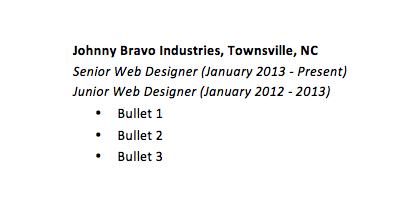
Use bullet points to highlight your most impressive achievements during these roles. Keep in mind that your resume should market you as the ideal candidate, so focus on your accomplishments rather than mundane duties.
You can also use bullet points to explain the reasons for your promotions, such as:
Promoted within 12 months for completing three major projects ahead of schedule and under budget.
This demonstrates to employers that your promotion was earned through merit, not just due to circumstantial vacancies.
However, this method may not be optimal for ATS, as it might attribute all skills to the earlier role, potentially lowering your resume score and missing higher-level roles.
If applying to a smaller company unlikely to use ATS, this format is visually appealing and effective.
Option #2: List Your Entries Individually
When your roles at the same company were substantially different—such as transitioning from assistant editor to web developer—list the company once, but separate the job titles as distinct positions.
This method highlights your achievement history and tenure in each position:
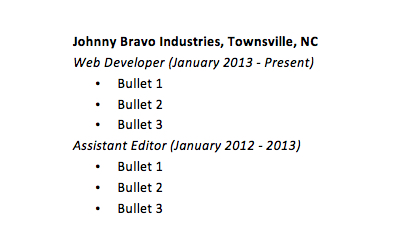
Be sure to use bullet points to detail your most significant accomplishments and experiences relevant to the job you’re targeting.
If the new role represented a step up, clarify that; even lateral moves showcase adaptability and a broad skill set.
This format is advantageous for ATS, as each job title is clearly defined with its own subsection detailing your experience.
Option #3: Create a Separate Section
If you have relevant work experience dating back over 15 years, consider establishing a separate section to list job titles and dates without detailing accomplishments.
This allows you to demonstrate career progression while keeping your resume concise:
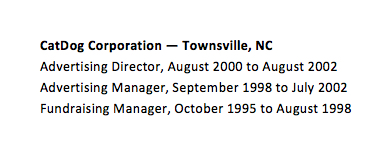
If you have noteworthy achievements from older roles, consider listing them in a separate accomplishments section. Ensure it’s impactful, as you only have limited space on your resume.
ATS will recognize this prior experience section as part of your overall work experience, which is acceptable as long as your more recent positions are fully articulated elsewhere.
Option #4: List the Same Company Twice
Another option is to list the company’s name and address again but create separate sections for each job title. You can detail your most impressive accomplishments for each role:
XYZ Inc. — Rochester, NY
VP of Marketing — June 2017-Present
Increased website traffic by 145% year-over-year
Managed a social media campaign that drove sales by 36%
Designed a new website layout featured in “Best SEO of March 2019”
XYZ Inc. — Rochester, NY
Marketing Manager — March 2015-June 2017
Hired and managed a team of 8-12 writers to develop a blog
Reduced development costs by 36%
Organized group pitch meetings and developed 20 new articles weekly
This resume format is favorable for ATS as it mirrors listing experience at different companies. If applying to a larger organization that likely uses ATS, this method is ideal.
However, it occupies significant space, so weigh the value of that space and consider trimming details from more junior roles.
Example Resumes Using Each Option
-
Stacked Entries Example
edX, Cambridge, MA | June 2017-Present
Sales Manager | May 2019-Present
Sales Representative | June 2017-May 2019-
Managed a team of 12 salespeople, resulting in a 23% increase in sales month-over-month
-
Engaged 10 potential clients daily via phone and 20 via email
-
Awarded Salesperson of the Month, March 2019
-
-
Individual Entries Example
ABC Corporation, Las Vegas, NV | April 2017-Present
Marketing Manager | April 2019-Present-
Boosted website traffic by 60% in three months
-
Managed a remote team of 20+ illustrators, designers, developers, writers, and editors
-
Enhanced app engagement by 32%, leading to a 40% increase in mobile sales
Data Analyst | April 2017-Present
-
Formulated strategies for marketing and product teams based on data visualizations
-
Reduced freelance content production costs by 15% through data-driven solutions
-
-
Separate Section Example
Prior Professional Experience
Starbucks | Seattle, WA
Lead Web Developer | April 2008-June 2012
Junior Web Developer | June 2006-April 2008
IT Intern | January 2006-May 2006 -
Same Company Twice Example
XYZ Inc, Green Bay, WI
Office Manager | 04/2019-Present-
Oversaw the purchase of $100,000 in office supplies annually
-
Maintained relationships with 12+ vendors
-
Streamlined schedules, enabling a 14% increase in workflow productivity
XYZ Inc, Green Bay, WI
Office Assistant | 07/2017-04/2019-
Handled 30+ customer calls and 100+ emails daily
-
Boosted customer satisfaction rates by 13%
-
Why You Should Showcase Promotions on Your Resume
Displaying promotions on your resume enhances your attractiveness as a candidate to recruiters and hiring managers. They indicate that you were a valuable employee entrusted with greater responsibilities. Promotions also demonstrate reliability and the ability to grow within the company.
Moreover, resumes are about showcasing your value through accomplishments, and receiving a promotion is certainly a significant achievement. While you can articulate how you added value, a promotion serves as concrete proof that your employer recognized your contributions. It’s a vital detail that bolsters your stated qualifications.
Ultimately, showcasing promotions on your resume helps you stand out as a candidate with proven loyalty, growth potential, and successful experience.
Formatting Tips for Applicant Tracking Systems (ATS)
While applying for jobs online is easier than ever, it has its challenges. Hiring managers and recruiters receive a continuous influx of applications, often relying on applicant tracking systems to filter out unqualified candidates.
The downside is that these systems lack intuition; if your resume is improperly formatted, you might miss out on showcasing your valuable experiences.
Here are some tips to optimize your resume for ATS:
-
Avoid elaborate formatting. While it may be tempting to use special bullet points to indicate promotions or job changes, stick to standard circle or square bullet points to ensure readability.
A useful tip is to copy and paste your resume into a plain text document (like Notepad). The formatting you see there reflects how ATS will interpret it.
-
Refrain from using tables and columns. These formats often break when parsed by ATS.
-
Clearly label company names and employment dates. Use either the full month or numerical format (e.g., June 2012 or 06/2012). Ensure that every job change is clearly labeled with corresponding time periods, so you receive the appropriate credit for your experience.
FAQ: Showcasing Promotions on Your Resume
-
Should you list any promotions on a resume?
Yes, you should list any promotions on your resume, as they can enhance your attractiveness to hiring managers. To effectively showcase your promotions, you can stack your entries, list them individually, create a separate section, or list the company twice.
-
What is the most effective way to make your resume stand out?
The most effective way to stand out is to emphasize your relevant skills and experience while tailoring your resume to each specific job. Tailoring your resume helps you incorporate keywords that enhance visibility. Focus only on relevant skills and experiences that align with the job you’re applying for.
-
How do you confidently present a promotion on a resume?
Articulate your accomplishments related to the promotion without exaggerating. It’s essential to be truthful about your promotions or accomplishments to present yourself as a solid candidate.
Provide examples of your achievements to illustrate your success, giving the hiring manager or recruiter a clearer understanding of your promotions and accomplishments.
Final Thoughts
Advancing within a company signals that you are a high performer who delivers results. Listing multiple roles within a company highlights your achievements and showcases your commitment to growth within an organization.
If your resume effectively communicates these strengths, you are well on your way to landing an interview and impressing potential employers.
Now go out there and impress your prospective employers!
References
-
Harvard University Graduate School of Design – How to Write A Resume That Stands Out
-
Roxbury Community College – How to Show a Promotion on Your Resume
- How To Write A Resume
- Resume Examples
- Resume Tips
- Resume Tips
- Best Resume Writing Services
- Things To Avoid On A Resume
- Resume Paper To Use
- What To Include In A Resume
- How To Write A Bio
- How To Write A Personal Statement
- Lied on Your Resume?
- Resume PDF
- Avoid Age Discrimination
- Words and Phrases You Shouldn't Include in Your Resume
- How Many Skills Should You List On A Resume
- Send A Resume As A Pdf
- Resume Critique
- Make A Resume Stand Out
- Resume Spelling
- Resume Past Or Present Tense
- How To List Projects On A resume
- Best Resume Action Words
- How To Quantify Your Resume
- Resume Bullet Points
- Are Resume Writers Worth It
- How Many Jobs To List On Resume
- Please Find Attached My Resume
- How To List Contract Work On Your Resume
- How To Put Research On Your Resume
- How To Upload Your Resume To LinkedIn
- Resume Mistakes
- How To Show Promotions On Your Resume
- Resume Vs CV

Author

Maddie Lloyd was a writer for the Zippia Advice blog focused on researching tips for interview, resume, and cover letter preparation. She's currently a graduate student at North Carolina State University's department of English concentrating in Film and Media Studies.