- Small Business Statistics
30 Essential Hybrid Work Statistics [2026]: Hybrid Work Model, Data, and Productivity
Hybrid work research summary. The hybrid work model has evolved into a widely adopted approach for organizing the workweek. Post-pandemic, both employers and employees have recognized the lasting benefits of remote and flexible work arrangements. This shift has led many organizations to embrace a permanent hybrid work model. Below are the key hybrid work statistics and insights into the future of work:
-
74% of U.S. companies are currently utilizing or planning to adopt a permanent hybrid work model.
-
44% of U.S. employees prefer a hybrid work model, in contrast to 51% of employers who share this view.
-
63% of high-growth companies have implemented a “productivity anywhere” hybrid work model.
-
55% of employees desire the flexibility to work remotely at least three days a week.
-
Companies’ average IT spending increased by 6.7% from 2020 to 2021 as they adapted to hybrid and remote work environments.
-
59% of employees are more inclined to choose an employer that offers remote work options over one that does not.
For further analysis, we broke down the data in the following ways:
Benefits of Hybrid Work Models | Employer Opinions on Hybrid Work | Executive Opinions on Hybrid Work and Company Culture | Employee Opinions on Hybrid Work | Hybrid Work Preferences by Generation | Hybrid Work Trends and Projections
General Hybrid Work Statistics
As hybrid work data continues to emerge, insights from both employees and employers are becoming clearer. Here are some pivotal statistics regarding hybrid work:
-
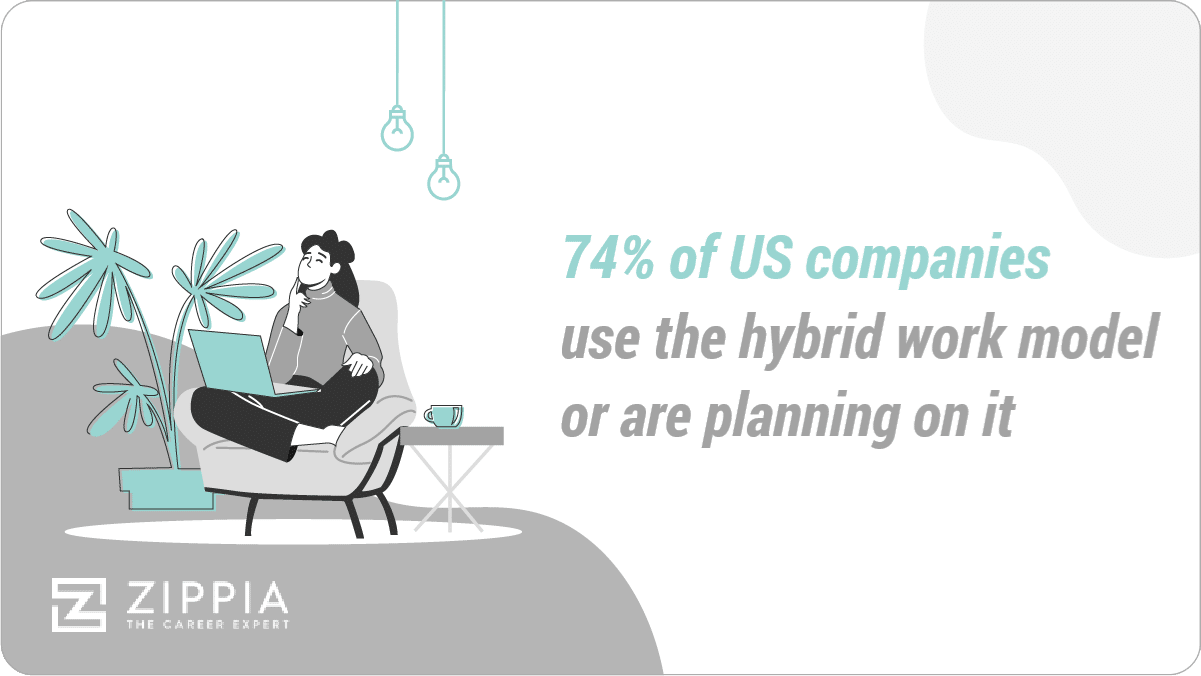
84% of companies cite employee health and wellness as a “very important” consideration in developing their work plans.
Additionally, 72% consider employee productivity crucial, while 58% prioritize access to talent and alignment with corporate mission.
Other significant factors include diversity, equity, inclusion, cybersecurity, and costs related to real estate and technology.
-
83% of workers express a preference for a hybrid work model moving forward.
Those who experienced a hybrid model during the pandemic reported lower burnout rates than their fully remote or fully in-office counterparts, according to an Accenture study.
-
Average IT spending by companies rose by 6.7% from 2020 to 2021.
This reflects organizations’ ongoing investment in technology to support remote and hybrid work environments.
Hybrid Work Benefits
The hybrid work model offers numerous advantages, positively impacting both employees and employers. Here are some key benefits:
-
On average, organizations observe a 12% reduction in turnover when they allow employees to engage in remote work.
-
54% of employees would consider leaving their current job for one that offers greater flexibility, particularly in remote work options.
-
Companies save an average of $11,000 per year per part-time remote worker.
-
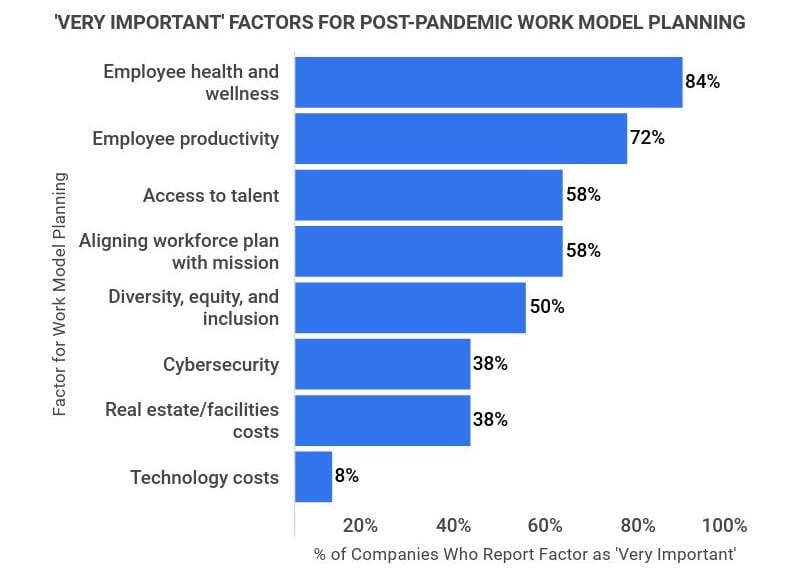
83% of companies report that collaboration on new projects has remained equal to or improved post-pandemic, according to Statista.
Employer Opinions of Hybrid Work
Hybrid work has gained popularity among employers as they recognize its advantages. Here’s what employers think:
-
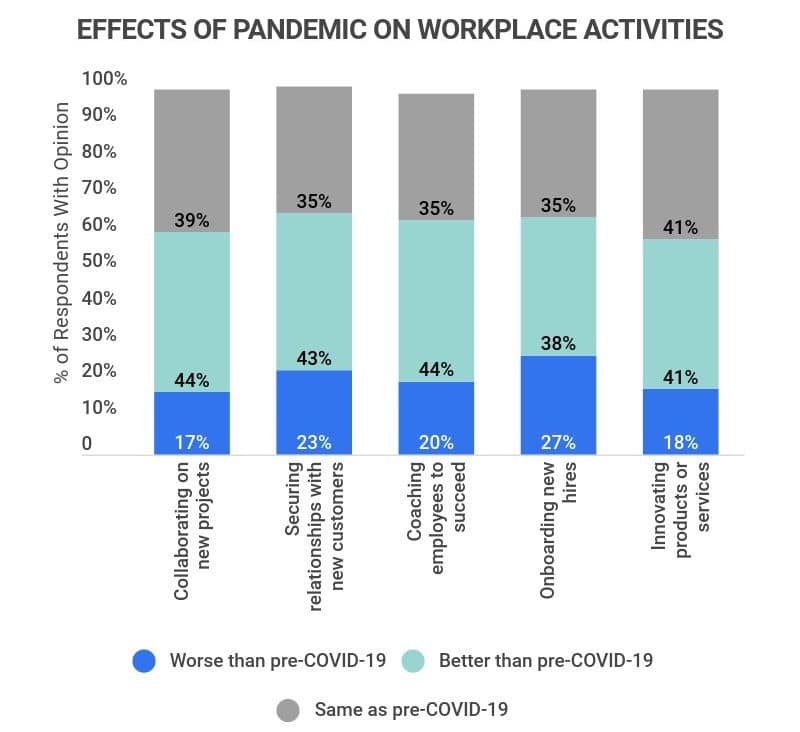
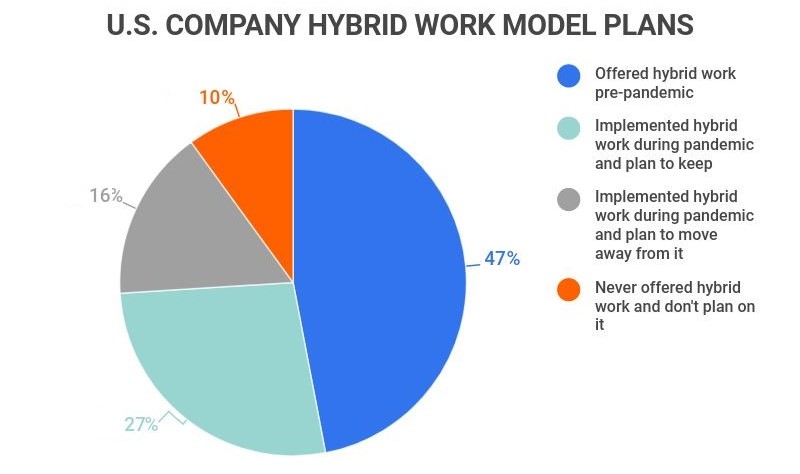
74% of U.S. companies are currently using or plan to implement a permanent hybrid work model.
Of these companies, 47% had a hybrid plan in place before the pandemic, while 27% established one during the pandemic and intend to make it permanent.
Conversely, 16% have opted for a hybrid approach but plan to revert to traditional models, while 10% do not plan to adopt a hybrid model at all.
-
63% of high-growth companies have adopted hybrid work models.
These organizations have embraced “productivity anywhere” approaches, allowing employees to choose their work location based on daily needs.
-
69% of negative or low-growth companies focus on rigid work structures, either fully remote or fully in-office.
These companies tend to prioritize location over productivity, limiting flexibility for their workforce.
Executive Opinions of Hybrid Work
Executives often have differing views on hybrid work compared to other employers, primarily due to concerns about company culture and productivity. Here are their insights:
-
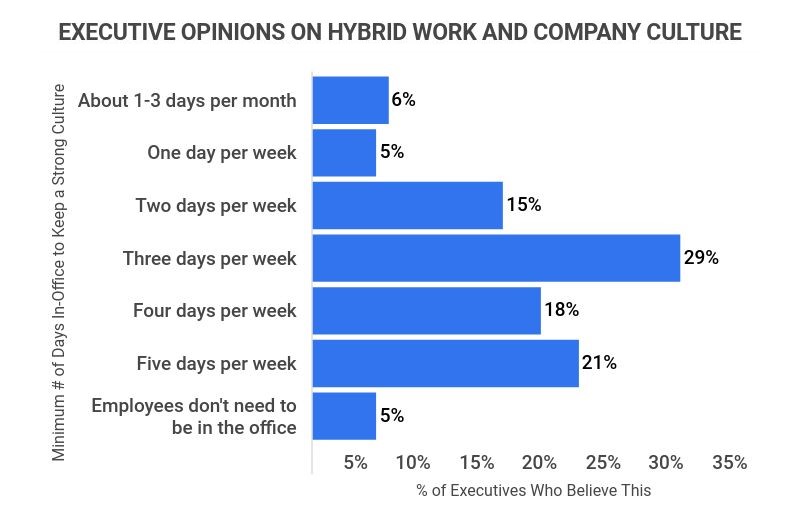
29% of executives believe that employees should be in the office at least three days a week to maintain company culture.
Meanwhile, 21% think that full-time office presence is necessary, and 18% advocate for four days in-office. Only 5% believe office presence is unnecessary.
-
65% of executives assert that having employees work in-office significantly boosts productivity.
This is the primary reason cited for valuing in-office presence, followed by the need for client meetings, collaboration, and fostering company culture.
-
68% of executives indicate they lack a detailed plan for hybrid work, despite most intending to implement one.
Specifically, 4% have not begun planning, 32% are in discussions, and another 32% have a broad vision but need to finalize details.
Employee Opinions of Hybrid Work
Most employees appreciate the benefits of remote work and see hybrid arrangements as a desirable compromise. Here’s what they think:
-
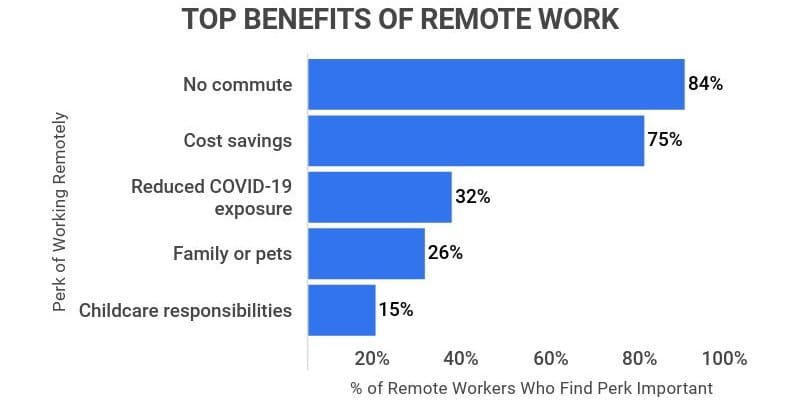
84% of employees value the elimination of commuting as a primary benefit of remote work, according to a Bloomberg survey.
Additionally, 75% cite cost savings from working from home, with over a third saving more than $5,000 annually by avoiding commuting costs.
Other notable benefits include reduced exposure to illnesses (32%), staying closer to family and pets (26%), and lessened childcare responsibilities (15%).
-
87% of employees believe that in-office work is essential for effective collaboration and building relationships with colleagues.
These needs highlight that if the office cannot meet these demands, employees may question the necessity of being present.
Other reasons for valuing office space include secure access to documents and equipment, client meetings, and opportunities for training and career development.
-
55% of employees prefer to work remotely at least three days a week.
This data, while slightly lower than previous years, indicates a desire for flexibility while acknowledging the value of in-office interactions.
-
30% of employees with less than five years of experience prefer to work remotely no more than one day a week.
This contrasts with 20% of all respondents. Additionally, 34% of these early-career employees feel less productive when working remotely, compared to 23% of all surveyed workers.
-
87% of employees with remote work options utilize this flexibility at least one day a week.
The breakdown of remote work days taken is as follows:
Number of Days Worked Remotely Per Week by Employees Given the Option to Do So
Days Per Week Percentage of Employees Able to Work Remotely No Days 13% One Day 13% Two Days 18% Three Days 16% Four Days 10% Five or More Days 32%
Hybrid Work Statistics by Generation
Generational differences also impact attitudes toward hybrid work. Generally, younger generations favor hybrid arrangements more than older ones. Here are the insights:
-
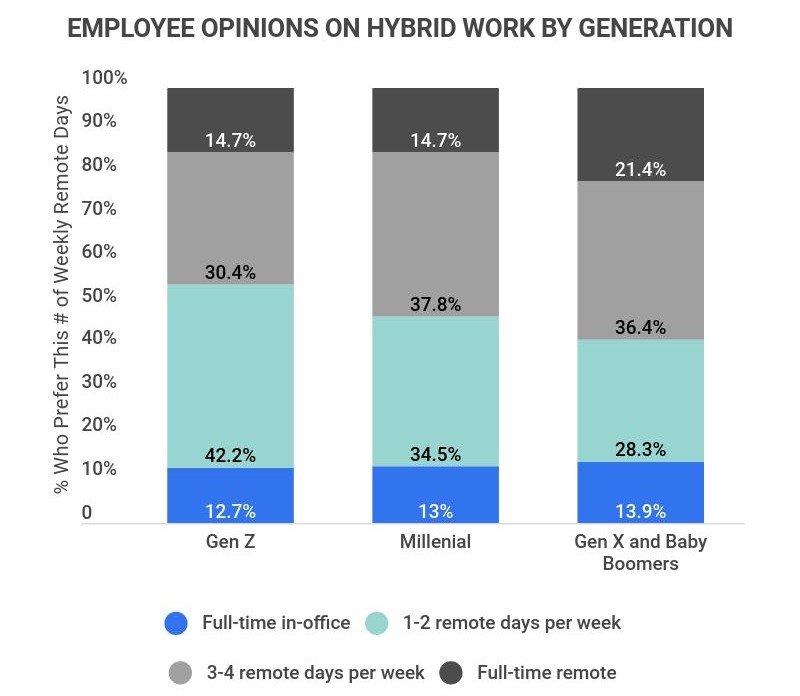
42.2% of Gen Z prefers to work remotely one to two days a week.
In comparison, 34.5% of Millennials and 28.3% of Gen X and Baby Boomers share this preference.
-
37.8% of Millennials want to work remotely three to four days each week, the highest among all generations.
-
21.4% of Gen X and Baby Boomers desire full-time remote work.
Conversely, only 14.7% of Millennials and 7.4% of Gen Z prefer the same.
-
Millennials primarily seek office space for collaboration and internal meetings.
64.2% of Millennials want office access for collaboration, while 61.5% seek it for meetings, more than any other generation.
-
Gen Z is inclined to utilize office spaces for desk work and training more than other demographics.
51.1% of Gen Z wants office access for desk work, compared to 40% of Millennials and 36.4% of Gen X and Baby Boomers.
For training and development, 48.9% of Gen Z prefer office resources, surpassing Millennials and Gen X.
-
Gen X and Baby Boomers prioritize office space for client meetings above all other generations.
49.2% of these groups want office access for client interactions, compared to 42.9% of Millennials and 37.1% of Gen Z.
Hybrid Work Trends and Projections
The hybrid work model is expected to gain further traction as companies refine their approaches. Here are some notable trends:
-
72% of companies plan to increase investment in virtual collaboration tools.
This indicates a commitment to enhancing remote and hybrid work practices.
Additionally, 70% intend to strengthen IT infrastructure for secure virtual connectivity, while 64% wish to provide more manager training for remote workforce management.
Companies are also focusing on upgrading conference rooms for enhanced virtual connectivity and investing in hoteling applications.
-
In December 2023, 52% of employers felt more productive working remotely, compared to 44% in June 2020.
As companies and employees adapt to remote work technologies, productivity gains continue to rise.
-
The number of online job searches for remote positions has remained significantly high since the pandemic.
While the initial surge was 460% from June 2019 to June 2021, the interest in remote work has stabilized across various sectors.
Hybrid Work Model Statistics FAQ
-
A hybrid work model is a setup where employees split their time between the office and remote work. This can involve some employees working in the office full-time while others work remotely, or everyone alternating between both environments. This model provides the flexibility employees desire while retaining the benefits of face-to-face interactions with colleagues and clients.
Overall, hybrid work models can save companies money by reducing office space needs, improve employee satisfaction, and enhance productivity while minimizing turnover.
-
What percentage of employees want a hybrid work model?
83% of U.S. employees prefer a hybrid work model. Throughout the evolution of remote work, it has become apparent that workers benefit from a blend of in-office and remote work. This balance reduces burnout and allows for personal flexibility while maintaining essential office interactions.
-
What are the advantages of hybrid working?
The advantages of hybrid working include enhanced flexibility, collaboration opportunities, professional development access, and cost savings. Employees enjoy the freedom to manage their work-life balance while retaining the ability to engage with colleagues and participate in professional development in-person. Additionally, companies benefit financially, with average savings of $11,000 per employee per year.
-
Does hybrid work increase productivity?
Yes, hybrid work can enhance productivity when executed effectively. The fact that 63% of high-growth companies have adopted hybrid work models, compared to the 69% of low-growth companies that maintain rigid work structures, suggests that a hybrid approach optimizes productivity and revenue growth.
Experts attribute increased productivity to greater comfort with remote work, improved work-life balance, and a consistent company culture upheld through in-office days.
-
How do you make a hybrid work model work effectively?
To ensure a successful hybrid work model, it’s crucial for employees and management to align on in-office time and its purpose. Effective training on virtual collaboration tools is essential to minimize friction between remote and in-office workers. Additionally, fostering open communication is vital for continually improving hybrid working conditions tailored to team needs.
Conclusion
The transition to remote work during the pandemic has led to a lasting shift in workplace dynamics, with many organizations now adopting hybrid work models as a permanent solution. A significant 83% of employees support this model, with 55% seeking the option to work from home at least three days a week.
Moreover, 74% of companies acknowledge the benefits of hybrid work, although opinions vary on the optimal number of in-office days, with many executives advocating for at least three. Overall, hybrid work appears to be a viable strategy for businesses, as evidenced by the 63% of high-growth companies that successfully implement this model, contrasting sharply with 69% of low-growth companies that do not.
References
-
CNBC. “The Latest Numbers on How Many Workers will be Returning to Offices, and How Often.” Accessed on October 28, 2021.
-
Accenture. “The Future of Work: A Hybrid Work Model.” Accessed on October 28, 2021.
-
Wikibon. “CIOs Signal Hybrid Work Will Power Spending Through 2022.” Accessed on October 28, 2021.
-
Forbes. “5 Proven Benefits of Remote Work for Companies.” Accessed on October 28, 2021.
-
Statista. “How Would You Describe How Effective Your Company Has Been at Performing The Following Activities with Employees Working Remotely?” Accessed on October 28, 2021.
-
Mercer. “Global Survey #8: In the United States, How Are Companies Addressing Flexibility, Inclusivity and the Continued Impact of the Pandemic.” Accessed on October 28, 2021.
-
Bloomberg. “Employees are Quitting Instead of Giving Up Working From Home.” Accessed on October 28, 2021.
-
PWC. “It’s Time To Reimagine Where and How Work Will Get Done.” Accessed on October 28, 2021.
-
McKinsey & Company. “What Executives are Saying About the Future of Hybrid Work.” Accessed on October 28, 2021.
-
Hubble. “Gen Z and Millennials are Much More Pro-Office Than Gen X and Baby Boomers.” Accessed on October 28, 2021.
-
Statista. “How Do You Plan To Change Investment Levels, if at all, in the Following Areas?” Accessed on October 28, 2021.
-
CNBC. “Pandemic Pushes Search for Remote Jobs Up 460%.” Accessed on October 28, 2021.
-
Accenture. “The Future of Work: Productive Anywhere.” Accessed on February 6, 2022.
-
McKinsey. “Americans Are Embracing Flexible Work — And They Want More of It.” Accessed on February 20, 2023.
- Small Business Statistics

Author

Abby is a writer who is passionate about the power of story. Whether it’s communicating complicated topics in a clear way or helping readers connect with another person or place from the comfort of their couch. Abby attended Oral Roberts University in Tulsa, Oklahoma, where she earned a degree in writing with concentrations in journalism and business.