Find a Job You Really Want In
The gender pay gap has seen significant improvements over the past few decades, reflecting a growing commitment to equal pay for equal work. However, disparities persist across various occupations, particularly affecting women in their prime working years.
Research shows that women aged 25 to 35, a critical period often intersecting with family growth, still earn substantially less than their male counterparts. A recent study revealed that women earn, on average, $12,600 less than men prior to having children and a staggering $25,100 less post-birth.
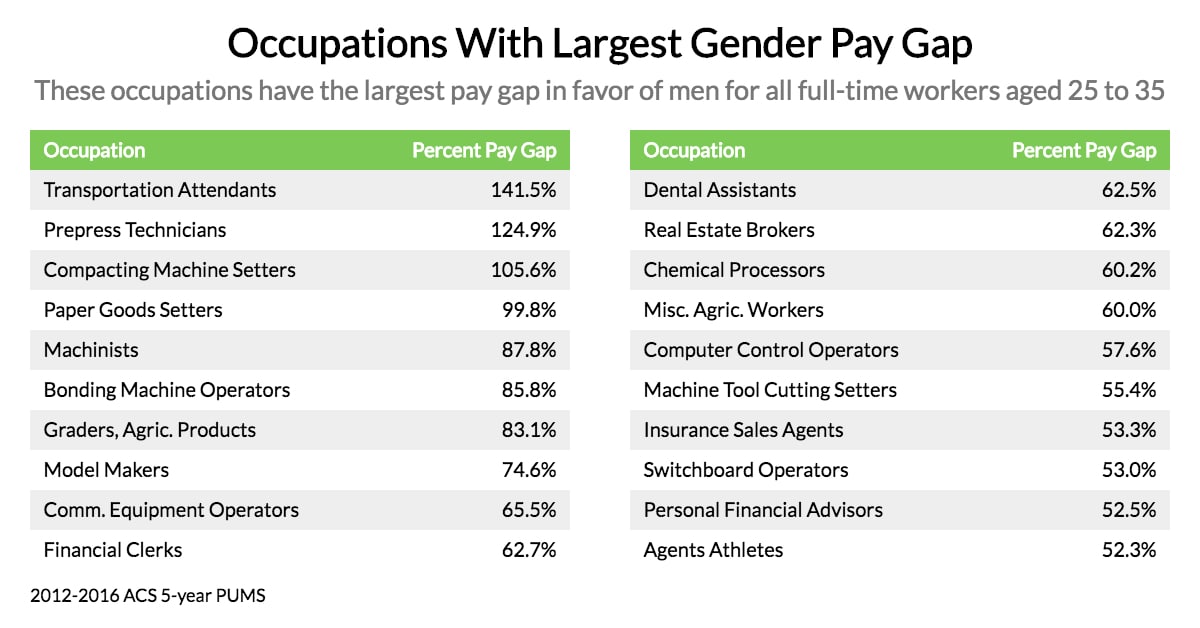
In examining these disparities, we focused on specific occupations that contribute significantly to the ongoing gender pay gap. For instance, male transportation attendants in this age group earn an average of $33,130, which is nearly $20,000 more than their female peers, who average just $13,716.
Here are some additional occupations notable for their substantial gender pay gaps:
Occupations With the Largest Gender Pay Gaps
- Transportation Attendants – 141.5%
- Prepress Technicians – 124.9%
- Compacting Machine Workers – 105.6%
- Paper Goods Machine Workers – 99.8%
- Machinists – 87.8%
- Adhesive Bonding Machine Operators – 85.8%
- Graders and Sorters of Agricultural Products – 83.1%
- Model Makers, Metal and Plastic – 74.6%
- Communications Equipment Operators – 65.5%
- Financial Clerks – 62.7%
Summary of Findings
- Male transportation attendants earn a remarkable 142% more than female transportation attendants ($33,130 vs. $13,716).
- Seven of the top ten occupations with the largest gender pay gaps are in the manufacturing sector.
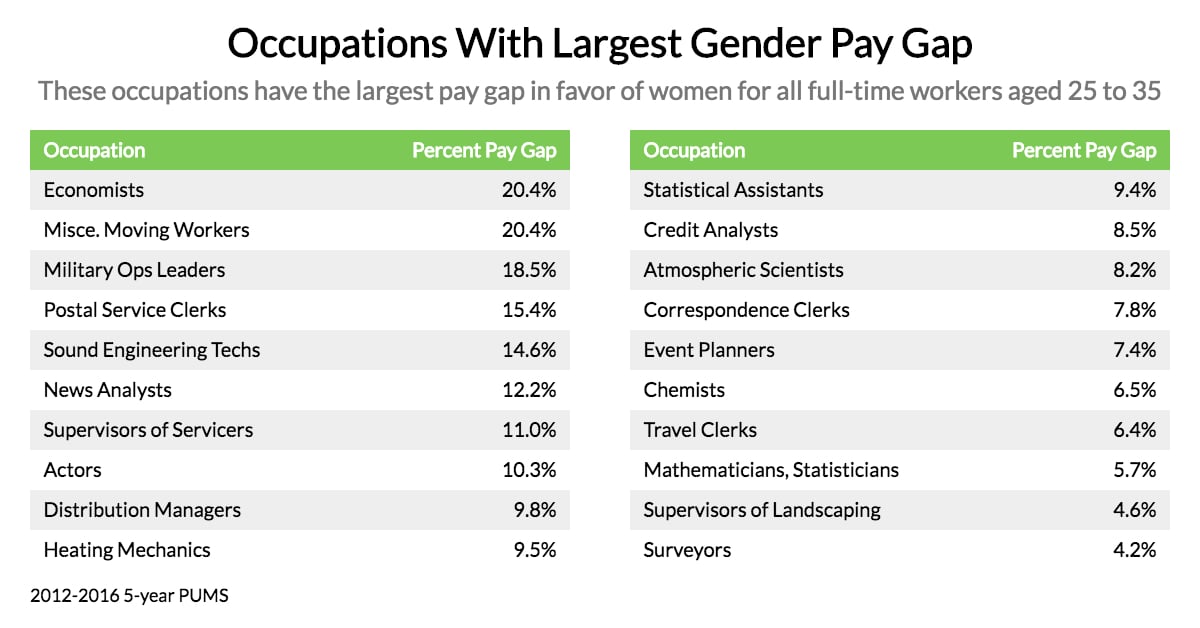
- Interestingly, in some roles such as economists and certain moving worker positions, women earn on average 20% more than their male counterparts.
- In three key occupations, men earn more than double that of women:
- Transportation Attendants – 141.5%
- Prepress Technicians – 124.9%
- Compacting Machine Setters – 105.6%
- Occupations where women earn more than men often feature a strong representation from STEM fields:
- Economists – 20.4%
- Statistical Assistants – 9.4%
- Atmospheric Scientists – 8.2%
- Chemists – 6.5%
- Mathematicians, Statisticians – 5.7%
In our analysis, we also examined occupations where women aged 25 to 35 earn more than their male counterparts.
Methodology
Our analysis utilized data from the American Community Survey’s PUMS database from 2017 to 2021 to identify occupations with the largest gender pay gaps for full-time workers aged 25 to 35. We focused solely on occupations with over 1,000 workers for both genders to ensure statistical relevance.
To calculate the pay gap, we determined the average income for each occupation by gender, then subtracted the female average from the male average to find the pay gap. This figure was divided by the female average to derive the percentage pay gap for men.
For example, the calculation for transportation attendants is as follows:
Male average income for the position: $33,130
Female average income: $13,716
Pay gap: $33,130 – $13,716 = $19,414
Percentage pay gap for men: $19,414 / $13,716 = 1.415 or 141.5%
A negative percentage indicates that women experience a higher average pay for that occupation. Our study highlights the top 20 positions exhibiting gender pay favoritism for both men and women.

Author

McLeod Brown is a former writer and researcher for the Zippia Career Advice blog. His work at Zippia focused on understanding the relationship between colleges, debt, and jobs. A graduate of the University of North Carolina at Wilmington with a BA in Business Administrator, he is now pursuing a masters of science in analytics from the Institute of Advanced Analytics.