- Facts and Figures
- Social Security Statistics
- Social Media Statistics
- Cell Phone Usage Statistics
- Cryptocurrency Statistics
- White Collar Crime Statistics
- Crowdfunding Statistics
- Branding Statistics
- How Many Emails Are Sent Per Day
- Money Laundering Statistics
- Childcare Availability Statistics
- Cold Calling Statistics
- Automation And Job Loss Statistics
- Student Loan Statistics
- Spam Statistics
- Password Statistics
- Ransomware Statistics
- Christmas Spending Statistics
- Average Grocery Cost By State
- Average Screen Time Statistics
- Average Monthly Expenses
- IoT Statistics
- Gen Z Statistics
Research Summary. We’ve all experienced that frustrating moment when we forget our passwords, and it can be even more troubling to recall the email account tied to those passwords. This common scenario has led to many individuals opting for similar or identical passwords across multiple accounts, a practice that may seem convenient but poses significant security risks.
How serious is the issue? Very serious. To shed light on password habits and their implications for data security, we’ve compiled crucial statistics about passwords. Our research reveals:
-
80% of hacking breaches are linked to password-related issues.
-
54% of employees admit to reusing passwords for both work and personal accounts.
-
On average, individuals maintain 100 passwords.
-
13% of Americans use the same password for all their accounts.
-
Approximately 23 million accounts are still secured with the password ‘123456.’
Reused Password Statistics
Many individuals find it challenging to remember multiple passwords, leading to widespread password reuse. Here are some telling statistics on this behavior:
-
52% of Americans use the same password for multiple (but not all) accounts.
This trend is driven by convenience, with 66% of individuals only changing their passwords in response to a security alert, potentially leaving other accounts vulnerable.
-
13% of Americans use the same password across all accounts.
This alarming statistic shows that if a hacker gains access to one account, they could easily infiltrate more sensitive ones, like bank accounts.
-
Only 35% of Americans do not reuse passwords.
This means that a significant 65% continue the risky practice of reusing passwords across various accounts.
Password reuse Share of Americans Reuse passwords on all accounts 13% Reuse passwords on multiple accounts 52% Don’t reuse passwords 35%
Weak Password Statistics
Weak passwords are a further concern, as they are easy to guess and compromise. Here’s what the data reveals:
-
59% of Americans incorporate their name or birthday in their passwords.
This suggests that many users not only have weak passwords but are also likely to reuse them across multiple accounts.
-
17% of Americans have successfully guessed someone else’s password.
This statistic highlights how simple it can be for hackers to access accounts using easily guessable passwords.
-
57% of individuals who have fallen victim to phishing still haven’t changed their passwords.
Despite the risks of password leaks, many individuals fail to update their compromised passwords.
-
‘123456’ is the most frequently used weak password.
In fact, 23 million accounts are secured with this password, among others like:
-
123456
-
123456789
-
12345
-
qwerty
-
password
-
12345678
-
111111
-
123123
-
1234567890
-
1234567
-
Password Behavior and Opinion Statistics
The inefficiencies and frustrations surrounding passwords contribute to the prevalence of weak security practices. Consider the following insights:
-
75% of Americans express frustration with passwords.
Many find the process of memorizing passwords tedious, with additional annoyance stemming from two-factor authentication and captcha requirements—48% and 71% of users, respectively, report frustration with those.
-
57% of individuals prefer passwordless account access.
Moreover, 70% choose passwordless options when available. Among businesses, 91% believe that transitioning to passwordless solutions is the future.
-
49% of Americans depend on their memory to manage passwords.
This is slightly less than the 59% of UK citizens and 55% of the global population who do the same.
-
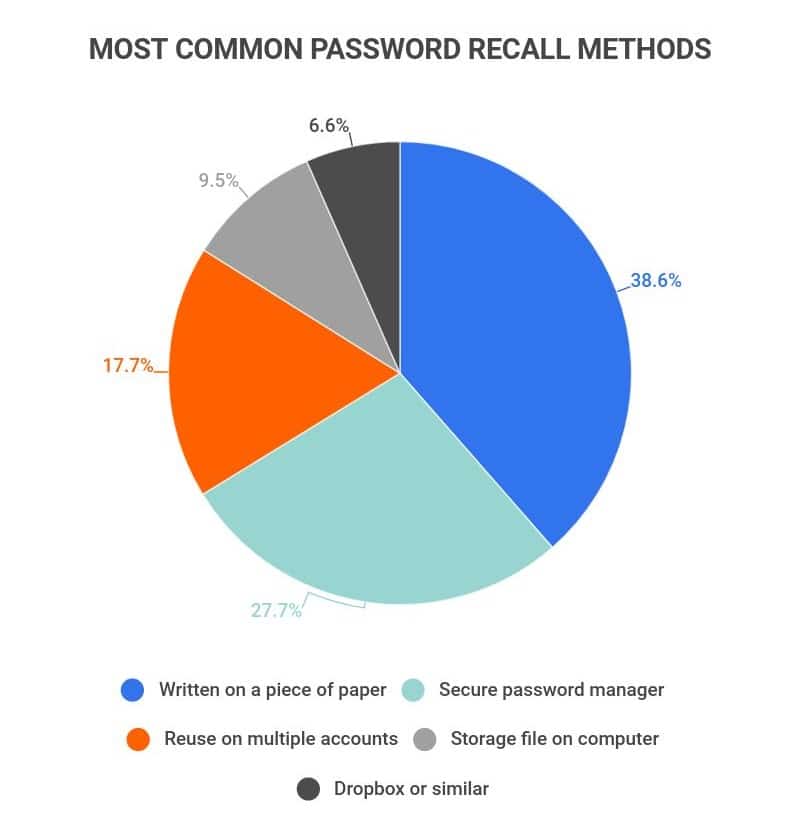
38.6% of individuals write their passwords down on paper.
In comparison, 27.7% utilize a secure password manager, while others rely on memory, store them on their computers, or use cloud services like Dropbox.
Password recall method Share of respondents Written on piece of paper 38.6% Secure password manager 27.7% Reuse on multiple accounts 17.7% Storage file on computer 9.5% Cloud storage (e.g., Dropbox) 6.6% -
78% of individuals have reset at least one password in the last 90 days due to forgetfulness.
This statistic underscores how common it is for people to forget passwords, necessitating frequent resets.
Workplace Password Statistics
Passwords in the workplace present heightened security risks, making strong security practices even more critical. Here are some essential insights:
-
Employees reuse passwords an average of 13 times.
This practice significantly increases the risk of a data breach, which can have costly repercussions for companies, employees, and consumers alike.
-
69% of employees share passwords with colleagues.
This practice can pose significant security risks, especially if former employees retain access to sensitive accounts.
-
81% of company data breaches result from poor password practices.
Weak or reused passwords can have devastating consequences, impacting not just the company but also its clients and stakeholders.
-
62% of employees have shared work passwords via text or email.
This method of sharing can lead to unintentional security breaches.
Password Statistics FAQ
-
What percentage of people reuse passwords?
65% of individuals reuse passwords. This figure includes 52% who reuse passwords on a limited number of accounts and 13% who use the same password across all accounts. Password reuse is particularly dangerous, as it is a common target for hackers, with passwords being involved in 64% of all data breaches.
-
What percentage of people have weak passwords?
83% of individuals utilize weak passwords. This includes the 59% of Americans who incorporate easily guessable personal information like names or birthdays.
Surprisingly, 17% of those who have attempted to guess someone’s password have succeeded, emphasizing the risks of weak passwords.
-
What are the most common passwords?
‘123456’ remains the most common password, used by at least 23 million accounts. In total, 24% of Americans use variations of weak passwords like ‘abc123,’ ‘password,’ and ‘qwerty.’ Other frequently used passwords include:
-
123456
-
123456789
-
12345
-
qwerty
-
password
-
12345678
-
111111
-
123123
-
1234567890
-
1234567
-
-
How many data breaches are caused by poor password security?
81% of data breaches in companies stem from inadequate password security. This includes weak passwords, password reuse, and sharing sensitive information. Given that employees reuse passwords an average of 13 times and 69% share passwords, the risks are substantial.
-
What is the strongest type of password?
The most secure passwords consist of at least 12 characters, including an uppercase letter, a number, and a symbol. Such passwords are deemed nearly unbreakable, taking an estimated 34,000 years for a computer to crack.
To efficiently manage these strong passwords, many individuals turn to secure password managers.
-
How common is it to forget a password?
Forgetting passwords is exceedingly common, with 78% of individuals resetting at least one password every 90 days due to forgetfulness. Shockingly, 21% forget their passwords within two weeks of creating them.
Many resort to writing down passwords, which introduces its own security risks, underscoring the benefits of using a secure password manager.
Conclusion
Password security remains a critical issue; with 65% of Americans reusing passwords and many relying on weak passwords, hackers find it remarkably easy to gain unauthorized access. As of 2022, 81% of company data breaches were attributed to poor password practices, emphasizing the need for improved security measures.
Although managing passwords can be frustrating, prioritizing password security is essential. This can be achieved by creating robust passwords that include at least 12 characters, an uppercase letter, a number, and a symbol, while avoiding reuse and sharing.
We strongly recommend utilizing a secure password manager to efficiently manage and store your passwords, reducing the likelihood of forgetfulness and enhancing your overall security.
References
-
Cloudnine – Over 80 Percent of Hacking Related Breaches Were Related to Password Issues: Cybersecurity Trends
-
Help Net Security – 54% of all employees reuse passwords across multiple work accounts
-
Earthweb – How many passwords does the average person have in 2022?
-
WorkSmart – 59% of Americans Use a Name or Date of Birth in Their Passwords
-
Tom’s Guide – Here’s 2022’s worst passwords — don’t use any of these
-
New York Post – Americans are sick and tired of passwords and security questions
-
Security – 70% of Consumers Choose Passwordless MFA Login Over Traditional Usernames and Passwords
-
Security – 92% of businesses believe going passwordless is the future
-
Help Net Security – 55% of people rely on their memory to manage passwords
-
Digital Guardian – Uncovering Password Habits: Are Users’ Password Security Habits Improving? (Infographic)
-
Help Net Security – 78% of people forgot a password in the past 90 days
-
PassCamp – Employees reuse passwords 13 times, on average. What can you do?
-
Betanews – 69 percent of employees share passwords with colleagues
-
CybersecurityDive – Employees can’t quit habit of writing down, sharing passwords
- Facts and Figures
- Social Security Statistics
- Social Media Statistics
- Cell Phone Usage Statistics
- Cryptocurrency Statistics
- White Collar Crime Statistics
- Crowdfunding Statistics
- Branding Statistics
- How Many Emails Are Sent Per Day
- Money Laundering Statistics
- Childcare Availability Statistics
- Cold Calling Statistics
- Automation And Job Loss Statistics
- Student Loan Statistics
- Spam Statistics
- Password Statistics
- Ransomware Statistics
- Christmas Spending Statistics
- Average Grocery Cost By State
- Average Screen Time Statistics
- Average Monthly Expenses
- IoT Statistics
- Gen Z Statistics

Author

Jack Flynn is a writer for Zippia. In his professional career he’s written over 100 research papers, articles and blog posts. Some of his most popular published works include his writing about economic terms and research into job classifications. Jack received his BS from Hampshire College.