Find a Job You Really Want In
In today’s competitive job market, navigating the application process can be overwhelming. While the internet has simplified job searches and application submissions, receiving a response — even a rejection — remains a challenge. Currently, it’s a candidate-driven market, with corporate job postings attracting an average of 250 applications within just 200 seconds of being listed.
To understand the nuances of hiring discrimination, we analyzed a database of approximately 7.5 million resumes to determine whether the format of a resume influences hiring decisions. Our findings reveal that resume format indeed plays a significant role, with hiring managers often favoring “masculine” styles over those that are more traditionally structured and error-free.
What do we mean by “masculine”? This term refers to observable differences in how male and female candidates typically format their resumes. Key variables we examined include:
- Time spent at each job
- Months between jobs
- Character count
- Word count
- Jobs listed
Here’s a closer look at the data that led us to conclude why “Alex” might secure a position while “Alexandria” does not.
Men’s Resumes Tend to Be More Erratic and Have More Mistakes
Unfortunately, recruiters often look for reasons to eliminate candidates. In our study, we first assessed what constitutes the average resume.
While the median statistics were similar across genders, men typically displayed greater variability. This indicates that while the averages and medians may favor women, men are more represented at the extremes of the distribution.
Time Spent on the Job
Male median: 15 months
Female median: 13 months

Months Between Jobs
Male median: 0
Female median: 0

Character Count
Male median: 1216
Female median: 1174

Word Count
Male median: 494
Female median: 482

Jobs Listed
Male median: 4
Female median: 4

This Isn’t Necessarily Risk-Taking; It’s Rule-Breaking
While it may appear that men are more inclined to take risks, it could be that they are simply more willing to break resume norms. However, deviating too far from established guidelines can be detrimental, as career experts caution against excessive rule-breaking. Our analysis indicates that men tend to make nearly twice as many spelling and grammatical errors compared to women.
A Question of Format
Men may deviate from traditional formatting norms and make more mistakes, but our observations also align with findings regarding tech resumes — women’s resumes often feature a more colorful and verbose style, which can be less objective and concise.
- Despite having higher character and word counts, men provide more specific details about their past job experiences.
- Men are significantly more likely to utilize bulleted lists, while women often include personal statements or executive summaries.
- A notable portion of women include non-traditional sections such as personal attributes, a practice adopted by only 3 percent of men.
And This, at Least, Is a Good Thing
This discrepancy is crucial, as research indicates that hiring managers do not spend the full five minutes they claim to review resumes — often, it’s just six seconds.
Laszlo Bock, former head of HR at Google, advises that candidates should succinctly present accomplishments in a format that emphasizes results:
“For all your accomplishments, use the format ‘Accomplished X by doing Y as measured by Z.’”
This approach aids recruiters in quickly identifying key qualifications and relevant information. According to an ERE study, a skimmable resume enhances its evaluation by 60 percent.
Obvious Gender Discrimination Exists in Hiring, but Formatting Discrimination Is More Subtle
A recent article in Fortune highlights the experience of Erin McKelvey, who struggled to land a tech job until she altered her resume to feature the more masculine name “Mack.”
Similarly, a linguistics PhD found that identical resumes for fictional candidates, “John” and “Jennifer,” revealed that both male and female hiring managers favored “John,” often offering him higher salaries.
These examples illustrate a tendency to discriminate against feminine and ethnic names; however, it’s important to note that while the names changed, the resumes’ formatting remained constant.
Blind Hiring Might Not Be the Answer
To combat gender-based discrimination, some companies have adopted blind hiring practices — removing identifying information from applications to enhance diversity.
However, a study by the Australian government indicated that blind hiring can be counterproductive, as it found that the removal of names reduced the likelihood of women being shortlisted for positions.
Female Applicants’ Methods Are Discriminated Against
Name-based discrimination in hiring is a well-documented issue. Our study does not dispute this; rather, it suggests that traditionally feminine communication styles and application methods may disadvantage women in the hiring landscape.
Research shows that men will apply for jobs when they meet only 60 percent of the qualifications, whereas women tend to apply only if they meet 100 percent.
Consider this graph from the Harvard Business Review:
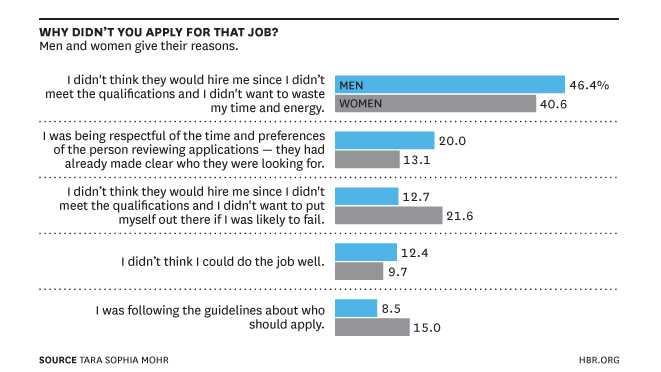
It is revealing that three factors account for 78% of barriers faced by women in applying for jobs, primarily related to perceptions of job qualifications as genuine requirements.
This suggests that women do not simply lack confidence; rather, they need better insights into how hiring processes function:
“What held them back from applying was not a mistaken perception about themselves, but a mistaken perception about the hiring process… women don’t need to try and find that elusive quality, ‘confidence’; they just need better information about how hiring processes really work.”
The variations in resume writing styles indicate that women face an additional challenge — the current norms in the HR industry often favor masculine writing styles.
Some Tips on What Matters on Resumes for Both Men and Women
There are essential rules that all candidates should adhere to when crafting their resumes. Here are some statistics on what to avoid:
- 61 percent of recruiters will dismiss a resume containing typos.
- 43 percent will reject applications for spelling errors.
- 76 percent will eliminate candidates with unprofessional email addresses.
It can be challenging to define what constitutes an “unprofessional” email address, but generally, if you created it in high school, it’s best to avoid using it post-graduation.
Ultimately, the most crucial aspect for all candidates is to diligently proofread their resumes and seek feedback from others to catch unclear phrases and ideas — and, as our study indicates, consider using bullet points for clarity.

Author

David Luther was the Content Marketing Editor for the Zippia Advice blog. He developed partnerships with external reporting agencies in addition to generating original research and reporting for the Zippia Career Advice blog. David obtained his BA from UNC Chapel Hill.