- Job Seeker Statistics
- Career Change statistics
- Internship Statistics
- Job Search Statistics
- Average Number Of Jobs Applied
- Average Salary Increase When Changing Jobs
- Part Time Job Statistics
- Age Discrimination Statistics
- Networking Statistics
- Interview Statistics
- Average Number of Jobs In A Lifetime
- Resume Statistics
- Side Hustle Statistics
- Teacher Statistics
Research Summary. With each job opening receiving hundreds of applications, job seekers often need to submit numerous resumes before landing an interview. This highlights the importance of having a professionally crafted resume and leveraging your professional network to enhance your hiring prospects. Our data analysis team has conducted thorough research and found the following:
-
Online job openings receive over 250 resumes each, with IT positions averaging around 386 applications.
-
Hiring managers typically spend an average of 6 seconds reviewing a resume.
-
Only about 2% of submitted resumes lead to an interview.
-
On average, job seekers need to send between 50 to 100 resumes to secure a job.
-
10% of applicants have submitted over 50 applications without receiving any feedback.
-
Approximately 85% of job openings are filled through networking rather than job boards.
-
Candidates who are referred are twice as likely to be interviewed and four times more likely to be hired.
-
A professionally written resume can increase your earning potential by 7% to 32%.
-
68% of job seekers who work with a professional resume writer find employment within 90 days.
-
63% of recruiters cite talent shortages as their biggest challenge in finding qualified candidates.
For further insights, we have analyzed the data in the following categories:
Formatting | Additional Format Statistics | Rejection | Cover Letters | Social Media | Job Title

Resume Formatting Statistics
Because recruiters and hiring managers dedicate limited time to each resume, it’s crucial to create one that is clear, concise, customized, and well-organized. If you have substantial work experience, consider a two-page format.
-
The average resume contains 489 words, with around 380 words typically being the threshold for a single-page resume.
-
Nearly 24% of hiring managers spend less than 30 seconds reviewing a resume.
-
63% of recruiters prefer resumes that are tailored to the specific job opening, which means it’s essential to customize your resume for each application.
-
Eye-tracking studies indicate that resumes that stand out to recruiters often feature: simple layouts, a clear overview section (like a summary or objective), and legible fonts.
-
77% of employers believe that experienced candidates should not limit themselves to a single-page resume.
-
Data indicates that recruiters are 2.9x more likely to select a candidate with a two-page resume for managerial positions and 1.4x more likely for entry-level roles.
-
However, 17% of hiring managers view a two-page resume as a deal-breaker.
-
Not including a professional skills list can negatively impact your resume as much as one year of unemployment.
-
It’s advisable to use a heading statement that highlights your value proposition.
-
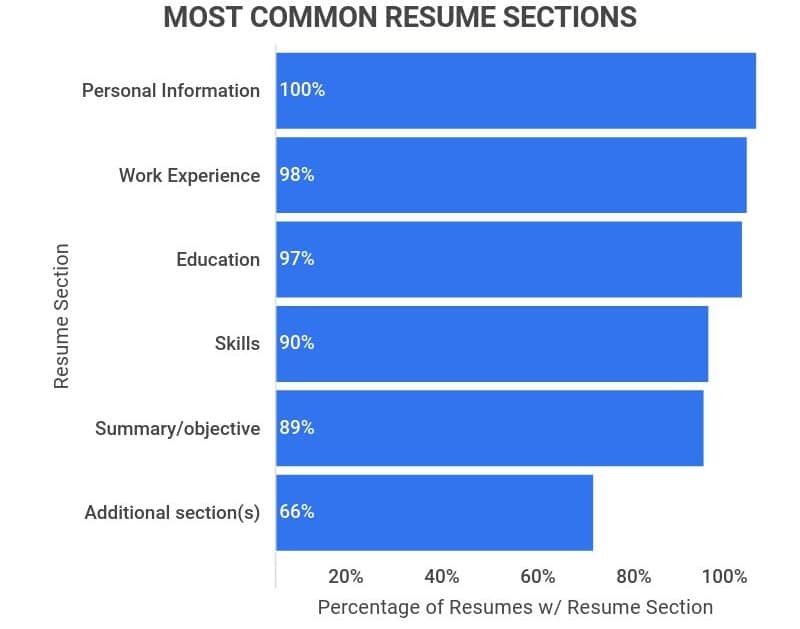
Most modern job seekers include at least one “additional” section to substantiate their qualifications.
Additional Resume Format Statistics
-
61% of hiring managers consider customizing your resume the top strategy for improving job application success. This includes adding a cover letter, addressing the hiring manager directly, and linking to an online portfolio, blog, or personal website.
-
However, 40% of recruiters express dissatisfaction with excessive design elements in resumes.
-
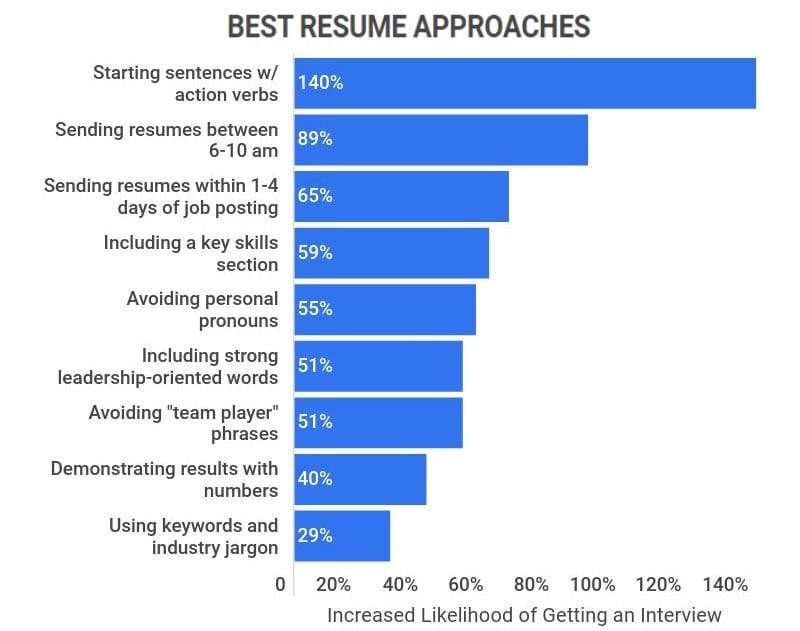
The most effective resume strategies include beginning sentences with action verbs (140%), submitting resumes between 6 a.m. and 10 a.m. (89%), applying within one to four days of the job posting (65%), including a key skills section (59%), avoiding personal pronouns (55%), emphasizing strong leadership language (51%), steering clear of “team player” clichés (51%), demonstrating results with quantifiable metrics (40%), and incorporating relevant keywords and industry-specific terminology (29%).
-
Job descriptions average 21.8 skills listed, while resumes typically showcase only about 13 skills.
-
Research indicates that hiring managers respond more favorably to resumes without ethnic identifiers.
-
77% of employers highlight the importance of soft skills, with 16% believing they are more crucial than hard skills.
-
43% of resumes are submitted in file formats that are not compatible with ATS software.
Percent Of Recruiters That Dislike Certain Clichés
| Cliché | Percent of Recruiters That Dislike It |
|---|---|
| Work independently | 47% |
| Hard Worker | 42% |
| Work well under pressure | 39% |
| Good communicator | 36% |
| Enthusiastic | 35% |
| Team player | 32% |
| Good listener | 28% |
| Excellent written communication skills | 24% |
| Proactive | 22% |
| Good problem solver | 19% |
Resume Rejection Statistics
Many resumes fail to pass through applicant tracking systems (ATS). Those that do often face rejection due to generic applications, absence of a thank you note, and lack of job-specific customization.
-
Up to ¾ of large companies (including approximately 98.8% of Fortune 500 firms) utilize ATS to automatically sort, scan, and rank resumes based on keywords, with many resumes not making it through this software.
-
About ¾ of qualified applicants have been rejected by ATS due to unreadable resumes.
-
5% of applicants are dishonest regarding their prior roles or tenure. 75% of human resources managers have identified inaccuracies on resumes.
-
Recruiters spend an average of 3.14 minutes reviewing a candidate’s resume, often making decisions within the first minute. 40% of hiring managers take less than a minute to assess a resume.
-
59% of recruiters reject candidates due to poor grammar or spelling mistakes.
-
Over 50% of recruiters will dismiss a candidate if their resume is filled with clichés.
-
1 in 5 recruiters will eliminate a candidate before fully reading their resume.
-
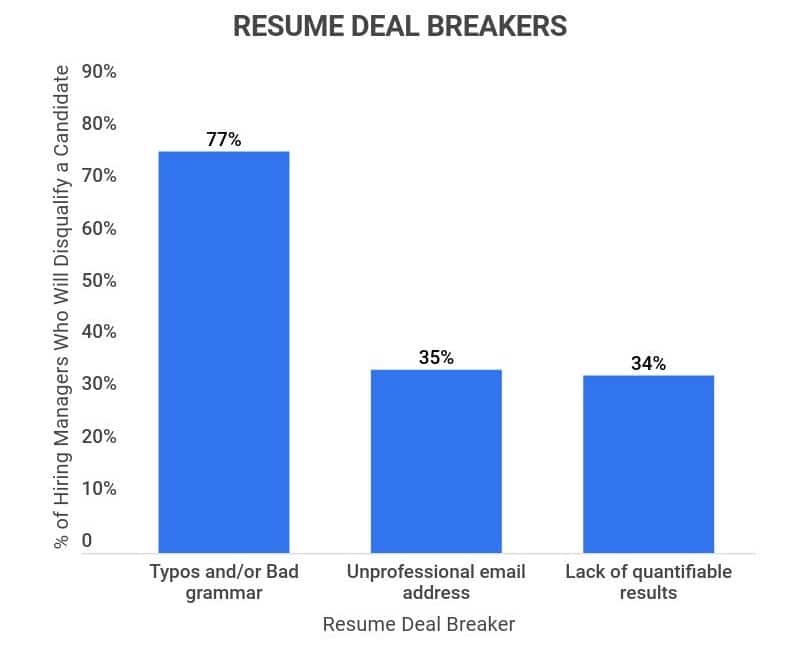
The most common resume deal breakers for hiring managers include: Typos or grammatical errors (77%), unprofessional email addresses (35%), lack of quantifiable results (34%).
-
Recruiters report that the leading reasons for rejecting a resume include: impersonal applications (84%), absence of a thank you note (57%), and insufficient resume customization (54%).
-
36% of resumes are rejected for being overly generic, 35% for failing to list relevant skills, 32% for excessively mirroring job descriptions, 27% for neglecting to include exact employment dates, and 13% for featuring a photo.
Resume Statistics Related to Cover Letters
Cover letters are crucial for a successful job search. This is why nearly half of job seekers write them, with many recruiters considering them essential.
-
Nearly half (47%) of job seekers take the time to write cover letters.
-
Over ¼ (26%) of recruiters always read cover letters and deem them vital for making hiring decisions.
-
Up to 38% of hiring managers feel that including a cover letter increases their attention to the application.
-
Almost half (45%) of recruiters state that a lack of a cover letter could lead to application rejection.
-
Nearly 70% of employers prefer cover letters that are half a page or shorter.
Resumes and Social Media Statistics
Social media profiles play a crucial role in the job application process, especially when your resume passes through ATS and reaches a recruiter or hiring manager.
-
A complete, updated LinkedIn profile is essential, as 77% of recruiters use the platform to find qualified candidates.
-
More than 90% of employers utilize social media to identify new talent.
-
Even with a high-quality resume, 54% of employers have rejected candidates based on their social media profiles.
Resume Statistics by Position
While we cannot cover the specifics for every industry, our data provides valuable insights for various positions. Here are some tips tailored for specific roles:
Accountant Resume Statistics
-
Essential resume sections include: Personal Information, Education, Work Experience, Skills, and Summary or Objective.
-
Common additional sections include: Languages, References, Software, Certificates, Interests, Courses, Additional Activities, Legal Clauses, Conferences, Licenses, and Publications.
-
The 10 most common accountant resume skills include:
-
Communication
-
Microsoft Excel
-
Microsoft Office
-
Time Management
-
QuickBooks
-
Teamwork
-
Microsoft Word
-
Problem Solving
-
Accounts Payable/Receivable
-
Adaptability
-
Administrative Assistant Resume Statistics
-
Essential resume sections include: Personal Information, Work Experience, Education, Skills, and Summary or Objective.
-
Common additional sections include: Languages, References, Software, Interests, Certificates, Additional Activities, Courses, Licenses, Conferences, and Publications.
-
The 10 most common administrative assistant resume skills include:
-
Communication
-
Salesforce
-
Time Management
-
Microsoft Office
-
Customer Service
-
Problem Solving
-
Organization
-
Microsoft Excel
-
Teamwork
-
Microsoft Word
-
Customer Service Representative Resume Statistics
-
Must-have resume sections include: Personal Information, Work Experience, Education, Summary or Objective, and Skills.
-
Common additional sections include: Languages, References, Certificates, Interests, Software, Additional Activities, Courses, Licenses, Conferences, and Publications.
-
The 10 most common customer service representative resume skills include:
-
Customer Service
-
Communication
-
Time Management
-
Problem Solving
-
Teamwork
-
Leadership
-
Adaptability
-
Microsoft Office
-
Multitasking
-
Organization
-
Data Scientist Resume Statistics
-
Must-have resume sections include: Personal Information, Work Experience, Education, Skills, and Summary or Objective.
-
Common additional sections include: Certificates, Additional Activities, Languages, Software, Interests, Publications, Courses, References, Conferences, and Licenses.
-
The 10 most common data scientist resume skills include:
-
Python
-
SQL
-
R
-
Machine Learning
-
Statistics
-
Tableau
-
Data Visualization
-
Spark
-
Microsoft Excel
-
SAS
-
Mechanical Engineer Resume Statistics
-
Must-have sections include: Personal Information, Education, Work Experience, Skills, and Summary or Objective.
-
Common additional sections include: Languages, Software, Certificates, Additional Activities, Interests, References, Courses, Publications, Licenses, and Conferences.
-
The 10 most common mechanical engineer resume skills include:
-
SolidWorks
-
Microsoft Office
-
AutoCAD
-
MATLAB
-
Teamwork
-
Leadership
-
Communication
-
Problem Solving
-
ANSYS
-
Project Management
-
Product Manager Resume Statistics
-
Must-have resume sections include: Work Experience, Personal Information, Education, Skills, and Summary or Objective.
-
Common additional sections include: Certificates, Software, Languages, Interests, Additional Activities, Courses, References, Publications, Conferences, and Licenses.
-
The 10 most common product manager resume skills include:
-
Agile
-
Product Management
-
Project Management
-
Leadership
-
JIRA
-
Scrum
-
Problem Solving
-
Strategic Thinking
-
Communication
-
SQL
-
Project Manager Resume Statistics
-
Must-have resume sections include: Personal Information, Work Experience, Education, Summary or Objective, and Skills.
-
Common additional sections include: Certificates, Languages, Software, Additional Activities, Interests, Courses, References, Licenses, Publications, and Conferences.
-
The 10 most common project manager resume skills include:
-
Project Management
-
Communication
-
Leadership
-
Microsoft Office
-
Microsoft Project
-
Problem Solving
-
Time Management
-
Risk Management
-
Strategic Planning
-
PMP Certification
-
Software Engineer Resume Statistics
-
Must-have resume sections include: Personal Information, Work Experience, Education, Skills, and Summary or Objective.
-
Common additional sections include: Languages, Additional Activities, Software, Certificates, Interests, Courses, References, Publications, Conferences, and Licenses.
-
The most common software engineer resume skills include:
-
Java
-
Python
-
JavaScript
-
SQL
-
C#
-
C++
-
Git
-
HTML
-
Node.js
-
CSS
-
Resume FAQ
-
What are 4 common resume mistakes?
The four common resume mistakes include typos or poor grammar, submitting a resume that isn’t tailored to the job description, failing to include quantifiable results (numbers), and using an unprofessional email address.
Even a single grammatical error can lead to a rejection from up to 20% of hiring managers and recruiters. Most of these mistakes can be avoided through careful proofreading, so ensure you review your resume multiple times before submission. Using tools like Grammarly or asking a friend for feedback can provide additional insights.
-
Is hiring a resume writer worth it?
Yes, hiring a resume writer is beneficial. Professional resume writers typically charge between $200 and $500, but the right service can lead to a starting salary that is at least $500 higher than what you might achieve without professional assistance.
-
No, a resume is distinct from a CV. A curriculum vitae translates to the “course of one’s life” and, in the US, is primarily used by academics, scientists, researchers, and certain government roles.
A CV encompasses every aspect of a person’s professional history, detailing projects, publications, conferences attended, speeches given, etc. It remains largely unchanged regardless of the application context, serving as a comprehensive document.
Conversely, a resume is a more concise document that focuses on relevant background and skills. In Europe, the term CV often refers to a resume-like document, so if you’re applying abroad and asked for a CV, your regular resume should suffice with minor adjustments.
-
What should I include in my resume?
Your resume should incorporate sections for contact information, work experience, education, skills, and a summary or objective statement. The work experience section should detail your job title, employment dates, and key accomplishments.
Your educational background should cover basic details (degree, GPA), but can also include additional experiences (projects, theses, extracurriculars) if you are a recent graduate.
Ensure your skills align closely with the qualifications mentioned in the job description. Your resume summary statement should highlight your years of experience and pertinent achievements.
-
How can I create a resume online?
Using Zippia’s resume builder, you can generate a professional-looking resume in under 15 minutes.
Conclusion
Crafting the ideal resume may seem daunting for many job seekers. Given that online job postings can attract over 250 applications, it’s understandable that hiring managers typically spend just 6 seconds on your resume.
Nevertheless, the manner in which you construct your resume can significantly influence your chances of being hired. Simple techniques, such as starting your resume with action verbs, can enhance your likelihood of securing an interview by 140%. Coupled with other strategies like optimal timing for submissions and the right skills to highlight, these elements can greatly impact whether an employer takes interest in your application.
References
The Undercover Recruiter. Top Resume Mistakes That Could Cost You the Job. Accessed 6/1/21.
The Motley Fool. 5 Resume Stats All Job Seekers Should Know. Accessed 6/1/21.
Roane State Community College. 10 Current Resume Trends Forecasts for 2020/2021 You Should Be Thinking About. Accessed 6/1/21.
Resume Valley. Current Resume Trends This 2021: The Future of Job Search. Accessed 6/1/21.
- Job Seeker Statistics
- Career Change statistics
- Internship Statistics
- Job Search Statistics
- Average Number Of Jobs Applied
- Average Salary Increase When Changing Jobs
- Part Time Job Statistics
- Age Discrimination Statistics
- Networking Statistics
- Interview Statistics
- Average Number of Jobs In A Lifetime
- Resume Statistics
- Side Hustle Statistics
- Teacher Statistics

Author

Chris Kolmar is a co-founder of Zippia and the editor-in-chief of the Zippia career advice blog. He has hired over 50 people in his career, been hired five times, and wants to help you land your next job. His research has been featured on the New York Times, Thrillist, VOX, The Atlantic, and a host of local news. More recently, he's been quoted on USA Today, BusinessInsider, and CNBC.