- Industry Statistics
- Wedding Industry Statistics
- Yoga Industry Statistics
- Music Industry Statistics
- Landscaping Industry Statistics
- Bicycle Industry Statistics
- Coffee Industry Statistics
- Car Rental Industry Statistics
- Home Improvement Industry Statistics
- Insurance Industry Statistics
- Supplements Industry Statistics
- Golf Industry Statistics
- Fitness Industry Statistics
- US Media And Entertainment Industry Statistics
- Firearm Industry Statistics
- Financial Services Industry Statistics
- Health And Wellness Industry Statistics
- Trucking Industry Statistics
- Wine Industry Statistics
- Pet Industry Statistics
- Mobile App Industry Statistics
- Digital Marketing Industry Statistics
- Hotel Industry Statistics
- Retail Statistics
- Robotics Industry Statistics
- Jewelry Industry Statistics
- Appointment Scheduling statistics
- Restaurant Industry Statistics
- Food Delivery Statistics
- Food Truck Industry
- Fashion Industry
- Real Estate Industry
- US Film Industry
- US Beverage Industry
- USu202fFast Food Restaurants
- US Construction Industry
- US Book Industry
- Cosmetics Industry
- US Food Retail Industry
- US Pharmaceutical Industry
- US Healthcare Industry
- Airline Industry
- Automobile Industry
- Transportation Industry Statistics
- Event Industry Statistics
- Project Management Statistics
- Oil And Gas Industry Statistics
- Nursing Home Statistics
- Nursing Shortage Statistics
- Nursing Statistics
25 Revolutionary Robotics Industry Statistics [2026]: Market Size, Growth, And Biggest Companies
Research Summary. Robots have become an integral component of modern industry and daily life, from performing surgeries to enhancing online customer interactions and streamlining manufacturing processes. Below are the key statistics reflecting the current state of the robotics industry:
-
88% of companies plan to invest in integrating robotics within their operations.
-
Approximately 3 million industrial robots are currently operational worldwide.
-
Annually, around 400,000 new robots are introduced to the market.
-
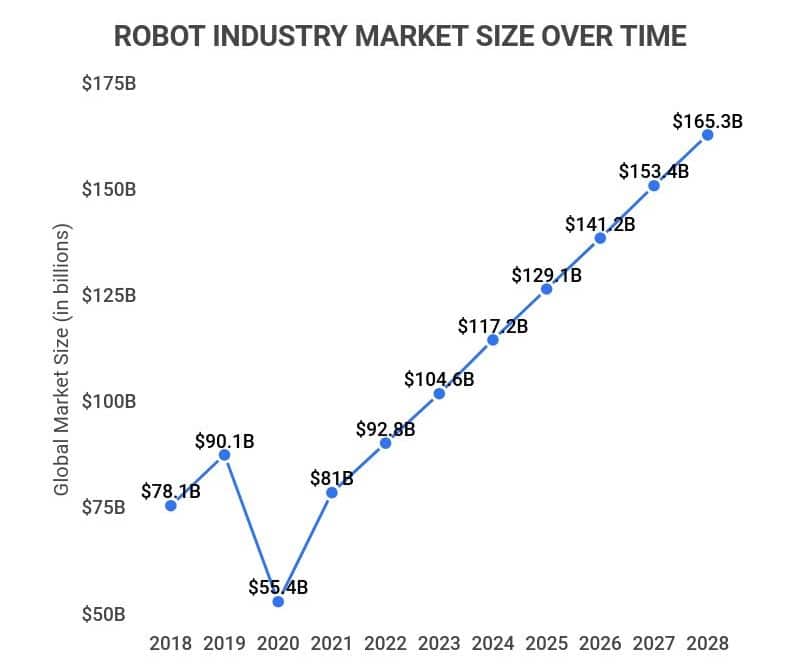
The global market value of the industrial robotics sector is estimated at $43.8 billion in revenue.
-
The North American robotics industry is projected to grow at a CAGR of 11.67% through 2026.
For a deeper dive into the data, we have categorized the information as follows:
Employer | Industry/Sector | Benefits and Challenges | Types | Trends and Projections
General Robotics Industry Statistics
-
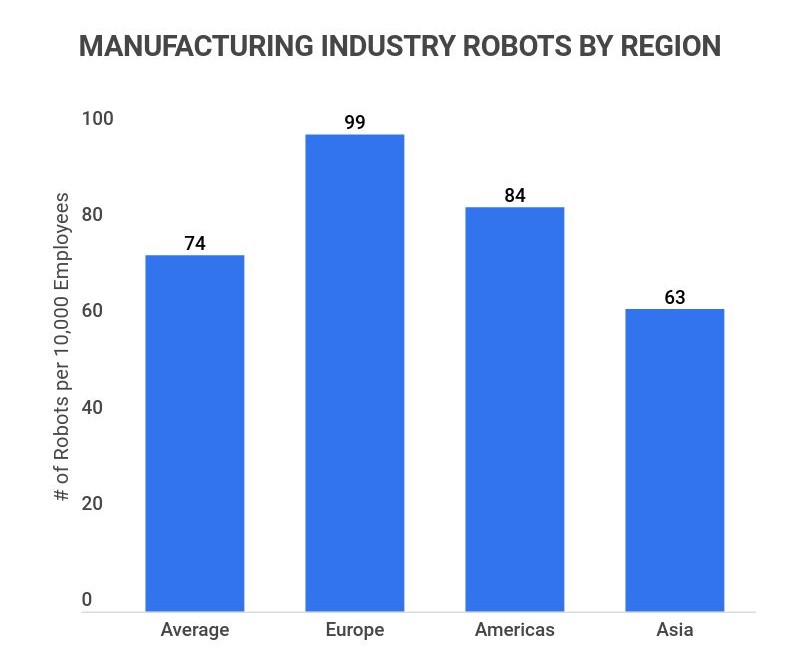
The average robot density in the U.S. stands at 228 units per 10,000 employees.
-
In 2021, the U.S. installed 34,987 industrial robots.
-
Globally, 517,385 industrial robots were installed in 2021.
Robotics Industry Employer Statistics
-
Honda Motor is the leading robotics company globally.
With a revenue of $142.4 billion and a workforce of nearly 220,000 employees, Honda is at the forefront of robotics innovation, including assistive robots for mobility and emotionally intelligent robots for human interaction.
-
There are approximately 132,500 robotics engineers in the U.S.
This field is projected to grow by 6.4% through 2026, with the highest concentration of robotics engineers found in California, Texas, Florida, Michigan, and Ohio.
-
Between March 2020 and March 2021, venture capitalists invested $6.3 billion in robotics companies.
This marks a significant increase from the previous year’s $4.3 billion investment, with $1.9 billion directed towards industrial robotics firms focusing on automation in warehouses, surgical procedures, and recycling systems.
Biggest Robotics Companies in the World
| Company | Revenue (In Billions USD) | Market Cap (In Billions USD) |
|---|---|---|
| Honda Motor | 142 | 42 |
| Siemens AG | 97 | 75 |
| Sony | 79 | 78 |
| Denso Corp | 47 | 227 |
| Midea Group | 39 | 52 |

Robotics Statistics by Industry/Sector
-
The automotive sector is the largest user of industrial robots.
As of 2017, this industry had nearly 900,000 robots, with numbers increasing annually. Following the automotive sector, the electrical and electronics industry employs around 600,000 industrial robots, and the plastics and chemicals industry has approximately 200,000.
Other significant industries utilizing robotics include:
-
Metal products
-
Other manufacturing sectors
-
Industrial machinery
-
Food and beverages
-
Basic metals
-
Glass and mineral products
-
Education/research/development
-
-
In 2021, the automotive industry installed 9,782 robotic units, while the metal and machinery sector saw an increase of 66% with 3,814 installations.
This represented a 7% decline in the automotive sector from the previous year, confirming its position as the second-highest demand for robots after electronics.
-
The U.S. Department of Defense allocated $7.5 billion for robotics in 2021.
This funding primarily supports unmanned vehicles across air, land, and sea, with 87% earmarked for the Navy, Air Force, Army, and Marine Corps, and the remaining 13% for specialized defense agencies.
Benefits and Challenges of Robotics Integration
-
Implementing robotics can save companies up to 20% in operational costs.
This figure has increased from 15.8% in 2016 and is expected to reach 22% by 2025.
-
By 2025, robots are projected to displace 85 million jobs while creating 97 million new opportunities.
This shift is anticipated to eliminate many entry-level roles, allowing for the creation of more creative and managerial positions for the workforce, particularly benefiting younger employees.
-
The high cost of robotic units remains a significant barrier for companies.
16% of respondents identified this as their most pressing challenge, with 53% citing it among their top five difficulties. Other challenges include the lack of standardized programming platforms and limited automation experience.
Types of Robotics
-
Industrial robots dominate the landscape.
These machines perform a wide array of tasks, from car manufacturing to surgical procedures.
-
55% of surveyed companies utilize collaborative robots.
These robots work alongside humans, complementing traditional industrial robots, which are used by 87% of firms, while 74% employ automated guided vehicles (AGVs), and 63% have robotic cells for tasks like packaging and assembly.
-
15.1% of all general surgeries were robot-assisted in 2018.
This figure, while modest, has risen significantly from 1.8% in 2012. The debate continues regarding the cost-effectiveness of robotic surgeries compared to traditional methods.
Robotics Industry Trends and Projections
-
The North American robotics industry is projected to maintain a CAGR of 11.67% from 2019-2026.
-
U.S. robot density has increased from 189 robots per 10,000 employees in 2016 to 228 in 2019.
-
2020 saw a slowdown in new robotic installations, declining by 8%, marking the second consecutive year of this trend after eight years of growth.
-
Global industrial robot shipments are expected to reach 518,000 in 2024, up from 394,000 in 2020.
-
Annual installations of industrial robots rose from 166,000 in 2011 to 517,000 in 2021.

Robotics Industry FAQ
-
What is the role of robotics in the Fourth Industrial Revolution?
The role of robotics in the Fourth Industrial Revolution is to provide innovative ways to integrate technology and human workforces. This revolution focuses on the convergence of technologies, where robotics will play a crucial role.
Technologies such as Robotics, Artificial Intelligence, Virtual Reality, Augmented Reality, and Unmanned Aerial Vehicles are increasingly interlinked, often functioning within a single robotic system.
-
Honda Motor, Siemens AG, Sony, Denso Corp., and Midea Group lead the robotics sector. These companies represent the highest revenues in the industry, with all but Siemens AG and Midea Group based in Japan.
In terms of annual industrial robot installations, China leads with 1.684 million installed in 2020, followed by Japan, the U.S., and Korea.
-
What jobs are going to be replaced by robots?
Repetitive and manual jobs are most susceptible to replacement by robots. While some jobs that require reasoning are also being automated, this is less common. Positions such as fast-food preparation, welding, driving, and basic customer service are among those at highest risk.
-
What are the five major fields of robotics?
The five major fields of robotics include operator interface, mobility or locomotion, manipulators and effectors, programming, and sensing and perception. Professionals in this field often specialize within one of these areas due to the complexity of robotics.
A collaborative team is typically required to design, build, and program robots, creating a wide range of job opportunities within the industry.
-
How big is the robotics industry?
The robotics industry is expansive, with around 3 million industrial robots in operation globally, contributing to an industry valued at $43.8 billion.
As production scales and automation becomes more cost-effective, the industry’s growth trajectory is expected to continue. This includes the potential displacement of 85 million jobs currently held by humans by 2025.
-
How fast is the robotics industry growing?
The robotics industry is experiencing rapid growth, with a projected CAGR of 11.67% from 2019 to 2026. By 2024, global shipments of industrial robots are anticipated to reach 518,000, up from 394,000 in 2020.
2021 marked a recovery in the industry, with new robot installations increasing from 8% to 13%, indicating a positive trend following previous declines.
-
Are robotics engineers in demand?
Yes, there is a strong demand for robotics engineers. These professionals are essential for designing prototypes, testing machinery, and maintaining software systems. The job market for robotics engineering is expected to grow by 6.4% through 2026, requiring an additional 12,500 engineers over the next decade.
Conclusion
Robots are increasingly vital to various industries, performing tasks such as manufacturing, precision welding, and even surgical procedures. The U.S. currently averages 228 robotic units per 10,000 employees, with thousands of new installations each year.
While it is projected that up to 85 million jobs could be displaced by robots by 2025, many experts believe this will ultimately lead to the creation of more complex and rewarding roles for the workforce.
Moreover, companies stand to benefit financially, potentially saving up to 20% in operational costs through automation. However, the high initial investment remains a significant hurdle for many organizations looking to adopt robotic technologies.
Globally, the trends indicate a robust increase in robotic installations, with 394,000 robots shipped in 2020 alone, positioning the industry for continued growth well into the future.
References
-
Statista. “Global Size of the Market for Industrial Robots Between 2019 and 2027.” Accessed on December 10, 2021.
-
International Federation of Robotics. “Robot Race: The World’s Top 10 Automated Countries.” Accessed on December 10, 2021.
-
International Federation of Robotics. “IFR Presents World Robotics 2021 Reports.” Accessed on March 7, 2023.
-
Global Newswire. “Future Growth: Global Industrial Robotics Market Expected to Generate a Revenue of $85.2 Million by 2026, Growing at a CAGR of 8.6% from 2019-2026.” Accessed on December 10, 2021.
-
Statista. “Worldwide Installations of Industrial Robots From 2004 to 2020, with a Forecast Through 2024.” Accessed on December 10, 2021.
-
Insider Monkey. “5 Biggest Robotics Companies in the World.” Accessed on December 10, 2021.
-
CareerExplorer. “The Job Market for Robotics Engineers in the United States.” Accessed on December 10, 2021.
-
Forbes. “Robotics Firms Garnered $6.3 Billion in Venture Funding During the Pandemic Year.” Accessed on December 10, 2021.
-
Federal Reserve Bank of St. Louis. “Which Countries and Industries Use the Most Robots?” Accessed on December 10, 2021.
-
National Defense. “Pentagon Gets $7.5 Billion for Unmanned Systems.” Accessed on December 10, 2021.
-
Business Wire. “Replacing Humans with Robots Will Result in a 21.85% Increase in Savings by 2020, Says Technavio.” Accessed on December 10, 2021.
-
Harvard Business Review. “Why Robots Won’t Steal Your Job.” Accessed on December 10, 2021.
-
McKinsey & Company. “Industrial Robotics: Insights into the Sector’s Future Growth Dynamics.” Accessed on December 10, 2021.
-
MedTech Dive. “Robotic Surgeries Surge to 15% of all Procedures, Despite Limited Evidence.” Accessed on December 10, 2021.
-
Cision. “The $13Bn Industrial Robotics Market in North America, 2026 – Experiencing a CAGR of 11.67% From 2019.” Accessed on December 10, 2021.
-
International Federation of Robotics. “Robot Density Rises Globally.” Accessed on December 10, 2021.
-
Medium. “The Role of AI and Robotics in the Fourth Industrial Revolution.” Accessed on December 10, 2021.
-
Robotics Technician Training Online Education Program. “Understanding the 5 Primary Areas of Robotics.” Accessed on December 10, 2021.
-
Robotics Technician Training Online Education Program. “Understanding the 5 Primary Areas of Robotics.” Accessed on December 10, 2021.
-
International Federation of Robotics. “World Robotics Report: ‘All-Time High’ with Half a Million Robots Installed in one Year.” Accessed on March 7, 2023.
- Industry Statistics
- Wedding Industry Statistics
- Yoga Industry Statistics
- Music Industry Statistics
- Landscaping Industry Statistics
- Bicycle Industry Statistics
- Coffee Industry Statistics
- Car Rental Industry Statistics
- Home Improvement Industry Statistics
- Insurance Industry Statistics
- Supplements Industry Statistics
- Golf Industry Statistics
- Fitness Industry Statistics
- US Media And Entertainment Industry Statistics
- Firearm Industry Statistics
- Financial Services Industry Statistics
- Health And Wellness Industry Statistics
- Trucking Industry Statistics
- Wine Industry Statistics
- Pet Industry Statistics
- Mobile App Industry Statistics
- Digital Marketing Industry Statistics
- Hotel Industry Statistics
- Retail Statistics
- Robotics Industry Statistics
- Jewelry Industry Statistics
- Appointment Scheduling statistics
- Restaurant Industry Statistics
- Food Delivery Statistics
- Food Truck Industry
- Fashion Industry
- Real Estate Industry
- US Film Industry
- US Beverage Industry
- USu202fFast Food Restaurants
- US Construction Industry
- US Book Industry
- Cosmetics Industry
- US Food Retail Industry
- US Pharmaceutical Industry
- US Healthcare Industry
- Airline Industry
- Automobile Industry
- Transportation Industry Statistics
- Event Industry Statistics
- Project Management Statistics
- Oil And Gas Industry Statistics
- Nursing Home Statistics
- Nursing Shortage Statistics
- Nursing Statistics

Author

Abby is a writer who is passionate about the power of story. Whether it’s communicating complicated topics in a clear way or helping readers connect with another person or place from the comfort of their couch. Abby attended Oral Roberts University in Tulsa, Oklahoma, where she earned a degree in writing with concentrations in journalism and business.