Find a Job You Really Want In
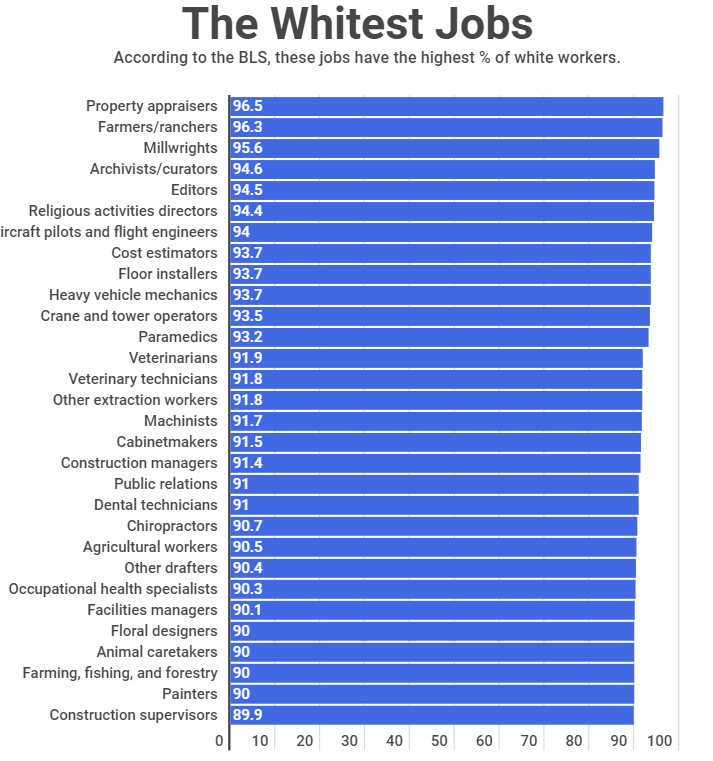
As of 2026, the landscape of the workforce remains predominantly white, with the Bureau of Labor Statistics (BLS) reporting that 78% of employees identify as white. Despite this, the ongoing racial pay gap highlights persistent inequities that hinder workers of color from accessing certain professions.
Utilizing the latest data from the BLS, we’ve identified the jobs with the highest and lowest percentages of white workers, providing insight into current workforce demographics.
Key Findings
- Property appraisers lead the list with an overwhelming 96.5% of workers identifying as white, marking it as the job with the highest percentage of white employees.
- Following closely, farmers and ranchers also showcase a high percentage, with 96.3% being white.
- White-collar trades and supervisory roles dominate the “whitest jobs,” highlighting a trend in traditional employment sectors.
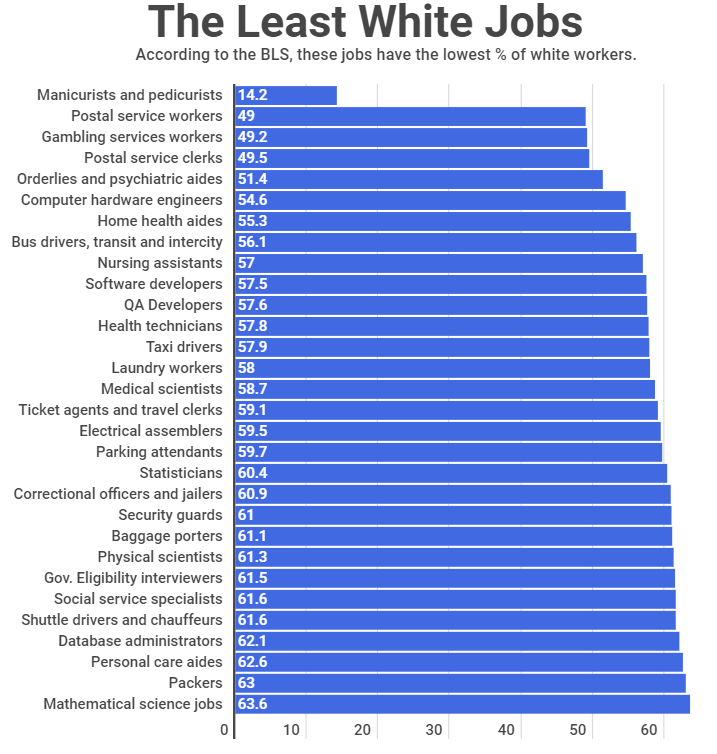
- Conversely, several government positions, such as those in postal services, exhibit greater diversity, signaling the effectiveness of recent diversity initiatives.
- Manicurists and pedicurists represent a workforce largely composed of individuals from diverse backgrounds.
- Interestingly, while many professions with the fewest white workers tend to be lower-paying, some high-paying roles, like Software and QA Developers, are notably diverse.
Below is a chart illustrating the jobs with the fewest white workers.
Methodology
The data presented here draws from the BLS’s most recent report on occupational racial demographics. We organized the information by the percentage of white workers to highlight both the “whitest jobs” and those with the least representation of white employees.
Understanding the Significance of This List
According to a recent CNBC Workforce Survey, 80% of employees expressed a preference for working at companies that prioritize diversity, equity, and inclusion. Nonetheless, many organizations and sectors still face challenges in achieving true representation.
While geographical factors and other benign influences contribute to the racial compositions of various professions, systemic issues such as access to education and workplace discrimination play a significant role in shaping employment outcomes.
There exists a clear demand for increased diversity across many sectors. However, without deliberate actions from all stakeholders, progress may be slow and insufficient.

Author

Kathy is the head of content at Zippia with a knack for engaging audiences. Prior to joining Zippia, Kathy worked at Gateway Blend growing audiences across diverse brands. She graduated from Troy University with a degree in Social Science Education.