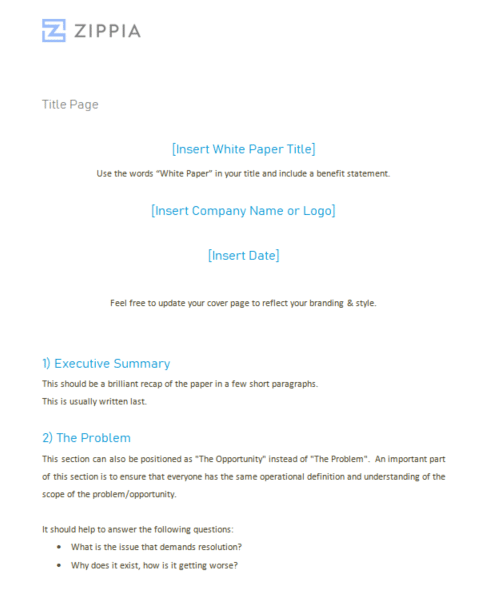
A white paper is a comprehensive and authoritative document that addresses a specific issue while presenting a solution. These documents serve as essential marketing tools for businesses to educate, inform, and influence their target audience on relevant topics.
By clicking Download, you agree to Zippia’s Privacy Policy and Terms of Use.

How to Create a White Paper
-
Define Your Audience. Identify who your readers are and what information they seek.
-
Identify a Problem. Focus on an issue that resonates with your target audience and aligns with your business goals.
-
Propose a Solution. Present a unique and meaningful solution to the identified problem.
-
Present Facts and Figures. Support your arguments with credible research, data, and statistics.
-
Maintain Professionalism. Ensure an authoritative and informative tone throughout the document.
-
Revise and Proofread. Review the document for clarity, coherence, and grammatical accuracy.
How to Utilize a White Paper Template
White paper templates streamline the writing process by providing a consistent format and style. To effectively use a white paper template:
-
Choose a template that aligns with your content and brand identity.
-
Follow the provided structure, incorporating your own research and findings.
-
Customize the template with your company’s logo, colors, and branding elements for consistency.
-
Keep your audience’s needs in mind, ensuring the content is engaging and accessible.
White Paper FAQs
-
What is the purpose of a white paper? The primary goal of a white paper is to educate the reader about a complex issue while articulating the organization’s perspective on the subject.
-
Do white papers need to be long? Not necessarily. The quality of the content is more important than the length of the document.
-
How detailed should a white paper be? A white paper should be comprehensive and provide thorough research, facts, and figures to back up the proposed solution.

Author

Matthew Zane is the lead editor of Zippia's How To Get A Job Guides. He is a teacher, writer, and world-traveler that wants to help people at every stage of the career life cycle. He completed his masters in American Literature from Trinity College Dublin and BA in English from the University of Connecticut.