
Automatically apply for jobs with Zippia
Upload your resume to get started.
Advisory system engineer skills for your resume and career
15 advisory system engineer skills for your resume and career
1. Technical Support
Technical support or tech support are the services provided by any hardware or software company to users. They help in solving the technical difficulties the customers face with their products or services. Moreover, the tech support employees maintain, manage, and repair the IT faults. They are also responsible for resolving the network problems, installing and configuring hardware and software.
- Developed and implemented a web based trouble ticket system which greatly improved technical support response time, prioritization and tracking.
- Spearheaded customer briefings, hardware configuration reviews, technical support, and solutions architecture for sales and technical consultant teams.
2. EMC
- Reviewed schematics and PCB physical designs with EMC, Mechanical and Component teams to ensure the design met corporate standards.
- Collaborated with ecosystem partners to drive EMC VSPEX/ Cisco Systems UCS in the two largest accounts in Maine.
3. SAN
SAN abbreviation for storage area network is a computer network that provides storage access.
- Designed large-scale storage solutions using SAN, NAS, CAS and REST by leveraging and developing relationships with customer engineering staff.
- Supported maintenance of DMS at NAVCOMTELSTA, San Diego, CA, which required support of Area Control Center personnel.
4. NAS
A NAS (Network Attached Storage) is a storage device connected to a network that allows storage and recovery of data from a centralised location for users on an authorized network. Comparable to a private cloud NAS provides the benefits of an on-site public cloud but is faster and less expensive. Offering tremendous competitive advantages, it also provides increased levels of customer service and extends collaborative reach across a project. Effortless to operate NAS, provides granular security features along with uncomplicated data backup and, recovery making it a must-have for data management.
- Tested and evaluated emerging technologies, including WAN networks and Network Attached Storage (NAS) technologies.
- Performed backup testing on NAS product using VERITAS Backup Exec software and the Windows 2000 Advanced Server embedded backup software.
5. Linux
Linux is a Unix-like operating system. Just like Windows, Mac OS, and IOS, Linux is an operating system used by millions across the globe. Android itself is powered by the Linux operating system. Linux manages all the hardware resources that are associated with your computer. The software is famous because of the protection it grants from viruses, malware, and crashes. The Linux operating system is entirely free and is an open-source software meaning it can be altered by those equipped with the knowledge to code.
- Cross platform performance analysis, architectural sizing to include Unix, Linux, Windows and Mainframe application stacks.
- Led in-house and consultant team in large-scale Linux server upgrade for multinational consulting firm, which significantly enhanced system performance.
6. Customer Satisfaction
- Assisted the CE team in the installation of these systems which were completed without incident and resulted in high customer satisfaction.
- Improved customer satisfaction with customers by 25% in the area of VM/XA, MVS/XA and VSE/ESA support.
7. Technical Solutions
- Developed significant expertise in building customer alliances, team collaboration, and efficient problem-solving skills with business minded and technical solutions.
- Documented requirements and service level agreements and then presented candidate technical solutions to upper management.
8. Virtualization
- Deployed Microsoft Hyper-V virtualization technology in remote supported client environments.
- Developed and maintained the internal IT infrastructure, which leveraged virtualization and clustering using Hyper-V.
9. Technical Leadership
- Provide technical leadership and direction to customers and internal staff.
10. Pre-Sales
- Delivered pre-sales storage demonstrations / presentations to customers & partnering clients.
- Maintained a smooth transition from pre-sales activity to solution development.
11. Unix
UNIX is a computer operating system that was first created in the 1960s and has been constantly updated since then. The operating system refers to the set of programs that enable a machine to function. It is a multi-user, multi-tasking device that works on computers, laptops, and servers. UNIX systems also have a graphical user interface (GUI), similar to Microsoft Windows, that makes it simple to use.
- Implement multiple TSI applications in a SUN E1000 server consisting of 4 domains * UNIX system administrator for eight servers.
- Created READ ONLY account(s) for users and investigated all UNIX security issues on the production environment.
12. TCP/IP
- Implemented and managed IP Addressing; configured TCP/IP addressing on a servers and workstations.
- Performed installation (racking/cabling/patch panel/switch), configuration, test, application install, and TCP/IP routing.
13. Database
A database is a collection of data and information which makes it easy to view, access, and manage. Databases save a lot of time and can store huge amounts of data. Databases make sorting data easier and stores it in certain fields which narrows the searching criteria. A database usually contains tables, graphs, and columns to display data.
- Evaluated impact of adaptation modifications to an Oracle database system and made changes/updates as necessary in accordance with customer requirements.
- Prepared shell scripts for automation of pro-active monitoring and database administration tasks.
14. Software Development
Software development is the mechanism by which programmers create computer programs. The Software Development Life Cycle (SDLC) is a framework for developing applications that follow technological needs and consumer requirements. It consists of many stages. The SDLC establishes an international standard that software developers can use to enhance and create their programs. It provides a well-defined framework for software developers to pursue in the production, maintenance, and design of premium quality software. The aim of the software development process is to create high-quality software on time and within budget.
- Developed and delivered technical training classes on software development and PC networking.
- Directed all phases of software development life cycle through product acceptance for 100 person team.
15. Problem Resolution
A problem resolution refers to how a person identifies the problem, determining its cause, creating a reasonable solution, and implementing a conclusion. With the help of a client specialist, it is easier to handle such a situation. Problem resolution plays a vital role in helping resolve problems efficiently and effectively.
- Perform infrastructure problem resolution and assist in the development and documentation of technical standards.
- Coordinated post deployment support and problem resolution for all deployments.

What skills help Advisory System Engineers find jobs?
Tell us what job you are looking for, we’ll show you what skills employers want.
List of advisory system engineer skills to add to your resume
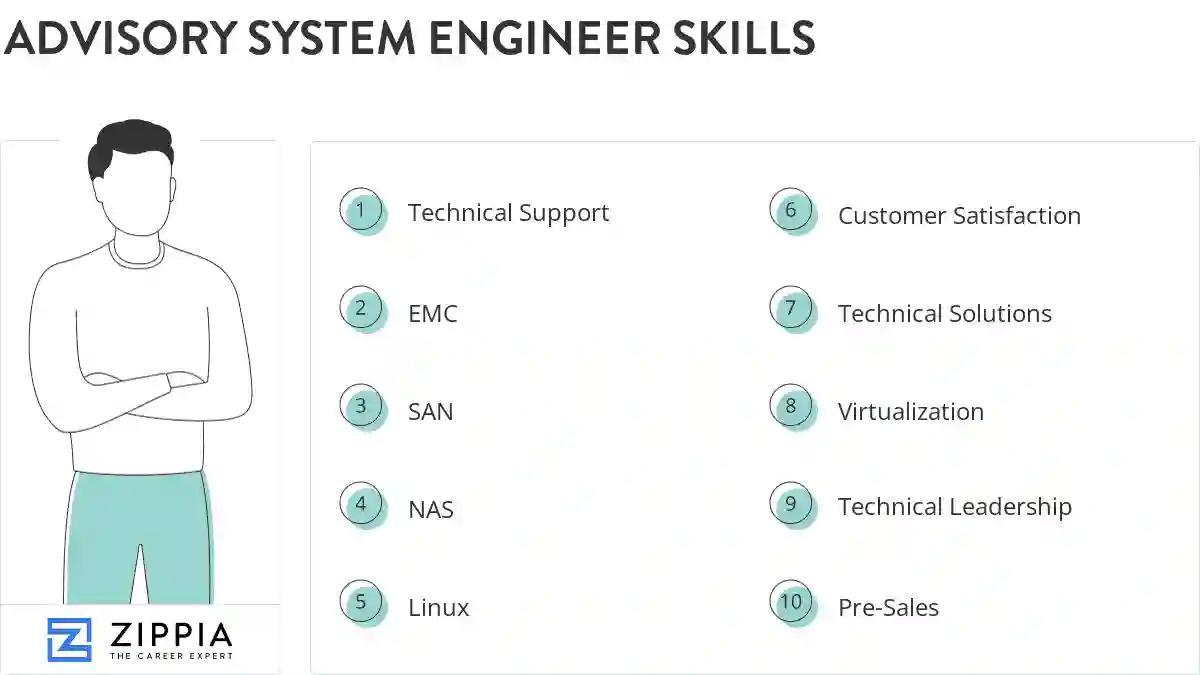
The most important skills for an advisory system engineer resume and required skills for an advisory system engineer to have include:
- Technical Support
- EMC
- SAN
- NAS
- Linux
- Customer Satisfaction
- Technical Solutions
- Virtualization
- Technical Leadership
- Pre-Sales
- Unix
- TCP/IP
- Database
- Software Development
- Problem Resolution
- Sales Support
- SME
- Application Development
- Post Sales
- Mainframe
- PC
- SQL
- Capacity Planning
- DB2
- Advisory System
- VM
- AIX
- JCL
- Solaris
- Tandem
- SLA
- HR
- Production Environment
- Lan
- C++
- RFP
- Test Scripts
- Customer Support
- Symposium
- XML
- CPU
- DBA
Updated January 8, 2025
