
Automatically apply for jobs with Zippia
Upload your resume to get started.
Aircraft stress analyst skills for your resume and career
11 aircraft stress analyst skills for your resume and career
1. Aircraft Maintenance
- Interfaced with aircraft maintenance and engineering personnel for reliability improvements based on trend analysis data.
- Conducted analysis on aircraft performance data to support the aircraft maintenance reliability program.
2. OEM
OEM stands for Original Equipment Manufacturer and is a term for a company that produces and markets the parts of equipment for another company after having received the go-ahead to do so. The company can also produce devices from the combination of parts from different companies while in partnership with these companies. This is common in the computer hardware industry and is popular in the automobile and computer industries.
- Experienced with OEM documentation and Illustrated Parts Catalogues.
3. FEA
The Finite Element Analysis (FEA) is software that can simulate physical phenomenon with the help of numerical procedures. FEA helps companies in developing better and cost-effective products by reducing the number of physical prototypes.
- Build FEA models of composite doors for determining shear and bending loads on core and laminate build-ups.
4. Structural Analysis
A structural analysis is a type of method or process determining the condition and situation of a particular structure. Engineers, architect and other related professional often use it to study and review the behavior, dynamics, issues, and failures encountered during a project. It is the key to engineering design structure that identifies the system's performance and integrity and its effect. The purpose of the analysis is to assess the stresses, deformations, acceleration, internal forces, and stability.
- Experienced with foundational structural analysis concepts such as crippling, buckling (flanges, webs, shear-ties, inter-rivet, etc.
- Presented structural analysis results and path forward recommendations in Critical Design Review to program leadership for Airbus A350-900 IFS weight optimization.
5. Maintenance Data
- Analyzed maintenance data sent in from Learjet 60 and 45 Operators and Owners through out the world to CAMP Systems.
6. Test Data
- Validated wing finite element model with test data.
- Experience with flight test monitoring and exposure to post-processing of flight test data using Matlab.
7. Certification Efforts
- Submitted engineering reports to FAA representatives in support of certification efforts.
8. Federal Aviation Administration
- Complied with all Federal Aviation Administration and General Electric regulations.
- Coordinate engine import/export with the Federal Aviation Administration.
9. USAF
- Participated in Software Evaluation group for the USAF (10 Years of experience).
10. Airframe
Airframes are a type of mechanical structure used for an aircraft. This part usually consists of the wings, tail assembly, fuselage, undercarriage, and landing gear. It has a monolithic component in it that has ribs, frames, stringers, bulkheads and others. The Airframe is created, designed, and used to endure all the air force every time the aircraft takes off. It helps withstand the aerodynamics as well the pressure of the payload, crew, and the fuel.
- Research airframe and engine log books on multiple types of aircraft to verify all necessary maintenance guidelines have been complied with.
- Review all flight logs for updating accurate airframe and landings/cycle hours.
11. Structural Integrity
- Work closely with designers to ensure door designs strike a good balance between solid structural integrity and weight/cost efficiency.
- Verified structural integrity and durability of 777 engine ancillary components under dynamic load conditions.

What skills help Aircraft Stress Analysts find jobs?
Tell us what job you are looking for, we’ll show you what skills employers want.
List of aircraft stress analyst skills to add to your resume
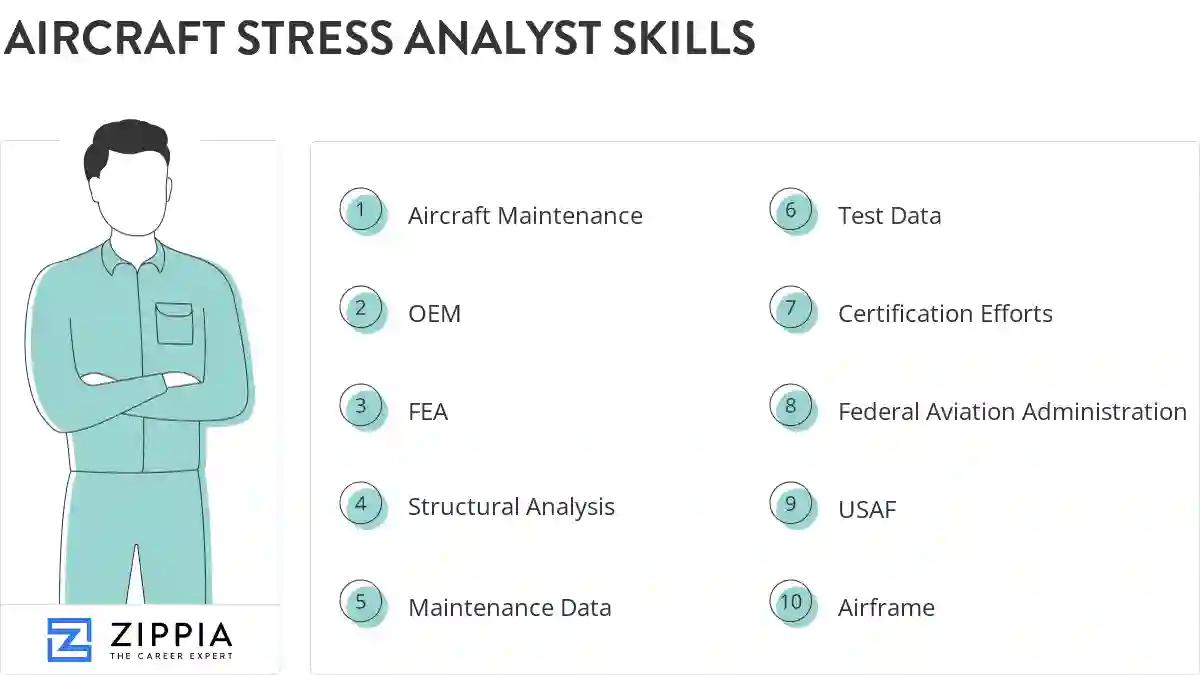
The most important skills for an aircraft stress analyst resume and required skills for an aircraft stress analyst to have include:
- Aircraft Maintenance
- OEM
- FEA
- Structural Analysis
- Maintenance Data
- Test Data
- Certification Efforts
- Federal Aviation Administration
- USAF
- Airframe
- Structural Integrity
Updated January 8, 2025
