
Automatically apply for jobs with Zippia
Upload your resume to get started.
Application integrator skills for your resume and career
15 application integrator skills for your resume and career
1. Application Integration
- Set up application integration between the development and production servers for 10 internal customers which resulted in increased productivity.
2. Architecture
- Developed several reference architecture to support various bids.
- Proposed alternative integration architecture scenarios.
3. Java
Java is a widely-known programming language that was invented in 1995 and is owned by Oracle. It is a server-side language that was created to let app developers "write once, run anywhere". It is easy and simple to learn and use and is powerful, fast, and secure. This object-oriented programming language lets the code be reused that automatically lowers the development cost. Java is specially used for android apps, web and application servers, games, database connections, etc. This programming language is closely related to C++ making it easier for the users to switch between the two.
- Project for clarify system integration with various applications developed in Java, Support of applications, troubleshooting, consulting.
- Collaborate and co-ordinate with distributed teams for requirements sync-up* Perform release management activities for deploying the Java application in Prod environment
4. XML
XML is a medium for storing and transporting data that is independent of software and hardware. XML stands for eXtensible Markup Language. XML, like HTML, is a markup language that was created to store and transport data. It was created with the intention of being self-descriptive. There are no predefined tags in the XML language. Another feature is that XML is extensible.
- Lead BizTalk/C# developer creating dynamic mapping orchestrations to transform incoming Excel-formatted invoice documents to company specific XML formats.
- Registered customized Oracle reports and XML Publisher reports using System Administrator and Application Developer.
5. ETL
- Developed Enterprise ETL tool for importing over 25,000 new contacts and organizations from 3rd party data into Deltek Vision CRM.
- Use MSSQL database as a source and transform & load the data into HIVE database using Talend ETL tool.
6. FTP
- Deployed systems to extract laboratory charges across all facilities and FTP all data to 3rd party billing company.
- Installed, Configured, support, administrate, MS/NT V4 Inter/Intranet WWW, FTP, E-mail servers.
7. HL7
(HL7) Health Level Seven International is a non-profit ANSI-accredited standards development organization dedicated to providing benchmarks and solutions that empower overall health data unification. This framework enables sharing, integration, and recovery of electronic health information. This information strengthens clinical practices along with the evaluation, management, and deliver health services.
- Fix reported issues of the Integration engine components and Interfaces Co-ordinates with application analysts to fix HL7 interfaces.
- Managed the affiliated physician practice HL7 result interface projects.
8. SQL Server
- Ported the repository component to Informix, MySQL, SQL Server, and AS/400 databases.
- Designed, developed and administered content management system utilizing ColdFusion and SQL Server that integrated with corporate systems.
9. PowerShell
- Tested & edited PowerShell scripts for overall task sequence deployment on various models of client machines.
- automated everyday processes, monitored logs, learned C++ and PowerShell
10. Unix
UNIX is a computer operating system that was first created in the 1960s and has been constantly updated since then. The operating system refers to the set of programs that enable a machine to function. It is a multi-user, multi-tasking device that works on computers, laptops, and servers. UNIX systems also have a graphical user interface (GUI), similar to Microsoft Windows, that makes it simple to use.
- Developed Unix Korn Shell scripts that automated file transfers between servers.
- Developed Unix Shell scripts to manage/support the environment and installations.
11. Windows XP
- Involved in creating MSI packages for migrating from Windows XP to Windows 7 operating system.
- Ensured application compatibility with the Windows XP / Novell Xenworks environment.
12. Infrastructure
Infrastructure includes the organizational and physical structures needed to run an area or a society smoothly. It is a group of basic facilities required for any society or firm to run sustainably and efficiently. The infrastructural system is a high investing area and helps majorly in flourishing the economy and prosperity of a country. It is an underlying system needed for ensuring the safety and comfort of the public and to run a country smoothly. All the tasks needed to be performed for a flourishing economy and a happy and healthy public are included in infrastructure.
- Build Infrastructure and team in INDIA office for AristaSoft Intl.
- Analyzed technology infrastructure and technical staff for nationwide business-to-business consumer-focused photography company.
13. EDI
- Received numerous client appreciation emails on successful EDI Implementations
- Developed and tested the new EDI management system using Desktop EDI, Perl & COBOL.
14. Legacy Systems
- Improved legacy system reliability and accuracy by eliminating software bugs.
15. Test Cases
- Developed test cases for IBM Globalization project.
- Defined test cases and published detailed plans to test application functionality within best practice parameters.

What skills help Application Integrators find jobs?
Tell us what job you are looking for, we’ll show you what skills employers want.
List of application integrator skills to add to your resume
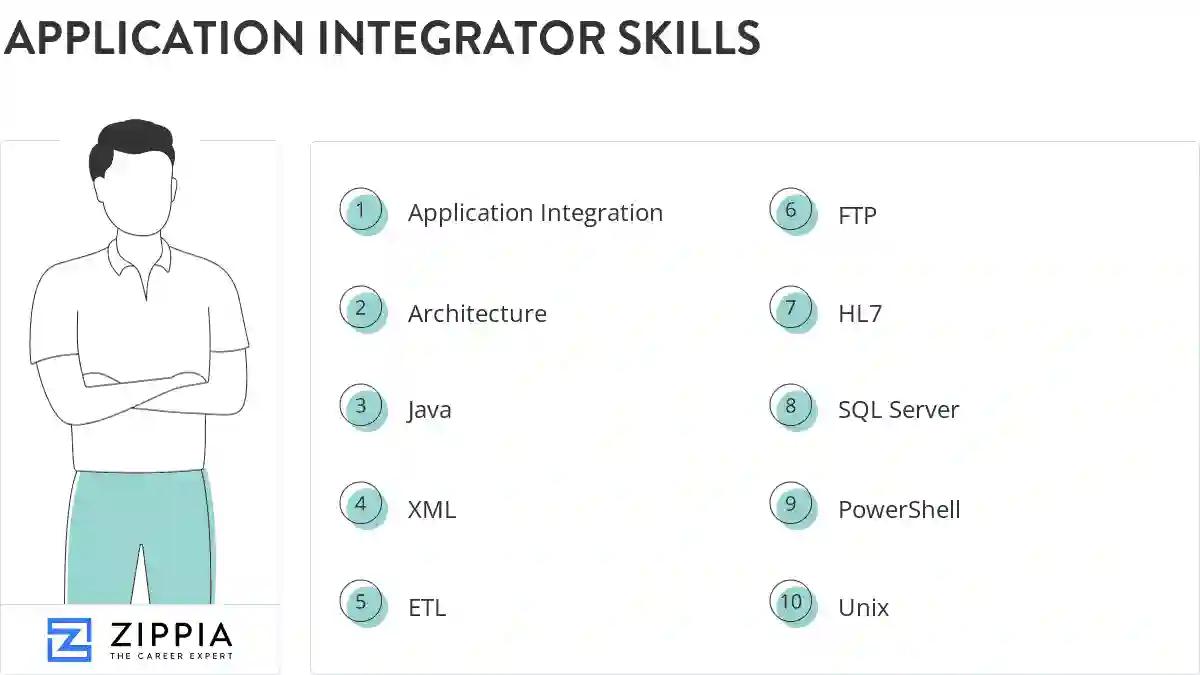
The most important skills for an application integrator resume and required skills for an application integrator to have include:
- Application Integration
- Architecture
- Java
- XML
- ETL
- FTP
- HL7
- SQL Server
- PowerShell
- Unix
- Windows XP
- Infrastructure
- EDI
- Legacy Systems
- Test Cases
- Perl
- Mainframe
- Lotus Notes
- DB2
- On-Call Support
- Business Processes
- Management System
- SCCM
- PL/SQL
- Application Development
Updated January 8, 2025
