
Automatically apply for jobs with Zippia
Upload your resume to get started.
Art educator skills for your resume and career

15 art educator skills for your resume and career
1. Classroom Management
- Received professional development in art education, behavioral/classroom management, childhood/adolescent development, classroom technology, interdisciplinary teaching and diversity/cultural awareness.
- Manage student behavior and classroom management to foster academic achievement, personal responsibility, leadership, intellect, and individuality.
2. Curriculum Development
- Staff development in Curriculum Development and Interdisciplinary Education.
- Acted as an interdepartmentalliaison during curriculum development.
3. K-12
K12 is a term that incldues all 12 years of education in the US education system. It includes the education offered at the primary stage, middle stage, and secondary stage. It includes children of ages as young as 5 to 18 years. The grades included in K12 are Kindergarten, the initial 5 stages, grades 6 to 8, and 9 to 12. This system is followed specifically followed in the US and may vary in other countries.
- Created and Developed curriculum K-12 Conducted lessons from curriculum and plans for all grade levels
- Designed and scheduled approximately 50 training and debrief sessions annually with astronauts, K-12 formal/informal educational facilities and higher education clients.
4. Fine Arts
- Implemented original programming for fine arts and traditional crafts education for adults and youth.
- Integrated technology and fine arts programs at a project based learning school.
5. Art History
Art history is the study of art over various periods of time. Art historians may be able to identify the material that created the art, which could say a lot about people during an era. By researching and understanding how and why art was created, one may have a better understanding of humanity and what was valued at the time the art was produced.
- Implemented studio art experiences through the lens of art history while connecting lessons to real world experiences and media.
- Developed thematic units in color theory, art history, drawing, painting, collage and digital art.
6. Visual Arts
- Participated as part of a collaborative visual arts education team.
- Organized Annual School Art Show representing 550- 600 students every year, featuring music, dance, theater and visual arts.
Choose from 10+ customizable art educator resume templates
Build a professional art educator resume in minutes. Our AI resume writing assistant will guide you through every step of the process, and you can choose from 10+ resume templates to create your art educator resume.7. Learning Environment
- Provided clear expectations and consistent routines in order, to create a positive achievement-oriented and structured learning environment.
- Provided an engaging and motivating learning environment.
8. Syllabus
- Develop and implement the Advanced Placed Studio Art curriculum and syllabus meeting CollegeBoard requirements in both Drawing and 2-D Design.
- Provide necessary procedures for updated the study syllabus or study curriculum.
9. Classroom Environment
- Created a classroom environment conducive to learning and appreciation of the arts.
- Design creative lesson plans and maintain a positive classroom environment that consistently earned proficient and distinguished marks in all professional evaluations.
10. Art Program
- Facilitated and prepared curriculum and facilitated in school art program K-5
- Implemented a traveling art program that included visiting the company's three locations weekly to teach ages 2.5 to 5 years.
11. IEP
- Prepared goals and objectives for children with various challenges * Prepared IEP's as required by Louisiana State Board of Education
- Differentiated instruction according to students' needs, and abilities taking into account English Language Learners and IEP accommodations.
12. Kindergarten
Kindergarten is an early form of education that begins when a child is about five years old. During kindergarten, children learn the basic elements of reading, writing, and mathematics in addition to colors, telling time, sharing, and similar principles. Kindergarten classes are typically overseen by a single teacher who lectures on all of the subjects listed.
- Designed and implemented movement and circus arts acrobatics curriculum for children grades kindergarten to 8th, with a focus on juggling.
- Created weekly newsletters for parent access to view student lessons Assisted Kindergarten teacher in role of classroom aide.
13. Studio Art
- Develop and implement curriculum for 2D Studio Art class: levels 1, 2 and Honors.
- Organized and maintained studio art space to accommodate 20 25 students.
14. Sculpture
The sculpture is an art form in which solid or synthetic materials are molded into three-dimensional art objects. The figures may be incorporated in freestanding objects, in assistance on surfaces, or in conditions ranging from pictures to contexts that fascinate the viewer. Sculptures fall into four main categories: molded, cast, carved, or assembled.
- Led a team of artists and volunteers to help with sculpture and installation projects for the Day of the Dead.
- Enhanced curriculum plans for ceramics and sculpture which, various methods and techniques were introduced.
15. Professional Development
Professional development means to have the essential training certification or education with the purpose of earning and having a successful career. Every job requires a different set of skills. However, new skills may be needed in the future. Professional development, in this regard, helps people to develop and polish the skills and become efficient workers.
- Led professional development in dance arts education for elementary schools teachers and administrators.
- Incorporated proven learning strategies in classroom from professional development seminars.
5 Art Educator resume examples
Build a professional art educator resume in minutes. Browse through our resume examples to identify the best way to word your resume. Then choose from 5+ resume templates to create your art educator resume.

What skills help Art Educators find jobs?
Tell us what job you are looking for, we’ll show you what skills employers want.
What skills stand out on art educator resumes?
Samantha Osborne
Assistant Professor of Graphic Design, Owner, Samantha Osborne Design, Eastern Illinois University
What soft skills should all art educators possess?
Samantha Osborne
Assistant Professor of Graphic Design, Owner, Samantha Osborne Design, Eastern Illinois University
i. An ability to see big picture: there are an infinite number of details in graphic design, whether you work in website design on the front or back end, or in print media with physical outputs. It's easy to get caught up on the details, especially when clients are making specific demands about things such as paper type. A skilled designer must be able to see beyond the details and look at the big picture for an effective design solution. For example, a client may be asking for an invitation design for an up-coming event. A skilled designer will ask questions and dig in, eventually uncovering that perhaps for a successful event, the client also needs a splash page and social media, either in place of or in addition to an invitation. A skilled designer addresses design problems holistically, rather than minutely.
ii. An ability to "read" people: designers are trained in art-specific vocabulary. Hue, saturation, pixels, gestalt...most non-art folks don't use or speak that language. When clients are describing their goals, they aren't using art-vocabulary. It's a designer's job to translate what the client is saying into an advanced and effective creative solution. They must be able to speak and understand the language of non-creative folks, as well as the language of the broader creative industry.
iii. An ability to make a convincing argument for your design solution(s): many young and inexperienced designer tend to get their hearts broken when a client smashes one of their [very well thought-out] ideas. Rather than rolling over, a designer must learn to navigate how best to build support for their idea(s). That might mean in some instances you work more fluidly with the client throughout the design process, so that they feel they have ownership in the development of the solution. In other instances it might mean that the designer is presenting options, rather than a single solution, so that the client feels empowered to make choices throughout the design process. And in some instances, it might be a matter of better explaining and presenting your idea to a client; perhaps the designer needs to push back more, perhaps they need to provide more research as to why their solution is best, or maybe they simply need to present it with more excitement and enthusiasm.
What hard/technical skills are most important for art educators?
Samantha Osborne
Assistant Professor of Graphic Design, Owner, Samantha Osborne Design, Eastern Illinois University
What art educator skills would you recommend for someone trying to advance their career?
Gina Anderson
Associate Dean for Educator Preparation and Partnerships, Texas Woman's University
List of art educator skills to add to your resume
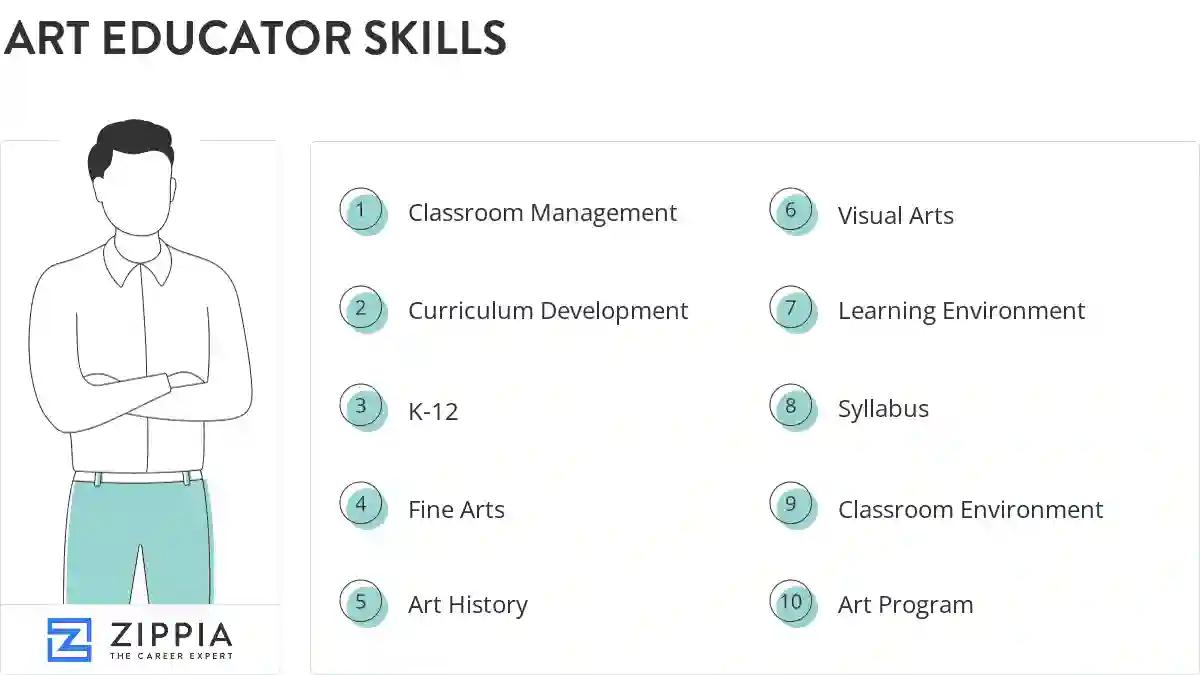
The most important skills for an art educator resume and required skills for an art educator to have include:
- Classroom Management
- Curriculum Development
- K-12
- Fine Arts
- Art History
- Visual Arts
- Learning Environment
- Syllabus
- Classroom Environment
- Art Program
- IEP
- Kindergarten
- Studio Art
- Sculpture
- Professional Development
- Digital Photography
- Art Classes
- Art Projects
- Creative Process
- Public Schools
- Printmaking
- Mathematics
- K-5
- K-8
- Social Justice
- Community Outreach
- Creative Expression
- State Standards
- Adobe Photoshop
- Student Performance
- Digital Art
- Student Learning
- PowerPoint
- Pre-K
- Elementary Schools
- School Administration
- Art Shows
- K-6
- Social Studies
- Course Materials
- Drama
- ESL
- Art Techniques
- Color Theory
- Art Exhibits
- Art Club
- at-Risk Youth
- Jewelry
- Art Lessons
Updated January 8, 2025
