
Automatically apply for jobs with Zippia
Upload your resume to get started.
Assembly inspector skills for your resume and career

15 assembly inspector skills for your resume and career
1. Hand Tools
- Replaced and repaired worn, defective, and damaged components, using hand tools, gauges, and testing equipment.
- Use hand tools, equipment and measuring instruments as necessary to verify correctness of rejection information when doubt exists.
2. Line Assembly
- Front Line Assembly II Inspection of frames for quality assurance in accordance to Intercraft guideline.
- Performed line assembly electronic components.
3. Inspection Results
Inspection Results are provided after inspecting and analyzing a structure for various defects, including whether a home is ready to be occupied or sold. There may also be inspection results during construction to ensure the structure abides by local zoning, electrical, and plumbing regulations. Without satisfactory inspection results, the structure may need additional work before continuing construction or becoming occupied.
- Perform quality assurance processes according to written procedures, document inspection results.
- Documented inspection results by completing reports and logs; summarizing rework and waste; inputting data into quality database.
4. RF
- Inspected Pre and Power Amplifiers Inspected Baxter switching power supply boards Inspected Litton RF.
- Team Lead assemblies thru hole RF arrestors * Quality Inspector
5. Circuit Boards
A circuit board refers to an electronic device used to offer mechanical support and connect components electrically using signal traces and conductive pathways.
- Tested printed circuit boards for functionality and conductivity.
- Inspected, repaired, and replaced printed circuit boards and other various electronic parts as needed.
6. Safety Policies
Safety policies are the rules and codes of conduct developed by an organization to ensure workplace safety.
- Adhere to all employment policies/safety policies/practices required by law/established by Company.
- Observed all safety policies and procedures Recognized and reported defective material and equipment to shift supervisor.Familiar with cleanroom protocols.
Choose from 10+ customizable assembly inspector resume templates
Build a professional assembly inspector resume in minutes. Our AI resume writing assistant will guide you through every step of the process, and you can choose from 10+ resume templates to create your assembly inspector resume.7. IPC
IPC, Infection Prevention and Control is a practical, evidence-based approach that aids the prevention, transmission, or control of the spread of infections in patients and health workers.
- Use of inside and outside calipers and micrometers, soldering- IPC Certified 610- 620.
- Keep yearly certification for soldering; IPC 610, J-STD 001.
8. Jigs
- Positioned and aligned parts, using fixtures, jigs, and templates.
- Worked from diagrams and drawings, made initial layouts, and used hand and/or power tools, jigs, and saws.
9. FAA
FAA (Federal Aviation Administration) is an aviation regulatory body in the USA.
- Perform and maintain proper inspection standards, methods and procedures used in compliance with Federal Aviation Administration (FAA) regulations.
- Assisted in writing an FAA approved NDT Written Practice Manual (based on NAS 410 and SNT-TC-1A).
10. QA
QA, or Quality Assurance is a procedure that entails all of the steps taken to avoid any errors in the manufacturing process or in the production of the goods that a company produces. It can also include ensuring the consistency of the services rendered. Quality assurance ensures that the quality of the service delivered to consumers meets or exceeds the promised expectations. This greatly aids in the prevention of any complications that might arise after the goods or services have been distributed. It makes sure that customers are satisfied.
- Worked to develop IPB4 QA assembly website for faster information retrieval and cross shift information sharing.
- Operate machines including QA machine and Assembly machines.
11. Quality Products
A quality product satisfies the client's intended need and matches the cost the consumer paid for it.
- Performed proper operation of machinery to produce quality products and trained other operators to do the same.
- Maintain quality products throughout the assembly and inspection process.
12. Engineering Drawings
Engineering drawings are technical drawings that tell about the requirements for engineering components or equipment. Such drawings have standardized languages and symbols. There are multiple types of engineering drawings such as isometric drawing, orthographic or multiview drawing, schematic drawings, one view, and two view drawings, etc.
- Inspected electrical wiring harnesses, boxes and assemblies according to engineering drawings, military specifications and inspection documents.
- Understand and interpret engineering drawings, specifications and work procedures.
13. Quality Checks
Quality checks are a component of quality control aimed at ensuring that quality requirements are met. Internally, quality checks provide assurance to managers, and externally, it provides assurance to clients, federal departments, authorities, and certifiers.
- Performed quality checks during machine operation to insure proper function.
- Ensured that all quality checks are performed and are being maintained within the specified control limits.
14. Dial Indicators
- Utilized precision measuring devices such as micrometers, calipers, dial indicators, bore gages and depth gauges.
- Assembled parts * Inspected using blueprints * Used micrometers, calibers, dial indicators and microscope left because of downsizing
15. Test Equipment
Test equipment is a mechanical tool or a device which is used create signals and gather response from an electronic device under test. It helps in detecting any faults in the device and it also proves the proper operation of the electronic device.
- Use metering devices, tape measures, and test equipment to perform inspections.
- Performed various functional testing using customer test fixtures and standard test equipment.
5 Assembly Inspector resume examples
Build a professional assembly inspector resume in minutes. Browse through our resume examples to identify the best way to word your resume. Then choose from 5+ resume templates to create your assembly inspector resume.

What skills help Assembly Inspectors find jobs?
Tell us what job you are looking for, we’ll show you what skills employers want.
List of assembly inspector skills to add to your resume
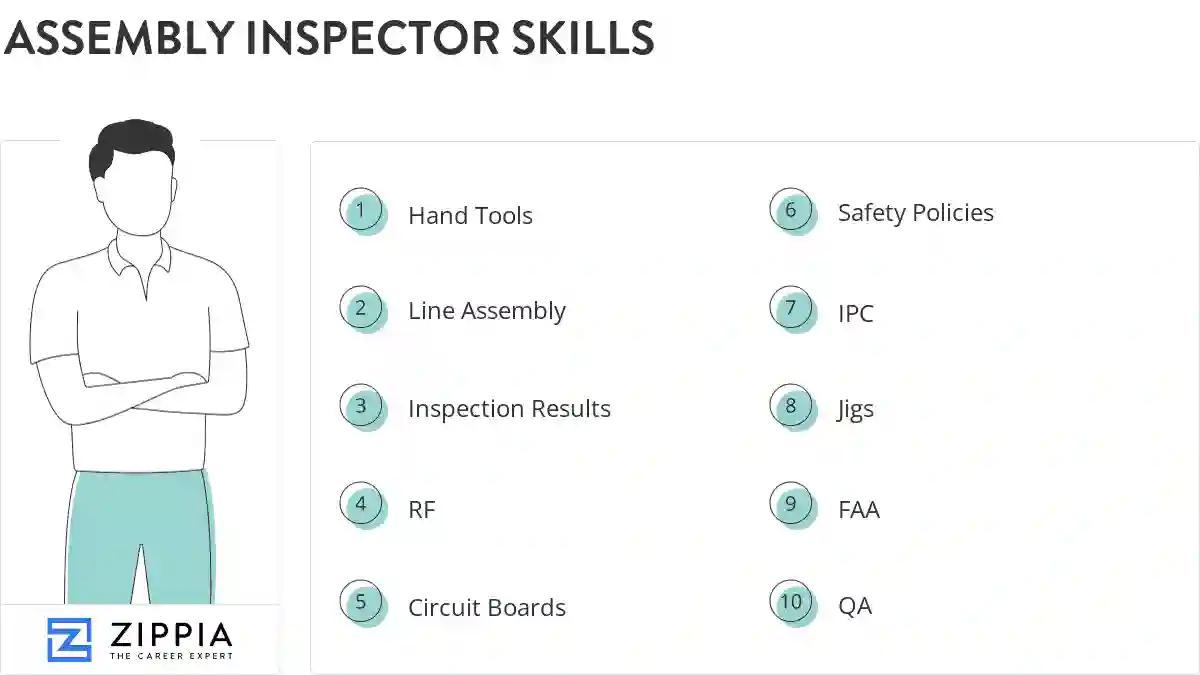
The most important skills for an assembly inspector resume and required skills for an assembly inspector to have include:
- Hand Tools
- Line Assembly
- Inspection Results
- RF
- Circuit Boards
- Safety Policies
- IPC
- Jigs
- FAA
- QA
- Quality Products
- Engineering Drawings
- Quality Checks
- Dial Indicators
- Test Equipment
- Test Data
- Clean Room Environment
- Honda
- ISO
- Quality Standards
- Catheter
- Customer Specifications
- GMP
- Medical Devices
- Electrical Components
- Assembly Process
- CNC
- SMT
- ESD
- Process Inspection
- BMW
- Visual Inspections
- Measure Materials
- PC Boards
- PCB
- Meeting Specifications
- Part Numbers
- Production Problems
- Quality Inspection
- Toyota
- FDA
- Reject Products
- Chrysler
Updated January 8, 2025
