
Automatically apply for jobs with Zippia
Upload your resume to get started.
Assembly specialist skills for your resume and career

15 assembly specialist skills for your resume and career
1. Assembly Operations
- Perform tasks from certified training in electronic and micro assembly operations.
- Moved between various assembly operations for multiple products.
2. Safety Procedures
Safety procedures are a set of standardized procedures, that ensures minimal to no risk to people, resources, and the work environment. A company follows the step-by-step safety procedures as it they not only keep the customers and the employees safe, but also help in avoiding legal claims.
- Understand and follow safety procedures at all times.
- Assisted with daily duties Follow safety procedures Multi task
3. Mechanical Assembly
- Assembled company products involving electrical and mechanical assembly and soldering Responsible for creating wiring harness boards and harnesses
- Performed electronic and electromechanical assembly from blue prints, Schematics and verbal instructions.
4. Assembly Line
Assembly line is a process used in industries to ensure the production of products in a cost effective manner by dividing up the responsibilities of each labor. Assembly lines enabled industries to hire more workers, therefore providing more employment opportunities to labors. This is possible because in this process the burden of all the tasks related to production are not laid on a single person, they are divided into small baby steps for each labor.
- Repaired any rejected units from Production Test* Numerous assembly line positions* Assembled specialty units, such as steering columns and prototype units
- Make sure everything is done and done right before it rolls off of the assembly line.
5. Assembly Process
- Investigated prototype parts and procured prototypes / mock ups to come up with countermeasures to unforeseen concerns based on assembly processing.
- Defined, Qualified, and Implemented an assembly process that had a high technical risk while maintaining project budget and schedule.
6. Hand Tools
- Licensed to operate lift trucks, forklifts, hoists, and air and hand tools.
- Used power tools and calibrated hand tools to complete assembly tasks.
Choose from 10+ customizable assembly specialist resume templates
Build a professional assembly specialist resume in minutes. Our AI resume writing assistant will guide you through every step of the process, and you can choose from 10+ resume templates to create your assembly specialist resume.7. Dexterity
- Perform a series of repetitive operations requiring manual dexterity and visual acuity.
- Assembled small cable wire harnesses that required a high level of manual dexterity and attention to detail.
8. Safety Rules
Principles or regulations that ensure the protection of people, objects, or the environment are called safety rules. These rules can be governing actions, devices, or procedures that help in minimizing the risks of loss, injury, or damage.
- Follow safety rules and procedures Meet and exceeded production goals
- Assemble trucks Reading comps Using MES Working with cranes and power tools Working in safe environment and following safety rules.
9. Quality Standards
Quality standards are a specific level of standards of products that are set by the companies for the customers that have to be met and maintained throughout the process until the time of delivery. Quality standards are information that includes the customer's requirements, guidelines, and characteristics for the needed final product or service.
- Performed all works in accordance with quality standards and established safety procedure.
- Inform and train employees to recognize quality standards in every operation.
10. IPC
IPC, Infection Prevention and Control is a practical, evidence-based approach that aids the prevention, transmission, or control of the spread of infections in patients and health workers.
- Hand soldering T/H and SMT components to IPC J-STD-001 and IPC610 standards.
- Communicate problems in the machine set-up of the Pick and Place to operator applying IPC -610 Standards
11. Test Equipment
Test equipment is a mechanical tool or a device which is used create signals and gather response from an electronic device under test. It helps in detecting any faults in the device and it also proves the proper operation of the electronic device.
- Perform go-not-go testing and inspection using electronic test equipment, to ensure parts and assemblies meet production specifications and standards.
- Skilled in using test equipment, calipers, and micrometers in order to measure the quality of the equipment.
12. Quality Checks
Quality checks are a component of quality control aimed at ensuring that quality requirements are met. Internally, quality checks provide assurance to managers, and externally, it provides assurance to clients, federal departments, authorities, and certifiers.
- Performed quality checks to ensure product conformance to manufacturing specifications.
- Performed quality checks on assembled products prior to shipping.
13. Assembly Drawings
- Drafted mechanical, electrical, pneumatic, hydraulic, and assembly drawings of corrugated box machines.
- Drafted mechanical, electrical, pneumatic, hydraulic, and assembly drawings.
14. Engineering Drawings
Engineering drawings are technical drawings that tell about the requirements for engineering components or equipment. Such drawings have standardized languages and symbols. There are multiple types of engineering drawings such as isometric drawing, orthographic or multiview drawing, schematic drawings, one view, and two view drawings, etc.
- Inspect schematics, bill of materials, and engineering drawings to order correct replacements for damaged or missing parts.
- Performed build processes using engineering drawings and specific planning processes to build hardware to class 3 level specifications.
15. ISO
- Key Accomplishment: Developed and implemented training for industry ISO 9001 Gold Certification.
- Documented all rework performed and maintained dailylog on all reworked units.ISO CERTIFIED
5 Assembly Specialist resume examples
Build a professional assembly specialist resume in minutes. Browse through our resume examples to identify the best way to word your resume. Then choose from 5+ resume templates to create your assembly specialist resume.

What skills help Assembly Specialists find jobs?
Tell us what job you are looking for, we’ll show you what skills employers want.
List of assembly specialist skills to add to your resume
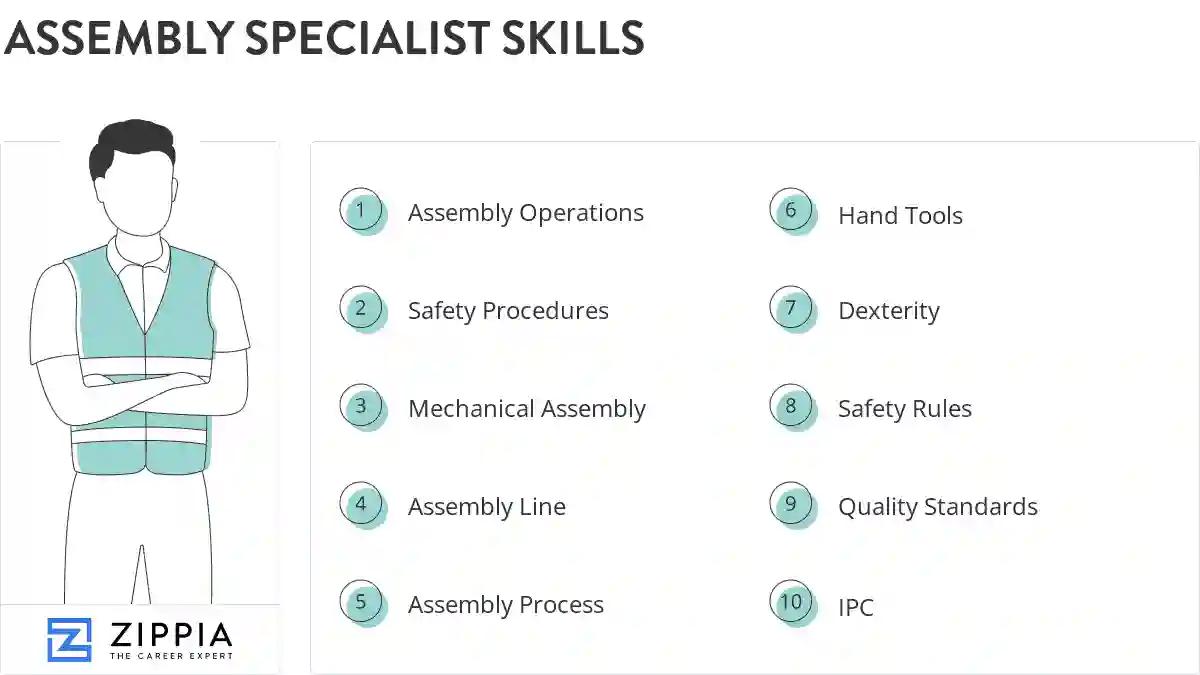
The most important skills for an assembly specialist resume and required skills for an assembly specialist to have include:
- Assembly Operations
- Safety Procedures
- Mechanical Assembly
- Assembly Line
- Assembly Process
- Hand Tools
- Dexterity
- Safety Rules
- Quality Standards
- IPC
- Test Equipment
- Quality Checks
- Assembly Drawings
- Engineering Drawings
- ISO
- Process Improvement
- CAD
- Circuit Boards
- Product Assembly
- ESD
- Electrical Components
- ECO
- Quality Inspection
- Product Quality
- SMT
- RF
- Soldering Irons
- GMP
- BOM
- Surface Mount
- Blueprint Specifications
- Customer Specifications
- PCB
- J-Std-001
- Hoists
- Medical Devices
- Jigs
- Control Panels
- CNC
- Safety Guidelines
- Customer Orders
- Windows
- Catheter
- Air Tools
- Inventory Control
- Drill Press
- Clean Room Environment
- Continuous Improvement
- PC
Updated January 8, 2025
