
Automatically apply for jobs with Zippia
Upload your resume to get started.
Assistant analyst skills for your resume and career
15 assistant analyst skills for your resume and career
1. PowerPoint
- Used Microsoft Word and PowerPoint for hard copy reports and PowerPoint wall screen projections.. Used Excel for analysis of extensive records.
- Prepared correspondence, reports, proposals using MS Word, Excel, Powerpoint, Access etc..
2. Financial Statements
A financial statement is a report of an individual or a company that includes all the information about the declared assets, the use of money, income, and also the contribution of shareholders over a certain period.
- Assisted in preparation of company's financial statements.
- Led monthly meetings to annalize the accurancy of clients' financial statements.
3. Data Entry
Data entry means entering data into a company's system with the help of a keyboard. A person responsible for entering data may also be asked to verify the authenticity of the data being entered. A person doing data entry must pay great attention to tiny details.
- Worked with Microsoft Office as well as other tools online for data entry and typing up reports.
- Schedule new consultations, coordinate and follow up patient appointments and cancellations and data entry.
4. Accruals
- Generated financial trade accruals in SAP and created as well as analyzed financial results related to managed accounts.
- Generated $50+Million/Quarter in trade accruals in SAP and analyzed financial results in assigned accounts.
5. SOX
- Forecast and Accrual reviews monthly to determine proper accounting for company under designated SOX what are SOX controls.
- Assisted in gathering data and preparing schedules in support of the internal SOX (Sarbanes-Oxley) audits.
6. Journal Entries
Journal entries can be defined as an act of keeping or making records of any transactions either economic or non-economic. The journal entries are made in the accounting systems of an organization. The entries are filled with two main fields; debit and credit. The debit and credit must be equal at the end of a journal entry else it is not considered correct. The journal entries also keep the date of transactions and the names of the accounts that were affected by the transactions.
- Prepared and entered journal entries to general ledger.
- Maintain Check Logs for disposed assets and perform journal entries to ensure accurate financials.
Choose from 10+ customizable assistant analyst resume templates
Build a professional assistant analyst resume in minutes. Our AI resume writing assistant will guide you through every step of the process, and you can choose from 10+ resume templates to create your assistant analyst resume.7. Financial Analysis
- Performed required departmental financial analysis for inclusion into the City's financial plan.
- Conducted in financial analysis for the replacement of equipment and manpower for the Armed Services.
8. Stata
STATA is a statistical software package used for data visualization, manipulation, statistics, and automated reporting. Individuals with experience in using other types of statistical software or a background in data science may find it easier to absorb the concepts of STATA quickly.
- Created STATA code to build various econometric models for forecasting policy-oriented macroeconomic analysis.
- Collected and manipulated large data sets and conducted econometric analysis using STATA.
9. Medicaid
- Assist Provider Enrollment in Medicare/ Medicaid Contracts.
- Assisted Medicaid Providers with updated procedure code coverage, reimbursement fees and explanation of benefit codes.
10. SAS
SAS stands for Statistical Analysis System which is a Statistical Software designed by SAS institute. This software enables users to perform advanced analytics and queries related to data analytics and predictive analysis. It can retrieve data from different sources and perform statistical analysis on it.
- Used SAS and relational database tools to develop audience segmentation recommendations for direct marketing campaigns with circulations of over 2 million.
- Interpreted and analyzed statistical data using SAS computer programs providing valuable insight toward the development of banking clients marketing efforts.
11. R
R is a free software environment and a language used by programmers for statistical computing. The R programming language is famously used for data analysis by data scientists.
- Develop a data mining GUI using R scripts incorporating cutting-edge machine learning algorithms for advanced remote sensing image classification.
- Performed Cluster Analysis in R to compare medical providers based on various calculated Statistics and services rendered.
12. Data Analysis
- Assisted the Associate VP of Strategy & Decision Support in research and data analysis, utilizing advanced Excel skills.
- Harvested campaign performance insights through data analysis via Act One, and team collaboration for radio airwaves.
13. Variance Analysis
- Prepared variance analysis and chart to support cost proposal.
- Performed variance analysis, purchase reconciliation, and audit labor miscode charges.
14. Data Collection
Data collection means to analyze and collect all the necessary information. It helps in carrying out research and in storing important and necessary information. The most important goal of data collection is to gather the information that is rich and accurate for statistical analysis.
- Analyzed collected material for content relevance and data collection requirements.
- Provide support to owners through assistance with data collection and analysis and reporting.
15. Conference Calls
Conference calls are call that involves three or more people who can speak at the same time. One of the persons connected may add the person to confer through the phone whose voice can be heard by all of those on the line. This can be done when the phone is used as a feature for a conference call that allows the initial caller to add more listeners or speakers on the same line without losing the first person he called. This is used to listen or communicate to different people at the same time that would save time, effort and avoid repeating the same discussion.
- Expedited flow of inventory from suppliers via phone, email, conference calls and chat.
- Collect and distribute Period Operating Scorecards for Foodservice Period Forecast/Scorecarding conference calls.
5 Assistant Analyst resume examples
Build a professional assistant analyst resume in minutes. Browse through our resume examples to identify the best way to word your resume. Then choose from 5+ resume templates to create your assistant analyst resume.

What skills help Assistant Analysts find jobs?
Tell us what job you are looking for, we’ll show you what skills employers want.
What skills stand out on assistant analyst resumes?
Hanna Kim Ph.D.
Associate Professor, Chair, Adelphi University
I say "try to" as the reality is that having faculty in all 4 subfields is not possible for many reasons. (The 4 subfields are cultural anthropology, archeology, biological anthropology (sometimes physical anthropology), and anthropological linguistics. These subfields are mirrored in graduate school where students going for PhDs will be focused on 1 subfield.)
For undergraduates with an anthropology degree seeking employment, I can speak only from the faculty side, not the employer side. My students report these factors as relevant to their being hired (and accepted into competitive schools in museum studies, social work, law school, etc.:
Analytical skills; clear writing; ability to synthesize large amounts of reading and data into well-supported arguments and interpretations; open-mindedness toward different identities and ways of being.
A hugely important skill that anthropology graduates have is the ability to be presented with a complex situation or problem, and to be able to chart a plan on how to approach the problem, gather data and other necessary information to solve the problem, and then to come up with a solution or possible strategies. Too often, particularly in situations involving human behavior, what is needed is a stronger grasp of social and cultural factors that could impede the desired outcome. Students of anthropology know that ways of doing things, and even seeing and thinking, are profoundly influenced by categories of thought that are culturally situated. This means that problem solving has to consider a network of variables that have an impact on behavior. Anthropology students, I would argue, would embrace this complexity rather than be hesitant to acknowledge it in favor of a more expedient and, in the long run, less successful solution.
What soft skills should all assistant analysts possess?
Hanna Kim Ph.D.
Associate Professor, Chair, Adelphi University
What hard/technical skills are most important for assistant analysts?
Hanna Kim Ph.D.
Associate Professor, Chair, Adelphi University
What assistant analyst skills would you recommend for someone trying to advance their career?
A.J. Arreguin
Professor, Our Lady of the Lake University
Students should volunteer with small/local businesses or create their brand (start a blog or become a niche social media influencer) to practice and build on their experience. Once the student/graduate does that, they should keep a weekly log with analytics to help them understand how to improve moving forward. This will be beneficial when applying for a communication/public relations job during an interview. The degree gets the student/graduate the talk, but the experience lands them the job.
What type of skills will young assistant analysts need?
Lise Abrams Ph.D.
Professor of Linguistics and Cognitive Science; Coordinator of Cognitive Science, Pomona College
List of assistant analyst skills to add to your resume
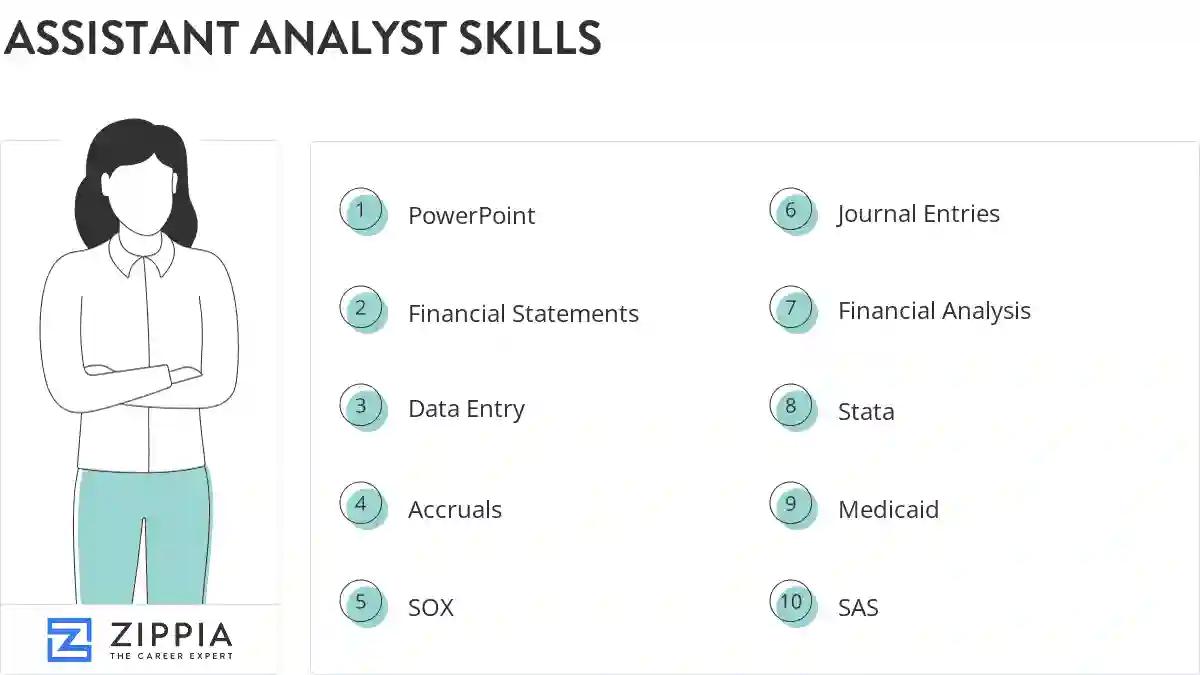
The most important skills for an assistant analyst resume and required skills for an assistant analyst to have include:
- PowerPoint
- Financial Statements
- Data Entry
- Accruals
- SOX
- Journal Entries
- Financial Analysis
- Stata
- Medicaid
- SAS
- R
- Data Analysis
- Variance Analysis
- Data Collection
- Conference Calls
- Windows
- SQL
- Financial Data
- Real Estate
- Research Reports
- Analyze Data
- Market Research
- Expense Reports
- Credit Card
- Management System
- Medicare
- Bloomberg
- Financial Reports
- Technical Analysis
- RAN
- Administrative Tasks
- HR
- GIS
- HIPAA
- Fundamental Analysis
- Industry Analysis
- Macroeconomic Analysis
- Corporate Policies
- Fixed Assets
- HPLC
- Statistical Data
- Customer Support
- Administrative Processes
Updated January 8, 2025
