Explore jobs
Find specific jobs
Explore careers
Explore professions
Best companies
Explore companies
Job outlook for assistant deans in the United States
Assistant dean job growth summary. After extensive research, interviews, and analysis, Zippia's data science team found that:
The projected assistant dean job growth rate is 7% from 2018-2028.
About 15,500 new jobs for assistant deans are projected over the next decade.
Assistant dean salaries have increased 7% for assistant deans in the last 5 years.
There are over 8,849 assistant deans currently employed in the United States.
There are 1,355 active assistant dean job openings in the US.
The average assistant dean salary is $83,688.
Are assistant dean jobs in demand?
Assistant dean job and salary trends over time
Assistant dean jobs over time
Assistant dean job growth rate over time
| Year | # of jobs | % of population |
|---|---|---|
| 2021 | 8,849 | 0.00% |
| 2020 | 7,992 | 0.00% |
| 2019 | 8,219 | 0.00% |
| 2018 | 8,137 | 0.00% |
| 2017 | 8,065 | 0.00% |
Average assistant dean salary over time
Assistant dean salary by year
| Year | Avg. salary | Hourly rate | % Change |
|---|---|---|---|
| 2025 | $83,688 | $40.23 | +2.2% |
| 2024 | $81,894 | $39.37 | +1.1% |
| 2023 | $80,976 | $38.93 | +2.1% |
| 2022 | $79,276 | $38.11 | +1.8% |
| 2021 | $77,903 | $37.45 | +2.5% |
Assistant dean jobs by state
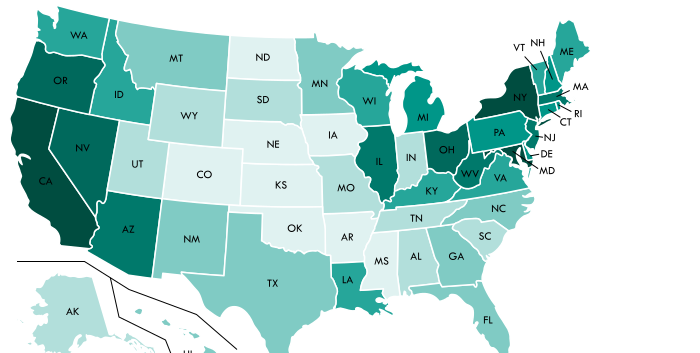
Most common states for assistant deans
| Rank | State | Population | # of jobs | Employment/ 1000ppl |
|---|---|---|---|---|
| 1 | District of Columbia | 693,972 | 23 | 3% |
| 2 | Alaska | 739,795 | 19 | 3% |
| 3 | New York | 19,849,399 | 111 | 1% |
| 4 | Massachusetts | 6,859,819 | 77 | 1% |
| 5 | Virginia | 8,470,020 | 65 | 1% |
| 6 | Colorado | 5,607,154 | 62 | 1% |
| 7 | Wisconsin | 5,795,483 | 43 | 1% |
| 8 | Connecticut | 3,588,184 | 29 | 1% |
| 9 | Oregon | 4,142,776 | 21 | 1% |
| 10 | West Virginia | 1,815,857 | 11 | 1% |
| 11 | Rhode Island | 1,059,639 | 9 | 1% |
| 12 | Maine | 1,335,907 | 7 | 1% |
| 13 | Vermont | 623,657 | 7 | 1% |
| 14 | Montana | 1,050,493 | 7 | 1% |
| 15 | South Dakota | 869,666 | 5 | 1% |
| 16 | Wyoming | 579,315 | 3 | 1% |
| 17 | California | 39,536,653 | 121 | 0% |
| 18 | Ohio | 11,658,609 | 34 | 0% |
| 19 | Maryland | 6,052,177 | 29 | 0% |
| 20 | Arizona | 7,016,270 | 22 | 0% |
Most common cities for assistant deans
| Rank | City | # of jobs | Employment/ 1000ppl | Avg. salary |
|---|---|---|---|---|
| 1 | Cambridge | 4 | 4% | $82,120 |
| 2 | Coral Gables | 2 | 4% | $65,713 |
| 3 | Amherst | 1 | 3% | $83,070 |
| 4 | Newark | 1 | 3% | $78,993 |
| 5 | Washington | 7 | 1% | $97,993 |
| 6 | Aurora | 2 | 1% | $51,490 |
| 7 | Boulder | 1 | 1% | $51,502 |
| 8 | Gainesville | 1 | 1% | $62,818 |
| 9 | Meridian | 1 | 1% | $73,471 |
| 10 | Pasadena | 1 | 1% | $94,669 |
| 11 | Tempe | 1 | 1% | $85,821 |
| 12 | Boston | 3 | 0% | $82,299 |
| 13 | Atlanta | 1 | 0% | $60,701 |
| 14 | Baltimore | 1 | 0% | $94,528 |
| 15 | Chicago | 1 | 0% | $81,431 |
| 16 | Indianapolis | 1 | 0% | $58,354 |
| 17 | Pittsburgh | 1 | 0% | $76,068 |
| 18 | Riverside | 1 | 0% | $93,171 |
Assistant Dean job outlook: Expert opinions
Our panel of assistant dean experts
University of Toledo
Melissa Gregory
Dean and ProfessorUniversity of Toledo
Liberal Arts And Sciences, General Studies And Humanities
What general advice would you give to an Assistant Dean?
Melissa Gregory: Melissa Valiska Gregory, Dean, College of Arts and Letters, University of Toledo, https://www.linkedin.com/in/melissa-gregory-193546290/, https://www.utoledo.edu/?utm_source=Google&utm_medium=PPC&utm_campaign=Gen-Enrollment&gad_source=1&gclid=Cj0KCQjwqpSwBhClARIsADlZ_TlC5r5c4-Sw7v9XW7tXvN3mlDs-TrgkdXuf8J8xwnvs7T-HF2gVPgoaAkYCEALw_wcB
What Assistant Dean skills would you recommend for someone trying to advance their career?
Melissa Gregory: I'm copying some UToledo faculty on this message in case you want to reach out to them for quotes:
Dr. Barry Jackisch, History
Dr. Patrick Lawrence, Geography and Planning
Dr. Kim Nielsen, Disability Studies
What will help Assistant Deans increase their earning potential?
Melissa Gregory: Today's contemporary liberal arts degrees typically do two things:
(1) prepare you for a lifetime of career adaptation by cultivating deep infrastructure skills such as communication, analysis, creativity, quantitative abilities, and others, which prepares you to adapt to the jobs that don't even exist, yet; and (2) offer you real-life professional experience in the form of internships and other kinds of hands-on training that provide you with specific credentials for graduate school or the current job market.
In other words, the key to a liberal arts degree is its flexibility. A liberal arts degree isn't as explicitly career-aligned as, say, a degree in pharmacy or engineering. But that is the whole point: a liberal arts degree takes the long view of how a graduate might advance successfully through a lifetime of work where economic, political, and technological forces regularly close out old jobs and create new opportunities (e.g., "sustainability" did not used to be a job category - now it is!). When coupled with professional experience, a flexible degree that has rigorously trained you to be smart and adaptive prepares you to enter the workforce quickly and also sets you up for long-term success.