
Automatically apply for jobs with Zippia
Upload your resume to get started.
Assistant designer skills for your resume and career

15 assistant designer skills for your resume and career
1. Sketch
- Assisted Designer with color selection, sketch development, proper fit concepts, and preparation of samples for buyer meetings.
- Communicate specifics about each design sketch by formulating technical packages to be sent to the production facilities utilizing Adobe Illustrator.
2. Tech Packs
A tech pack is an informative sheet that designers create to communicate with a manufacturer all the details and components necessary to turn a product into a finished product. It also serves as a "product contract" between a person and the manufacturer throughout the sampling and production process. Typically, designers include dimensions, materials, sketches, size specifications, colors, illustrations, hardware, grading, labels/tags, construction information, and legends. The tech pack is essential for quality control and also ensures that the submitted samples meet ones specifications exactly and that one does not waste time and money reproducing them if they are incorrect.
- Created and organized tech packs and merchandising/marketing materials.
- Design, tech packs, fabric/concept/design development
3. Adobe Illustrator
- Created line sheets for the Fall 2010, Holiday 2010, and Spring 2010 women's collection utilizing Adobe Illustrator.
- Designed with Head Designer using Adobe Illustrator on Fall/Winter (2011), Spring (2012) and handbag collections.
4. Line Sheets
A line sheet is a sales tool for product marketing and sales to display important information about a product to potential buyers and retailer partners. It is commonly used by manufacturers, wholesalers, brands, and designers in the fashion industry.
- Merchandised and assembled line sheets seasonally.
- Formulated and maintained line sheets, style guides, art sheets and rack guides and provided departments with updated information.
5. Trend Research
A trend is presumed future development that may have a long-term effect. Trend analysis is the practice of collecting data and attempting to spot a recurrence, or non-recurrence, pattern. This field revolves around predicting the future of a market based on data from past sales, client preferences, and demand.
- Traveled overseas for international trend research and theme inspiration for upcoming seasons.
- Cash handling, Customer Assistance, Customer Service, Designing, Sketching, Communicating with China, Trim and Trend Research
6. Garment Construction
Garment construction is a technical skill requiring the skills and knowledge of basic sewing techniques. These techniques include seams, darts, gathers, application of stitches, pleats, and edge finishing. Additionally, knowledge of various types of seams like a flat seam, lapped seam, French seam, and slot seam along with cut and style play an important role in the appearance of any garment.
- Generated technical design packages with full garment construction requirements for knit product development.
- Co-managed quality control department and gave instruction in garment construction and technique
Choose from 10+ customizable assistant designer resume templates
Build a professional assistant designer resume in minutes. Our AI resume writing assistant will guide you through every step of the process, and you can choose from 10+ resume templates to create your assistant designer resume.7. PLM
PLM stands for "product lifecycle management." This process is the management of a product's entire lifecycle, from when the product is first conceived and developed to when the product is sold and, eventually, disposed. A company may use PLM for a variety of reasons, most commonly to reduce the amount of errors in the manufacturing process and to ensure the product is sold more quickly.
- Trained co-workers across multiple divisions on PLM to efficiently communicate all Target approvals.
- Input information into Web PLM system and web store for factories to view and keep track of sample status.
8. Auto CAD
- Produced Auto CAD drawings for most interior elevations including cabinetry, electrical plans, and exterior landscape plans.
- Prepared Design documents using Auto Cad 2D and estimation of the total project cost.
9. Adobe Photoshop
- Created original print/pattern design using both Adobe Photoshop and Illustrator.
- Created original prints given minimal direction utilizing Adobe Photoshop.
10. Product Development
Product development is the complete procedure of creating a product from concept until release of the final product. Product development has many stages after which a product is released into the market. Identifying the need, creating the opportunity, conceptualizing a product, and providing a solution, all are different stages of product development.
- Administered product development process including sampling, prototype correction and final confirmation, sourcing and price negotiations.
- Focused various brand product developments, creating colorways to enhance merchandising opportunities.
11. Technical Design
Technical design is a blueprint or prototype design that explains the technical nature of an intended design and serves as a guide to engineers during the implementation process. It's a preliminary stage before the implementation of designs where engineers take out the time to study the sketch, and be guided on what to do as regards implementation and project delivery.
- Designed Specialty clothing for ski product line clothing while improving the quality and technical design details through strategic analysis and recommendations.
- Conveyed information provided by technical designer to factories to ensure quality control and overall garment expectations.
12. Presentation Boards
- Researched and analyzed fashion trends and prepared presentation boards.
- Created and developed seasonal presentation boards.
13. Design Development
Design development is used to refer to a number of positions and skills in a number of different industries. In the architectural world, Design Development is used to refer to an architectural plan that is already halfway or more done but needs further development, alteration, and testing. In the automotive industry, it refers to the skills necessary to create and develop new car, engine, and other designs, as well as to ensure that all designs are safe and effective.
- Assist lead designer in gathering information/material selection & design development of high-end residential and commercial design projects.
- Executed daily operations of filing, organizing, and ordering components for design development.
14. Concept Boards
- Assisted in trend forecasting and developed seasonal concepts -Created concept boards and accessorized for photo shoots
- Created concept boards identifying color and trend direction (trim, neckline and silhouette) utilized in seasonal designs.
15. Design Details
- Summarized design detail, measurement and email instructions to overseas factory.
- Research ideas on the seasonal design concepts, trims, design details, stripes, patterns, silhouettes, etc.
5 Assistant Designer resume examples
Build a professional assistant designer resume in minutes. Browse through our resume examples to identify the best way to word your resume. Then choose from 5+ resume templates to create your assistant designer resume.

What skills help Assistant Designers find jobs?
Tell us what job you are looking for, we’ll show you what skills employers want.
What skills stand out on assistant designer resumes?
Samantha Osborne
Assistant Professor of Graphic Design, Owner, Samantha Osborne Design, Eastern Illinois University
What soft skills should all assistant designers possess?
Samantha Osborne
Assistant Professor of Graphic Design, Owner, Samantha Osborne Design, Eastern Illinois University
i. An ability to see big picture: there are an infinite number of details in graphic design, whether you work in website design on the front or back end, or in print media with physical outputs. It's easy to get caught up on the details, especially when clients are making specific demands about things such as paper type. A skilled designer must be able to see beyond the details and look at the big picture for an effective design solution. For example, a client may be asking for an invitation design for an up-coming event. A skilled designer will ask questions and dig in, eventually uncovering that perhaps for a successful event, the client also needs a splash page and social media, either in place of or in addition to an invitation. A skilled designer addresses design problems holistically, rather than minutely.
ii. An ability to "read" people: designers are trained in art-specific vocabulary. Hue, saturation, pixels, gestalt...most non-art folks don't use or speak that language. When clients are describing their goals, they aren't using art-vocabulary. It's a designer's job to translate what the client is saying into an advanced and effective creative solution. They must be able to speak and understand the language of non-creative folks, as well as the language of the broader creative industry.
iii. An ability to make a convincing argument for your design solution(s): many young and inexperienced designer tend to get their hearts broken when a client smashes one of their [very well thought-out] ideas. Rather than rolling over, a designer must learn to navigate how best to build support for their idea(s). That might mean in some instances you work more fluidly with the client throughout the design process, so that they feel they have ownership in the development of the solution. In other instances it might mean that the designer is presenting options, rather than a single solution, so that the client feels empowered to make choices throughout the design process. And in some instances, it might be a matter of better explaining and presenting your idea to a client; perhaps the designer needs to push back more, perhaps they need to provide more research as to why their solution is best, or maybe they simply need to present it with more excitement and enthusiasm.
What hard/technical skills are most important for assistant designers?
Lorrie Ivas
Full-time Faculty, Santa Monica College
What assistant designer skills would you recommend for someone trying to advance their career?
Gina Pisut Ph.D.
Chair, Department of Human Sciences
What type of skills will young assistant designers need?
Barbara Anderson
Professor and Head, Kansas State University
List of assistant designer skills to add to your resume
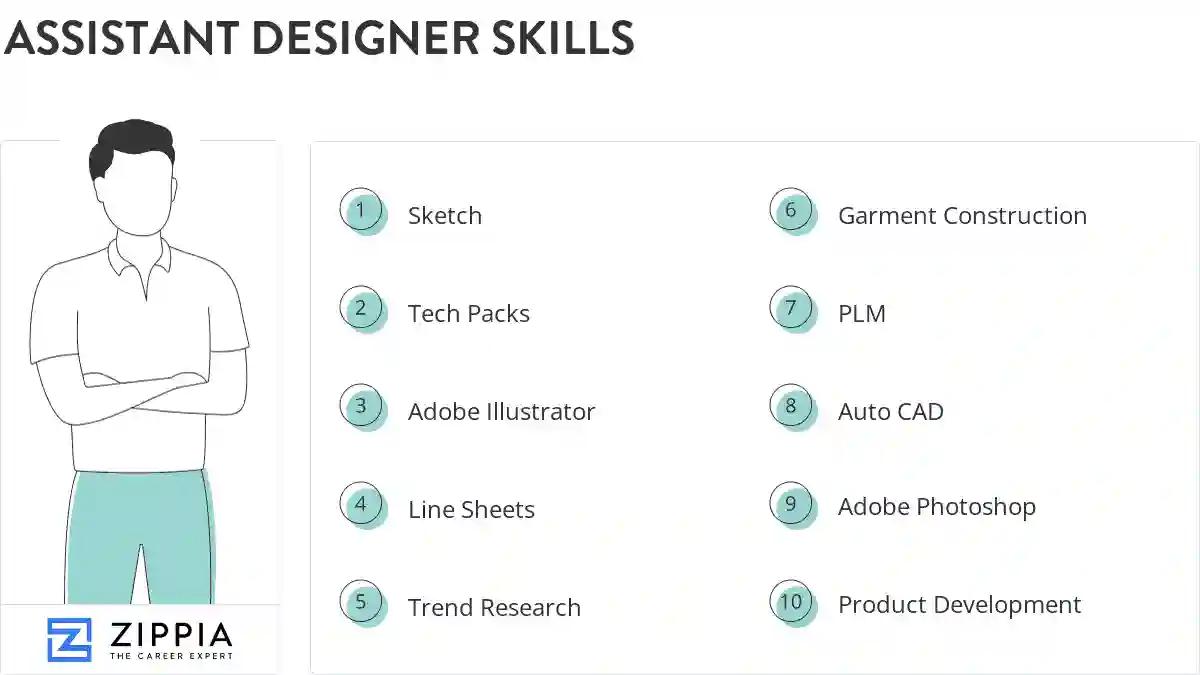
The most important skills for an assistant designer resume and required skills for an assistant designer to have include:
- Sketch
- Tech Packs
- Adobe Illustrator
- Line Sheets
- Trend Research
- Garment Construction
- PLM
- Auto CAD
- Adobe Photoshop
- Product Development
- Technical Design
- Presentation Boards
- Design Development
- Concept Boards
- Design Details
- Design Process
- Market Research
- Mood Boards
- Lab Dips
- Development Process
- Technical Sketches
- Embroidery
- Design Ideas
- BOM
- Design Concepts
- Sample Development
- Technical Drawings
- Strike Offs
- Color Palettes
- Design Meetings
- Design Boards
- Photo Shoots
- Sample Room
- Color Cards
- Solidworks
- Trend Boards
- Production Samples
- Color Standards
- Trade Shows
- Cost Sheets
- Space Planning
- Color Boards
- Conceptual Development
- Line Development
- Web PDM
- Overseas Vendors
- Color Ways
- PowerPoint
Updated January 8, 2025
