Explore jobs
Find specific jobs
Explore careers
Explore professions
Best companies
Explore companies
Job outlook for assistant professors of mathematics in the United States
Assistant professor of mathematics job growth summary. After extensive research, interviews, and analysis, Zippia's data science team found that:
The projected assistant professor of mathematics job growth rate is 12% from 2018-2028.
About 159,400 new jobs for assistant professors of mathematics are projected over the next decade.
Assistant professor of mathematics salaries have increased 6% for assistant professors of mathematics in the last 5 years.
There are over 6,458 assistant professors of mathematics currently employed in the United States.
There are 35,084 active assistant professor of mathematics job openings in the US.
The average assistant professor of mathematics salary is $65,586.
Are assistant professor of mathematics jobs in demand?
Assistant professor of mathematics job and salary trends over time
Assistant professor of mathematics jobs over time
Assistant professor of mathematics job growth rate over time
| Year | # of jobs | % of population |
|---|---|---|
| 2021 | 6,458 | 0.00% |
| 2020 | 7,250 | 0.00% |
| 2019 | 7,484 | 0.00% |
| 2018 | 7,498 | 0.00% |
| 2017 | 7,443 | 0.00% |
Average assistant professor of mathematics salary over time
Assistant professor of mathematics salary by year
| Year | Avg. salary | Hourly rate | % Change |
|---|---|---|---|
| 2025 | $65,586 | $31.53 | --0.1% |
| 2024 | $65,622 | $31.55 | +0.6% |
| 2023 | $65,212 | $31.35 | +3.3% |
| 2022 | $63,146 | $30.36 | +2.0% |
| 2021 | $61,908 | $29.76 | +3.5% |
Assistant professor of mathematics jobs by state
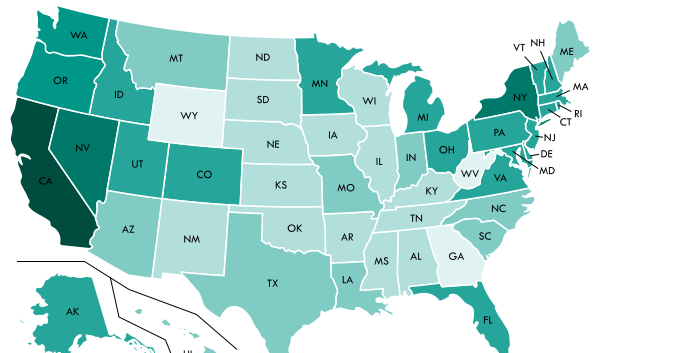
Most common states for assistant professors of mathematics
| Rank | State | Population | # of jobs | Employment/ 1000ppl |
|---|---|---|---|---|
| 1 | District of Columbia | 693,972 | 232 | 33% |
| 2 | Alaska | 739,795 | 189 | 26% |
| 3 | Vermont | 623,657 | 96 | 15% |
| 4 | Virginia | 8,470,020 | 1,118 | 13% |
| 5 | Colorado | 5,607,154 | 753 | 13% |
| 6 | West Virginia | 1,815,857 | 211 | 12% |
| 7 | Kentucky | 4,454,189 | 471 | 11% |
| 8 | Oregon | 4,142,776 | 435 | 11% |
| 9 | Montana | 1,050,493 | 120 | 11% |
| 10 | Massachusetts | 6,859,819 | 701 | 10% |
| 11 | Indiana | 6,666,818 | 652 | 10% |
| 12 | Nebraska | 1,920,076 | 191 | 10% |
| 13 | Rhode Island | 1,059,639 | 105 | 10% |
| 14 | South Dakota | 869,666 | 90 | 10% |
| 15 | New York | 19,849,399 | 1,776 | 9% |
| 16 | Maryland | 6,052,177 | 571 | 9% |
| 17 | Minnesota | 5,576,606 | 516 | 9% |
| 18 | Iowa | 3,145,711 | 293 | 9% |
| 19 | Delaware | 961,939 | 83 | 9% |
| 20 | New Hampshire | 1,342,795 | 113 | 8% |
Most common cities for assistant professors of mathematics
| Rank | City | # of jobs | Employment/ 1000ppl | Avg. salary |
|---|---|---|---|---|
| 1 | Newark | 4 | 12% | $74,136 |
| 2 | Gainesville | 2 | 2% | $68,288 |
| 3 | Fairfield | 1 | 2% | $70,617 |
| 4 | Washington | 2 | 0% | $75,952 |
| 5 | Chicago | 1 | 0% | $59,198 |
| 6 | Los Angeles | 1 | 0% | $107,245 |
Assistant Professor Of Mathematics job outlook: Expert opinions
Our panel of assistant professor of mathematics experts
Tiffin University
Kean University
North Carolina State University
California State University - Fresno
College of the Marshall Islands
University of South Florida
Franklin and Marshall College
AGWA - American Grant Writers' Association, Inc.
Texas State University

Seattle University
What will help Assistant Professors Of Mathematics increase their earning potential?
Alex Holte PhD: When you are starting out at any career, it is important to negotiate your salary. Many candidates feel that they have to accept their first offer, but in reality, at many jobs, there is some room for negotiation. Be mindful however, to not request a salary that is much higher than what is being offered as they may feel like a compromise would not be possible and move on to the next candidate.
Dr. Stephanie Opfer
Associate Professor of English, Assistant Dean of the School of Creative and Media ArtsTiffin University
Visual And Performing Arts
What will help Assistant Professors Of Mathematics increase their earning potential?
Dr. Stephanie Opfer: Unfortunately, teaching as an adjunct does not pay well. Students should keep their full-time jobs and teach part-time until they find a full-time job at a college or university. That part-time teaching provides them valuable experience and connections that make them more competitive candidates for full-time positions because they'd also be competing with candidates who have PhDs. So adjunct work is more of a long-term investment rather than an immediate return. Also, even full-time teaching jobs don't pay particularly well, so they'll really need to love teaching if they want to do it full-time. If they don't like teaching as an adjunct, they won't like doing it full-time.
What will help Assistant Professors Of Mathematics increase their earning potential?
Mia Fiore Ph.D.: Maximize your salary potential by teaching at a state school- if you do you can join the PSLF program and after ten years, your student loans will be forgiven.
Jane Kuandre
Associate ProfessorWhat Assistant Professor Of Mathematics skills would you recommend for someone trying to advance their career?
Jane Kuandre: Some essential skills for success in academia include critical thinking, effective communication, time management, and the ability to work both independently and collaboratively.
What general advice would you give to an Assistant Professor Of Mathematics?
Mario Bencomo: Programming is vital in applied mathematics and should be incorporated into courses. Having teaching pedagogy in incorporating programming at varying levels for courses that can be traditionally taught without these skills will be extremely valuable to future mathematics departments.
What Assistant Professor Of Mathematics skills would you recommend for someone trying to advance their career?
Mario Bencomo: Have as many relevant experiences towards tenure (relative to your university's/department's expectations). This includes: teaching and course development, grant writing, research publications, etc. You should be leveraging your graduate/post-doc experiences to give you these opportunities.
What will help Assistant Professors Of Mathematics increase their earning potential?
Mario Bencomo: Time management is everything! The biggest challenge will be to juggle 100 different deadlines any given week, with varying levels of priority. You will need to learn to prioritize and dedicate a proportional amount of time to each activity. Figure out what organizational tool works best for you and be flexible to adapt.
What will help Assistant Professors Of Mathematics increase their earning potential?
Alexander Velasquez: I think everyone should look into their career fields and find out what it is that makes you more valuable in that field. Are there any certifications that you can get? What is it that you need to know or learn that companies will find valuable? Much can be learned online, so pick up as many of those skills as you can, and make sure they're on your resume or CV. I believe all those things could maximize salary potential, especially when starting out.
What soft skills should all Assistant Professors Of Mathematics possess?
Lee Braver: Soft skills are most important to working once one has gotten a job rather than important to getting a job since those are quite difficult to discern from applications and brief interviews. That is one of the reasons schools can be wary of hiring with tenure; a person could look great on paper but be a nightmare to work with, and you're stuck with them.
I believe that tenacity, organizational skills and time management, and the ability to work long hours are crucial to getting tenure and succeeding in academia more broadly, in some ways more important than raw intelligence (if such a notion is coherent). Failure and rejection are endemic to the job; anyone who gets discouraged easily will do so. One must persevere in the face of sometimes harsh criticism and hostile conditions (especially now that much of the country has turned against higher education and the humanities in particular), and one must be able to juggle multiple responsibilities that make considerable time demands. In this, the tenure track resembles other early-career positions, such as medical residency or working towards partnership in a law firm. The untenured often must do the scut work that no one else wants to do, made more difficult by the fact that they are frantically trying to learn on the job with little to no guidance. It is not at all unusual for early-career professors to teach 4 classes per semester, at least some of which are new and/or large, do all the grading for them, serve on multiple committees, and write for elusive publications, all at once.
What hard/technical skills are most important for Assistant Professors Of Mathematics?
Lee Braver: Well, a Ph.D. is necessary, although one can sometimes be hired within striking distance of it. The ability to teach so as to bring students to the major and get high student evaluations are often requirements at teaching schools while writing well enough to publish, often in journals with single-digit acceptance rates, is crucial to research schools. Comfort with technology is becoming more and more important.
What skills will help Assistant Professors Of Mathematics earn the most?
Lee Braver: Let's see-an M.B.A., the ability to pick winning lottery numbers, being repelled by the humanities so that one goes into business-those would be pretty useful for making money. No one should go into academia for the money, not just not for wealth but even for a comfortable living, which is becoming more difficult to achieve in America in general. It is nearly impossible to make a living as an adjunct professor, which is where the profession is heading. There are many good-paying jobs, but those tend to congregate at the elite schools, the ones that emphasize research the most, and these are the fewest and hardest to get. Worse-paying jobs are also hard to come by, and the competition is just getting stiffer as more Ph.D.'s get dumped into the market each year which is itself accreting all those who did not land jobs in the previous years. At many institutions, raises are minimal since jobs are so hard to come by, and there's little else that rewards a humanities Ph.D. The only way to get a substantial raise is to get a credible offer from another institution and hope that yours wants to keep you enough to overbid them; otherwise, you're stuck, especially after getting tenure, and they know it. That's why tenure is called "golden handcuffs," though I think a better name might be something like velvet handcuffs, given gold's connotation of wealth.
How would you rate the starting salaries for Assistant Professors Of Mathematics, as well as the prospects for salary advancement?
David McMahan Ph.D.: Graduates in Religious Studies don't necessarily go into careers in religion. The standard career path for those involved is going to graduate school, spending several years getting a Ph.D., and facing a tough job market. Starting salaries can vary widely depending on the college or university.
What are the biggest trends we'll see in the Assistant Professor Of Mathematics job market given the pandemic?
John Porter Ph.D.: This will depend on what happens in the next six months or so. If the economy stays open and business can operate as it did a year ago, the trend will be more positive. When the economy is working, people are more financially secure. They have money to donate to foundations, and corporations have more profits to put into their funding resources.
If the economic shutdown increases where both businesses and individuals earn less money, there will be less money available for grant funding. The majority of grant funding comes from donations by everyday individuals.
If the economic shutdown is prolonged, then there will be an increase in government grant programs. The government gets its financial resources for things like grants by taxation. So individual taxes will likely increase.
Another line to balance is the excessive taxation of the rich. Nearly all very wealthy people have established a foundation where they give some of their wealth to grant awards to community non-profit organizations. When the government increases the taxes on this group, the excess money goes to the government to spend rather than local non-profits.
Are there any particularly good places in the United States for Assistant Professors Of Mathematics to find work opportunities?
Dr. Rodney Rohde Ph.D.: There are large vacancy rates all over the country. This is a good news/bad news issue. However, with a degree in medical laboratory science (also known as a clinical laboratory science) AND certification, one can find employment anywhere in the U.S. One of the great things about this career is that graduates honestly can decide where they "fit best" with regard to geography and employer (urban, rural, large, or small).
Alexander Mouton
Chair, Associate ProfessorSeattle University
Department of Art, Art History & Design
Will there be an enduring impact of the coronavirus pandemic on Assistant Professors Of Mathematics?
Alexander Mouton: It is hard to tell how the coronavirus pandemic will affect graduates. Some I know are joining the workforce or doing creative work, which is a good sign. How this will play out will be interesting to see, though it's a little hard for me to judge from the classroom!