Explore jobs
Find specific jobs
Explore careers
Explore professions
Best companies
Explore companies
Job outlook for associate relations specialists in the United States
Are associate relations specialist jobs in demand?
Associate relations specialist job and salary trends over time
Associate relations specialist jobs over time
Associate relations specialist job growth rate over time
| Year | # of jobs | % of population |
|---|---|---|
| 2021 | 520 | 0.00% |
| 2020 | 524 | 0.00% |
| 2019 | 524 | 0.00% |
| 2018 | 512 | 0.00% |
| 2017 | 500 | 0.00% |
Average associate relations specialist salary over time
Associate relations specialist salary by year
| Year | Avg. salary | Hourly rate | % Change |
|---|---|---|---|
| 2025 | $52,142 | $25.07 | +2.7% |
| 2024 | $50,764 | $24.41 | +1.9% |
| 2023 | $49,809 | $23.95 | +1.2% |
| 2022 | $49,228 | $23.67 | +2.2% |
| 2021 | $48,166 | $23.16 | +2.2% |
Associate relations specialist jobs by state
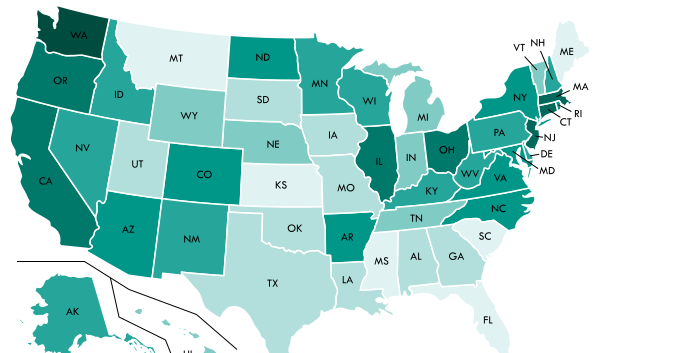
Most common states for associate relations specialists
| Rank | State | Population | # of jobs | Employment/ 1000ppl |
|---|---|---|---|---|
| 1 | District of Columbia | 693,972 | 257 | 37% |
| 2 | Wyoming | 579,315 | 56 | 10% |
| 3 | Massachusetts | 6,859,819 | 607 | 9% |
| 4 | Iowa | 3,145,711 | 285 | 9% |
| 5 | Delaware | 961,939 | 89 | 9% |
| 6 | Vermont | 623,657 | 54 | 9% |
| 7 | Nebraska | 1,920,076 | 148 | 8% |
| 8 | South Dakota | 869,666 | 67 | 8% |
| 9 | Alaska | 739,795 | 60 | 8% |
| 10 | Virginia | 8,470,020 | 633 | 7% |
| 11 | Maryland | 6,052,177 | 409 | 7% |
| 12 | Minnesota | 5,576,606 | 378 | 7% |
| 13 | Oregon | 4,142,776 | 300 | 7% |
| 14 | Utah | 3,101,833 | 223 | 7% |
| 15 | Rhode Island | 1,059,639 | 76 | 7% |
| 16 | North Dakota | 755,393 | 55 | 7% |
| 17 | Illinois | 12,802,023 | 732 | 6% |
| 18 | North Carolina | 10,273,419 | 632 | 6% |
| 19 | Arizona | 7,016,270 | 410 | 6% |
| 20 | Colorado | 5,607,154 | 318 | 6% |
Most common cities for associate relations specialists
| Rank | City | # of jobs | Employment/ 1000ppl | Avg. salary |
|---|---|---|---|---|
| 1 | East Brunswick | 1 | 2% | $60,749 |
| 2 | Overland Park | 1 | 1% | $42,073 |
| 3 | Miami | 1 | 0% | $41,799 |
| 4 | Philadelphia | 1 | 0% | $52,775 |
| 5 | Washington | 1 | 0% | $63,225 |
Associate Relations Specialist job outlook: Expert opinions
Our panel of associate relations specialist experts
Grand Valley State University
Elon University
Bowie State University
University of Florida
Wartburg College
San Francisco State University
Loyola University New Orleans
Dominican University of California
What general advice would you give to an Associate Relations Specialist?
Dr. Joy Daggs: I think making yourself the most well-rounded candidate you can be is the best way to maximize your salary potential. Try lots of things in your undergraduate experience. What you think you want to do as a freshman may not be as appealing after you try it. Most jobs do not require only one skill, so having a variety of skills where you can plug in several places in an organization is helpful. Even if you want to go into something like event planning, you still need writing skills, design skills, interpersonal skills, etc. to do that job effectively.
Don't be afraid to negotiate your salary. There are workshops from organizations such as AAUW (American Association of University Women) to help you build those skills.
What will help Associate Relations Specialists increase their earning potential?
Dr. Joy Daggs: I have quite a bit of advice:
1. Get as much experience as an undergraduate as possible. Many programs require internships, but even if they don't, seek opportunities to get experience. Take leadership roles in student organizations. Even if it's not specifically a 'public relations' entitled position, anything where you practice your skills is helpful. Even if you need to work a job in retail or service, those jobs still provide important benefits other than a paycheck. Don't discount your experiences!
2. Don't pass up opportunities to meet professionals. Many schools and departments bring their alumni on campus or do virtual events so that you can meet and chat with professionals. Even if it's not required for class, GO. You never know when a casual conversation may lead to an internship or an important professional connection.
3. Use your LinkedIn profile to your advantage. Make sure you have a professional picture that shows you in your best light. Follow organizations that you want to work for and other professional organizations related to your interests. I know of people getting interviews based off of LinkedIn interactions. Check your other social media accounts to make sure that you are not presenting yourself poorly. Most likely, organizations will Google you or look up your personal social media. There are reports of students losing opportunities because of poor social media choices.
What Associate Relations Specialist skills would you recommend for someone trying to advance their career?
Dr. Mikhila Wildey PhD: I think the ability to engage and connect with people will be very important in the field as we shift more and more to a culture that is driven by AI. Although AI can be a useful tool, it likely won’t ever fully replace the value of human interaction and connection. In addition, employers often comment that they want to see employees with strong work ethic, and I think this will continue to be the case in 3-5 years. Having a strong work ethic can separate the people that move forward in their careers to those who remain stagnant.
What will help Associate Relations Specialists increase their earning potential?
Dr. Mikhila Wildey PhD: My general advice for a graduate beginning their career in the field is to work hard, stay open-minded, and network! Most employees won’t stay in the same position for their entire career, and so I often tell graduates to not get too hung up on the first job needing to be the 'perfect' job for them. Often, the first job will be a place where they learn how to navigate the workplace, learn about their own strengths/weaknesses, and figure out what they like and don’t like. I encourage graduates to use this information to help them make decisions about the next steps in their career. And, if they are working hard and networking with people at their job, then opportunities will often times present themselves or be more available to them as they navigate their future career path.
What general advice would you give to an Associate Relations Specialist?
Kenn Gaither Ph.D.: Adopt a growth mindset and keep learning. The skills from college are still valuable and useful, but so too is the ability to stay at the forefront of relevant trends. Public relations practitioners are strategic communicators, requiring disciplinary expertise, knowledge of cultural and technological trends and news, and a broad skill set. Continuing to invest in these areas will give a new graduate both a competitive edge and pathway for upward mobility.
What Associate Relations Specialist skills would you recommend for someone trying to advance their career?
Dr. Rochelle Daniel: My general advice to a graduate who transitions into that first professional job in the Communication field is similar to advice I give Communication students for navigating internship workspaces (Communications Internship Handbook: What HBCU Students Need to Know, 2022). Be intentional about learning the organizational or office culture, really listen to find out what is expected of you, be flexible and adaptable when there are changes in workflow, and don't be afraid to ask questions.
Dr. Rebecca Frazer
Assistant Professor of Public RelationsUniversity of Florida
Public Relations, Advertising, And Applied Communication
What will help Associate Relations Specialists increase their earning potential?
Dr. Rebecca Frazer: Be eager, flexible, and willing to learn. Entry-level PR positions often involve a broad range of different tasks that may require the employee to quickly teach themselves new skills, software, and applications. Demonstrating an ability to catch on quickly and an eagerness to take on new challenges goes a long way in impressing an employer.
What Associate Relations Specialist skills would you recommend for someone trying to advance their career?
Dr. Penni Pier: You must be confident in the skill sets you have and negotiate for a beginning salary that is commensurate with your skills. A lot of emerging professionals shy away from negotiation (or making the right fit for that matter) because they are afraid of turning down a job. Interviews and the first series of negotiations set the tone for the relationship you will have with your employer. You also must be willing to look in geographic areas and related industries that need your skill sets to make give you the most opportunities to be choosy with your first professional position. While at your first position, it is important to make sure that your portfolio stays current, and they you are continuing to do professional development. Be proactive and learn (or enhance) any skills you find lacking. Work on client interaction and how to be a good collaborator with your colleagues. If you do these things and there is room for advancement with the organization that first hired, you this will give you a “leg up” in terms of salary potential. If there is not opportunity for advancement a first position will give you tangible work experience for your portfolio and an opportunity to practice your skills which in turn will make you more marketable if or when you decide to move on.
What general advice would you give to an Associate Relations Specialist?
Dr. Nick DiFrancesco: Communication- many grads lack even basic communication skills such as presenting, writing, or conversation; the industry is going to be seeking out not just the best and brightest, individuals who are personable, can relate and have rational discussions with others. The inability to engage in conversation and debate, or network with others is a serious issue among students, and these are skills that are absolutely vital to any professional.
What Associate Relations Specialist skills would you recommend for someone trying to advance their career?
Dr. Geri Merrigan: Listening, empathy, and perspective-taking remain as important as ever, because change is the only certainty, and globalization connects us to people quite different from ourselves. That means skills for inclusive communication matter – analyzing an audience and crafting messages for diverse stakeholders. Finally, understanding the technology (especially AI) that is most consequential for your industry/sector, for Communication Studies majors, means understanding current events, reading about AI, and evaluating the credibility of what you read.
Jeffrey Ory
President & CEO, il Stratega Marketing & Public Relations, Adjunct ProfessorLoyola University New Orleans
Public Relations, Advertising, And Applied Communication
What will help Associate Relations Specialists increase their earning potential?
Jeffrey Ory: Starting a career in public relations can be an exhilarating journey, filled with opportunities to shape perceptions and craft compelling narratives. As you embark on this path, there are a few foundational strategies that can enhance your success in the dynamic field of PR. First and foremost, cultivating a robust network is essential. The heart of public relations lies in forging strong connections. Engage actively with colleagues, journalists, and industry professionals. This can be achieved by attending industry events, participating in relevant organizations, and maintaining a vibrant presence on professional social media platforms like LinkedIn. These relationships will not only provide valuable insights and opportunities but also support your growth in the field. Equally important is honing your communication skills. In public relations, your ability to articulate ideas clearly and persuasively is paramount. Dedicate time to refining your writing and speaking abilities, ensuring you can deliver clear, concise, and compelling messages tailored to various audiences and media formats. This skill set is your toolkit, enabling you to convey your clients' messages effectively and resonate with your target audience. Staying informed cannot be overlooked. The landscape of public relations is constantly influenced by shifting industry trends, breaking news, and technological advancements. By keeping abreast of these changes, you can better anticipate and meet the needs of your clients and the media, thus solidifying your role as a knowledgeable and indispensable asset. Practical experience is another cornerstone of a successful PR career. Seek out internships or entry-level positions within PR agencies or in-house teams. These opportunities are invaluable for understanding the industry's dynamics from the inside out, providing a real-world context to the theories and strategies learned in academic settings. Lastly, embracing a proactive and creative mindset is crucial. Public relations thrive on innovation and initiative. Be ready to propose new ideas, tackle challenges with creative solutions, and manage crises with agility and poise. Your ability to think outside the box and act decisively in high-pressure situations will set you apart in the fast-paced world of public relations.
What will help Associate Relations Specialists increase their earning potential?
Elizabeth Foster Ph.D.: Be open to new experiences that may be different from the career path you originally had in mind. Remember, your first job will not be your last! Often students are exposed to new areas they had not previously considered in which they end up thriving. Starting in an agency is an excellent way to be exposed to a range of job functions and clients.
Kevin Faigle
Media Relations SpecialistWhat Associate Relations Specialist skills would you recommend for someone trying to advance their career?
Kevin Faigle: That's tough to answer. But one, try to see what other similar positions are being paid. There are plenty of websites where you can find salary ranges for positions and that may give a good basis for a starting point. Also, be sure to track everything you are good at and build that resume up. Sometimes a HR department will have a salary range in the job posting, and don't be afraid to ask for the higher amount or even negotiate. 100% of the questions you don't ask, the answer is no. If you are confident in your ability and confident in your background, then show that and push for a higher salary level.
Bradley Van Alstyne Ph.D.
Assistant Professor of Communications, Coordinator, Online Learning and Development, Chair of the Communications and Media Studies DepartmentDominican University of California
Communication and Media Studies
What skills will help Associate Relations Specialists earn the most?
Bradley Van Alstyne Ph.D.: The hard skills (audio and video) usually get you the job, but the soft skills allow you to keep it and grow!