
Automatically apply for jobs with Zippia
Upload your resume to get started.
Associate scientist, research and development skills for your resume and career
15 associate scientist, research and development skills for your resume and career
1. R
R is a free software environment and a language used by programmers for statistical computing. The R programming language is famously used for data analysis by data scientists.
- Designed R-statistical algorithms and wrote R codes to develop numerical regression.
- Created and validated R based automated analysis scripts for quality control release of manufactured materials.
2. Data Analysis
- Challenged with increasing product performance through material advancements, data analysis, and manufacturing process optimization for grid scale battery manufacturer.
- Responded to customer inquiries for data analysis and offered guidance for better usage of biochemical/ kits products to improve customer satisfaction.
3. Cell Culture
- Propagate and expand cell cultures to provide cells to all scientists in the research and development group.
- Provide cell culture support for product and equipment qualifications.
4. HPLC
- Determine pH solution stability and solubility profile, Help on method development and assay determination by HPLC.
- Developed and validated HPLC, GC and Karl Fischer methods for lead compounds/intermediates and related materials.
5. Method Development
- Worked closely with Principal Scientist for UPLC-based method development for assay and related substances methods.
- Monitor client contracts and protocols for method development (MD) then write analytical plans based on client specifications.
6. GMP
GMP stands for Good Manufacturing Practice. It is a system that ensures that all products like food, beverages, and medicinal drugs that are produced comply with the quality standards. It helps in minimizing the risks and hazards that cannot be eliminated after the testing of final products.
- Developed purification processes used for GMP manufacturing.
- Conducted multiple 5+ kilogram GMP campaigns in 100L - 400L reactors.
Choose from 10+ customizable associate scientist, research and development resume templates
Build a professional associate scientist, research and development resume in minutes. Our AI resume writing assistant will guide you through every step of the process, and you can choose from 10+ resume templates to create your associate scientist, research and development resume.7. PCR
PCR stands for Polymerase Chain Reaction, a tool to make millions of copies of a target part of DNA. Polymerase chain reaction involves the process of heating and cooling. The process takes place using a machine, which helps in heating and cooling off the substances. The purpose of heating exists to separate the DNA into two single strands.
- Project Management for Assay Development and Qualification of Real-Time PCR assays for relative gene expression level determination in cross-pollinated plants.
- Mentored other departments in design and implementation of PCR and high resolution melting analysis research studies and collaborations.
8. Analytical Methods
An analytical method is a method used to determine the chemical or physical property of a substance. It is a procedure to determine the relationship between different variables. This method can be conducted by combining scientific methods with any kind of formal process to solve a problem or prove a fact.
- Develop, optimize and validate analytical methods for testing a variety of developmental drug candidates.
- Authored scientific protocols, reports and analytical methods.
9. Assay Development
Assay development is a process in molecular biology to test or measure the activity of a drug or biochemical substance in an organic sample or organism and to screen putative compounds to determine the interaction and/or modification of the target. The aim is to standardize the assay and to be able to use it repeatedly and reproducibly.
- Provided technical support and troubleshooting of HIV diagnostic assay development process.
- Provided support for current products, customers, services, manufacturing through functional QC's, assay development and reagent qualifications.
10. Test Methods
Test methods are the steps in which thorough testing is conducted in a laboratory setting.
- Designed, developed, and documented test methods using new and existing laboratory equipment.
- Performed EP/USP compendial test methods.
11. Next-Generation Sequencing
- Led execution of research evaluation study to prepare Small-RNA sequencing libraries from clinical samples for Next-Generation sequencing.
- Analyzed various types of complex data including Next-generation sequencing data.
12. Elisa
An enzyme-linked immunosorbent assay or ELISA is an examination or test to measure and detect a person's specific antigen, antibodies, and protein. This type of test will identify if the sample component is infected with a relative disease or condition such as HIV infection, anemia, Zika Virus, and Lyme disease with just a single experiment.
- Experienced scientist in standardizing ELISA assays for existing and synthetic molecules in cancer therapy for Personalized Drug Management.
- Utilized Elisa, fluorescence polarization assay to identify the target.
13. Product Development
Product development is the complete procedure of creating a product from concept until release of the final product. Product development has many stages after which a product is released into the market. Identifying the need, creating the opportunity, conceptualizing a product, and providing a solution, all are different stages of product development.
- Research and development position assisting with two media product developments through validation, verification, and stability testing.
- Collaborate with teams to troubleshoot and solve new product development-related problems and execute quality control activities.
14. Technical Reports
Technical reports are a type of document that is used to indicate either the progress, result, or process of scientific research or the state of problems occurring within such research. A technical report may also showcase the report's overall conclusion and may also include recommendations. This kind of report does not require a peer review and isn't published officially but distributed within the organizations where it was formed.
- Analyzed complex scientific results and prepared summaries and technical reports.
- Tabulated, graphed, and prepared technical reports for senior personnel.
15. RNA
A Ribonucleic acid (RNA) has a vital role in determining the biological macromolecule commonly found in all bodily cells. It is the synthesis of protein, carriers message instruction from the Deoxyribonucleic acid or DNA. RNA is a kind of single-stranded cell that has different forms. It allows the molecule to go back and forth to its original condition.
- Developed a binding experiment utilizing fluorescence polarization to screen discovery compounds for interaction with various RNA constructs.
- Characterized the therapeutic RNA product, for tumor-source and process-related impurities.
5 Associate Scientist, Research And Development resume examples
Build a professional associate scientist, research and development resume in minutes. Browse through our resume examples to identify the best way to word your resume. Then choose from 5+ resume templates to create your associate scientist, research and development resume.

What skills help Associate Scientists, Research And Development find jobs?
Tell us what job you are looking for, we’ll show you what skills employers want.
What skills stand out on associate scientist, research and development resumes?
Rev. Grace Song
Won Buddhist Studies Department Chair, Won Institute
-Ability to facilitate discussion and various meditation exercises
-Experience teaching online and offline
-High level of cultural humility
What soft skills should all associate scientist, research and developments possess?
Rev. Grace Song
Won Buddhist Studies Department Chair, Won Institute
-Good time management skills
-Ability to resolve conflicts
-Self-aware
-Values collaboration
What hard/technical skills are most important for associate scientist, research and developments?
Rev. Grace Song
Won Buddhist Studies Department Chair, Won Institute
-Certificated mindfulness instructor
-Experience running retreats/workshops
What associate scientist, research and development skills would you recommend for someone trying to advance their career?
Scott Johnson
Professor and Director, University of Maine
What type of skills will young associate scientist, research and developments need?
Joe Harrison
Animal Scientist and Extension Specialist, Washington State University
What technical skills for an associate scientist, research and development stand out to employers?
Dr. Joey Neilsen
Assistant Professor, Villanova University
List of associate scientist, research and development skills to add to your resume
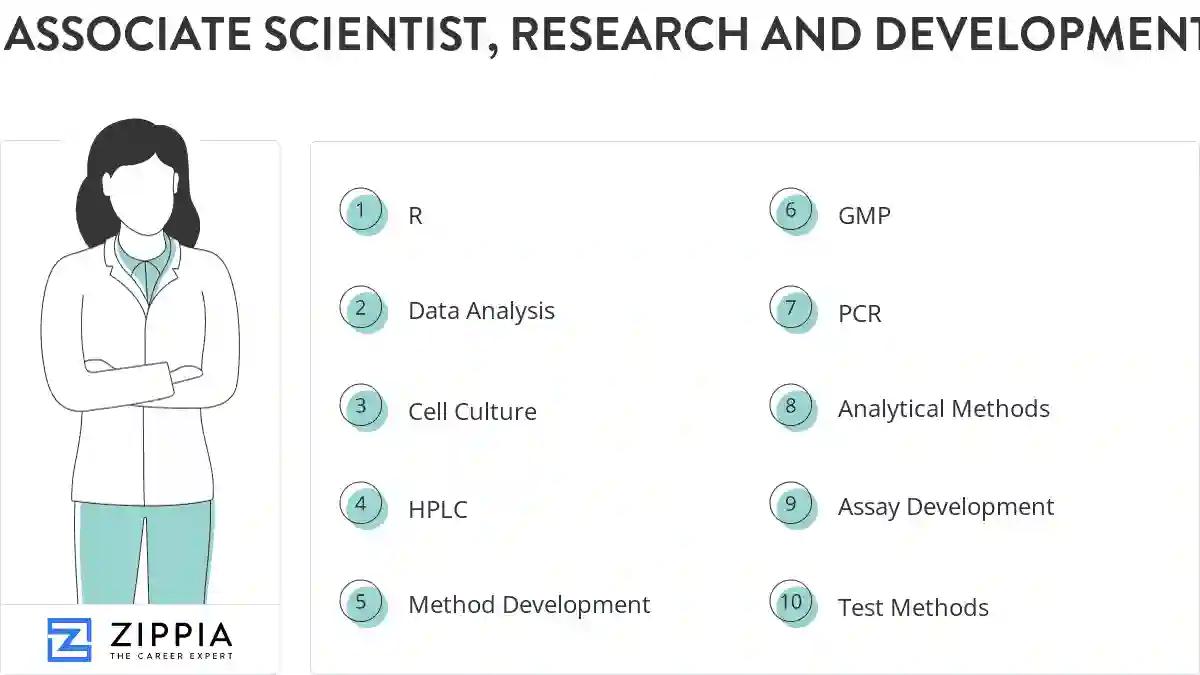
The most important skills for an associate scientist, research and development resume and required skills for an associate scientist, research and development to have include:
- R
- Data Analysis
- Cell Culture
- HPLC
- Method Development
- GMP
- PCR
- Analytical Methods
- Assay Development
- Test Methods
- Next-Generation Sequencing
- Elisa
- Product Development
- Technical Reports
- RNA
- API
- Analytical Instruments
- Drug Products
- Pilot Plant
- Dosage Forms
- Extraction
- Method Validation
- Clinical Trials
- Liquid Chromatography
- FDA
- Electrophoresis
- GLP
- DNA
- GC
- Cell-Based Assays
- Bioassays
- CE
- Test Results
- DOE
- QC
- CMC
- NMR
- Stability Samples
- Drug Substance
- Clinical Studies
- Cell Lines
- USP
- Laboratory Investigations
- Research Projects
- Immunoassay
- SDS-PAGE
- Titration
- Stability Studies
Updated January 8, 2025
