
Automatically apply for jobs with Zippia
Upload your resume to get started.
Audio/visual manager skills for your resume and career
15 audio/visual manager skills for your resume and career
1. Audio Visual Systems
- Maintained all Audio Visual systems and together with the staff performed daily checks to ensure full functionality.
- Engineered, managed, and installed complex audio visual systems for the Super Yacht industry.
2. Audio Visual Equipment
- Provided training of new AV staff and hotel personnel on use and operation of audio visual equipment.
- Supervised set up, operation and striking down of audio visual equipment, lighting and staging.
3. Video Equipment
Video equipment refers to any device involved in recording or broadcasting a video feed. Video equipment may also involve a boom microphone - used to record high quality sound - any video editing software necessary, and broadcasting equipment if the user is broadcasting their recordings live.
- Maintained, repaired, and operated a variety of audio visual, lighting, projection, and video equipment.
- Perform minor repairs and routine cleaning of audio and video equipment after tearing down equipment after event completion.
4. Digital Signage
- Supported web based conferencing, digital signage, and internal multicast streaming.
- Installed, & managed Rockefeller site for digital signage graphic displays.
5. Technical Support
Technical support or tech support are the services provided by any hardware or software company to users. They help in solving the technical difficulties the customers face with their products or services. Moreover, the tech support employees maintain, manage, and repair the IT faults. They are also responsible for resolving the network problems, installing and configuring hardware and software.
- Develop and implement centralized student technical support to provide assistance to students and faculty.
- Provided applications technical support for customers.
6. Customer Satisfaction
- Implemented quality assurance program to continuously improve customer satisfaction.
- Acted as key Marketing Representative for company responsible for promoting new products, bringing in new business and maintaining customer satisfaction.
7. Projection
- Developed a new annual report procedure that streamlined budget projections.
- Operate Audio, Video, and Projection Systems, Audio/Video Teleconferencing as well as Computer Maintenance and Tech Support
8. Visual Support
- Directed volunteers in audio/visual support during services for 200 congregants.
- Implemented consulting for customers to identify needs and ensure timely provision of audio visual support.
9. Video Conferencing
- Installed and maintained video conferencing/broadcast systems for hospital operating rooms.
- Managed, coordinated and physically set-up video conferencing systems.
10. Troubleshoot
Troubleshooting is the process of analyzing and fixing any kind of problem in a system or a machine. Troubleshooting is the detailed yet quick search in the system for the main source of an issue and solving it.
- Mix, engineer and troubleshoot live performances.
- Set up new equipment, as well as troubleshoot and perform overall maintenance on all equipment.
11. Control Systems
- Managed the installation of audio/visual and control systems.
- Maintain on-site AV and remote control systems.
12. Meeting Rooms
A meeting room is a room set aside solely to hold meetings and conferences to discuss issues, set priorities, and make decisions. A meeting room also can be used to hold training sessions, brainstorming, and/or strategy sessions.
- Prepared flow sheets for audiovisual technicians to guide them in setting meeting rooms.
- Set up and cleaned meeting rooms and cleaned business center.
13. Audio Visual
Audiovisual refers to material intended for showing to the public and has sound accompanying it.
- Produced financial reports and metrics that addressed: productivity, operational expenses, training room and audio visual utilization.
- Led corporate audio visual portfolio and provided direction to Sprint facilities management during building relocation and refresh projects.
14. Event Planning
- Managed convention equipment sales and assisted with event planning.
- Coordinated with all department heads during pre-event planning.
15. Equipment Maintenance
Equipment maintenance is any process that includes the use of maintenance methods and procedures to keep the organization's equipment in good and reliable working condition. This may include routine maintenance as well as corrective repairs. The practice takes place in a variety of settings, including catering establishments, industrial factories, manufacturing facilities, hotels, etc.
- Managed all budgeting, procurement, and equipment maintenance contracts for Center involving an operational budget of over 3.5 million dollars.
- Managed operating budgets, purchasing, equipment maintenance and repairs, hiring, and training.

What skills help Audio/Visual Managers find jobs?
Tell us what job you are looking for, we’ll show you what skills employers want.
List of audio/visual manager skills to add to your resume
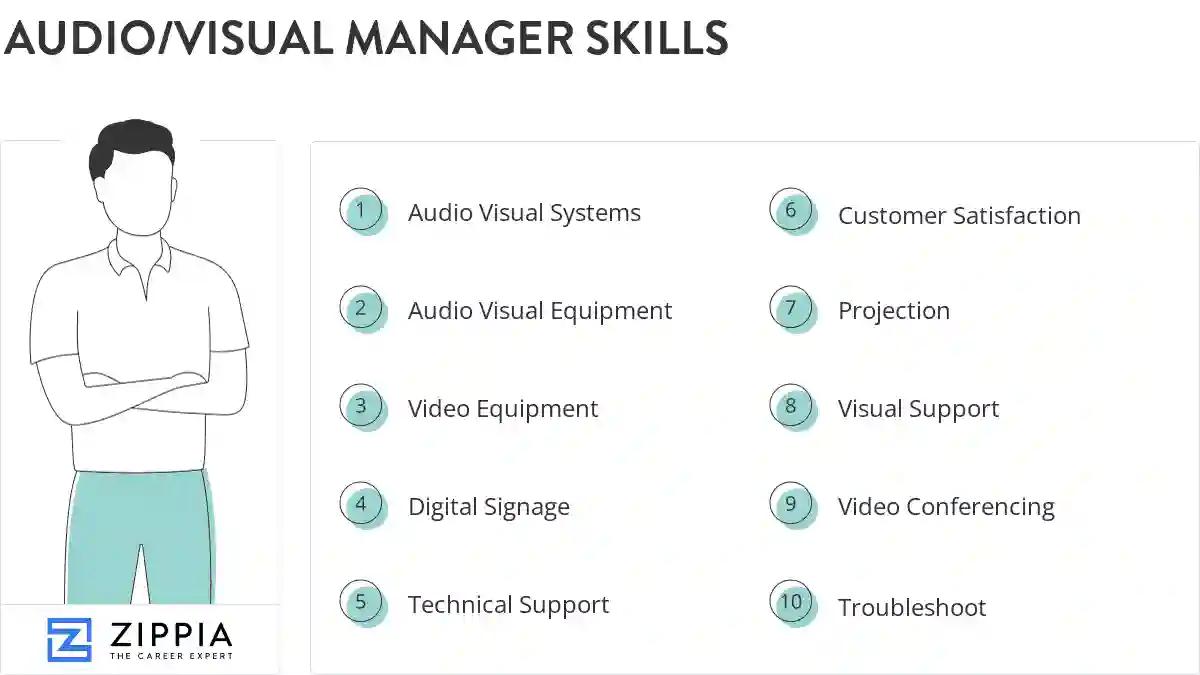
The most important skills for an audio/visual manager resume and required skills for an audio/visual manager to have include:
- Audio Visual Systems
- Audio Visual Equipment
- Video Equipment
- Digital Signage
- Technical Support
- Customer Satisfaction
- Projection
- Visual Support
- Video Conferencing
- Troubleshoot
- Control Systems
- Meeting Rooms
- Audio Visual
- Event Planning
- Equipment Maintenance
- Equipment Set-Up
- Multimedia
- Equipment Inventory
- Teleconferencing
- VTC
- Videoconferencing
- Client Satisfaction
- Sound Systems
- Live Events
- Trade Shows
- AMX
- Technical Equipment
- Customer Support
- Project Management
- Content Management
- LCD
- Technical Aspects
- Corporate Events
- Video Conferences
- Event Technology
- DVD
- PowerPoint
- CCTV
- BEO
- Webcasts
- Electronic Equipment
- YouTube
- Event Order
- Corporate Clients
Updated January 8, 2025
