
Automatically apply for jobs with Zippia
Upload your resume to get started.
Automation analyst skills for your resume and career
15 automation analyst skills for your resume and career
1. Java
Java is a widely-known programming language that was invented in 1995 and is owned by Oracle. It is a server-side language that was created to let app developers "write once, run anywhere". It is easy and simple to learn and use and is powerful, fast, and secure. This object-oriented programming language lets the code be reused that automatically lowers the development cost. Java is specially used for android apps, web and application servers, games, database connections, etc. This programming language is closely related to C++ making it easier for the users to switch between the two.
- Involved in setup and Configuration of testing environment with Eclipse, TestNG, Selenium WebDriver and Selenium Java client driver.
- Involve in Manual and Automated Testing of the front-end application that was developed using Java, and Oracle technologies.
2. Macro
- Analyzed manual processing procedures and wrote several macros and scripts creating significant efficiency gains.
- Created forms, reports, macros, and tables to extract, transform, and transport ORACLE data.
3. Business Process
A business process is a group of tasks that are performed by people working in a business to attain a worthy product and to present it to their customers. A business process can also be defined as performing several steps to achieve a certain goal set by a company. Business processes need to set purposeful goals and the outcome of that goal should be clear.
- Test Automation team supports in converting the manual Business Process Testing Components to automated Components across different applications of Sprint.
- Communicated business requirements to offshore team to create automated test scripts for business processes.
4. C #
- Prepared weekly status report which include project name and PAC # with the detail information.
- Performed Automation Testing of each Build and then Regression testing on each builds using C # and Selenium WebD r iver.
5. UI
- Developed Jenkins build job for Selenium BDD automated tests for the UI, Acceptance and Regression tests.
- Created UI and Rules based test cases for Personal and Business lines.
6. QA
QA, or Quality Assurance is a procedure that entails all of the steps taken to avoid any errors in the manufacturing process or in the production of the goods that a company produces. It can also include ensuring the consistency of the services rendered. Quality assurance ensures that the quality of the service delivered to consumers meets or exceeds the promised expectations. This greatly aids in the prevention of any complications that might arise after the goods or services have been distributed. It makes sure that customers are satisfied.
- Debugged/Reviewed framework for automation to enhance the efficiency of Automated QA projects.
- Developed, documented and implemented QA standards for assigned applications.
Choose from 10+ customizable automation analyst resume templates
Build a professional automation analyst resume in minutes. Our AI resume writing assistant will guide you through every step of the process, and you can choose from 10+ resume templates to create your automation analyst resume.7. JavaScript
- Interfaced with the development team utilizing ASP, JavaScript and Visual Basic and produced detailed user-interface prototypes and performed usability testing.
- Authored/Deployed business to business e-commerce web application utilizing WebFocus Maintain including modular programming, search engines and JavaScript.
8. Technical Support
Technical support or tech support are the services provided by any hardware or software company to users. They help in solving the technical difficulties the customers face with their products or services. Moreover, the tech support employees maintain, manage, and repair the IT faults. They are also responsible for resolving the network problems, installing and configuring hardware and software.
- Created ADHOC reports as required and provided technical support to staff and was the backup system administrator for the LAN.
- Coordinated production schedules with applications management, DBA's, network support, computer operators, and technical support.
9. HTML
- Developed automated tests using Hybrid Automation framework - Dynamic data handling using XML containers, HTML Reports.
- Used HTML Report to improve the readability for QTP/UFT run result.
10. Test Data
- Test Script Development which involves test data management and database validation.
- Performed the role of Subject Matter Expert (SME) and involved in Test Data Preparation and Test Execution.
11. Regression
- Used Quality Center to communicated defects encountered during Regression Test and followed-up with developers until all issues were resolved.
- Created tests that validated customer segmentation application for different kind of users and for regression scenarios.
12. API
- Utilize Selenium to effectively design and develop automation script; as well as SoapUI to perform Web Services API testing.
- Create USH (Universal Self Help) tickets for API Ops and various teams for system/tasks investigations.
13. UAT
UAT stands for user acceptance testing, and it is the last phase in the software testing process that determines whether the software is fit for the purpose it was built or not. UAT checks two main things; whether the software fulfills the business requirements and can it be used by the end-users. It is the final and most critical step in the testing stages and it determines whether the software should be introduced in the market or not.
- Prepare proposal requests for automated systems and support all phases including development, integration and UAT of the project life cycle.
- Supported in creating Test cases to check the functionality of the enhanced application and performed User Acceptance Testing (UAT).
14. Automation Framework
- Performed identification and implementation of the automation framework, environment, approach, and methodologies which are used for automated testing.
- Gained knowledge to develop customized BDD automation framework using Cucumber, Watir-WebDriver, and Ruby.
15. Data Validation
Data validation is the process of reviewing and arranging data for efficient data analysis. Data validation includes checking data accuracy, quality of data source, and identifying the importance or relevance of the data.
- Performed web services data validations, input parameter validations, XML/WSDL configurations.
- Performed Database testing for data Validation.
5 Automation Analyst resume examples
Build a professional automation analyst resume in minutes. Browse through our resume examples to identify the best way to word your resume. Then choose from 5+ resume templates to create your automation analyst resume.

What skills help Automation Analysts find jobs?
Tell us what job you are looking for, we’ll show you what skills employers want.
What skills stand out on automation analyst resumes?
Hanna Kim Ph.D.
Associate Professor, Chair, Adelphi University
I say "try to" as the reality is that having faculty in all 4 subfields is not possible for many reasons. (The 4 subfields are cultural anthropology, archeology, biological anthropology (sometimes physical anthropology), and anthropological linguistics. These subfields are mirrored in graduate school where students going for PhDs will be focused on 1 subfield.)
For undergraduates with an anthropology degree seeking employment, I can speak only from the faculty side, not the employer side. My students report these factors as relevant to their being hired (and accepted into competitive schools in museum studies, social work, law school, etc.:
Analytical skills; clear writing; ability to synthesize large amounts of reading and data into well-supported arguments and interpretations; open-mindedness toward different identities and ways of being.
A hugely important skill that anthropology graduates have is the ability to be presented with a complex situation or problem, and to be able to chart a plan on how to approach the problem, gather data and other necessary information to solve the problem, and then to come up with a solution or possible strategies. Too often, particularly in situations involving human behavior, what is needed is a stronger grasp of social and cultural factors that could impede the desired outcome. Students of anthropology know that ways of doing things, and even seeing and thinking, are profoundly influenced by categories of thought that are culturally situated. This means that problem solving has to consider a network of variables that have an impact on behavior. Anthropology students, I would argue, would embrace this complexity rather than be hesitant to acknowledge it in favor of a more expedient and, in the long run, less successful solution.
What soft skills should all automation analysts possess?
Hanna Kim Ph.D.
Associate Professor, Chair, Adelphi University
What hard/technical skills are most important for automation analysts?
Hanna Kim Ph.D.
Associate Professor, Chair, Adelphi University
What automation analyst skills would you recommend for someone trying to advance their career?
A.J. Arreguin
Professor, Our Lady of the Lake University
Students should volunteer with small/local businesses or create their brand (start a blog or become a niche social media influencer) to practice and build on their experience. Once the student/graduate does that, they should keep a weekly log with analytics to help them understand how to improve moving forward. This will be beneficial when applying for a communication/public relations job during an interview. The degree gets the student/graduate the talk, but the experience lands them the job.
What type of skills will young automation analysts need?
Lise Abrams Ph.D.
Professor of Linguistics and Cognitive Science; Coordinator of Cognitive Science, Pomona College
List of automation analyst skills to add to your resume
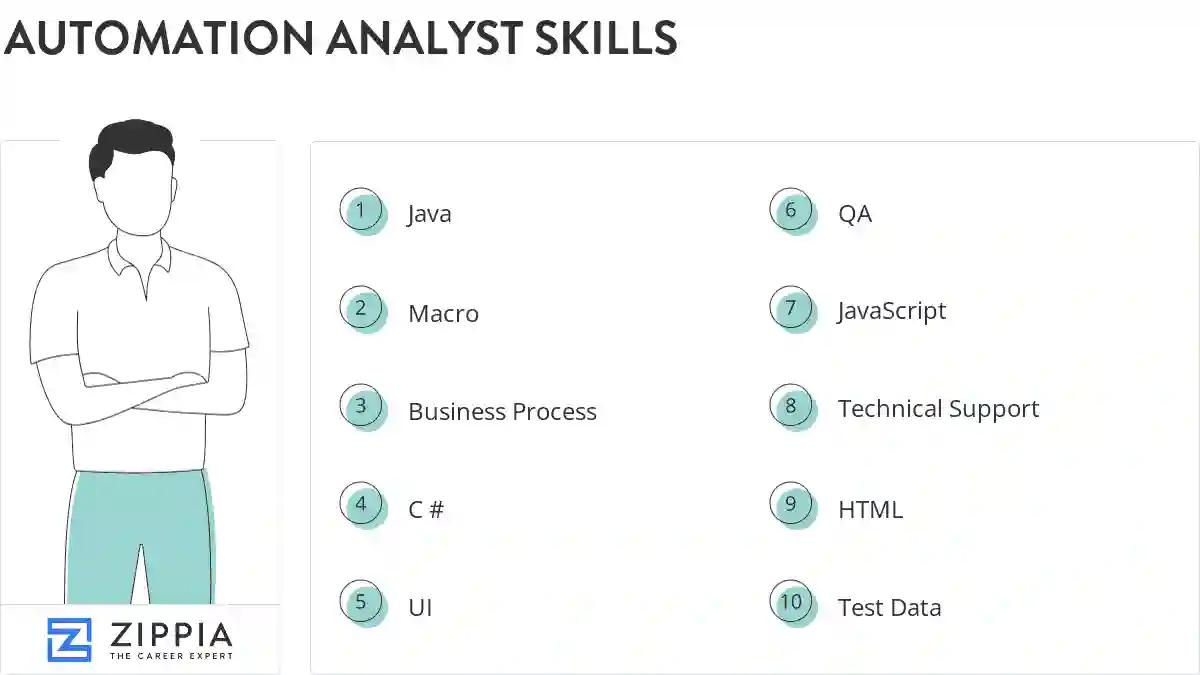
The most important skills for an automation analyst resume and required skills for an automation analyst to have include:
- Java
- Macro
- Business Process
- C #
- UI
- QA
- JavaScript
- Technical Support
- HTML
- Test Data
- Regression
- API
- UAT
- Automation Framework
- Data Validation
- Test Results
- Jira
- Selenium Web
- User Acceptance
- SQL Server
- Ruby
- Data Driven
- Cucumber
- Unix
- UFT
- HP ALM
- Regression Test Cases
- Functional Specifications
- Jenkins
- Automation Test Scripts
- CSS
- Test Plan
- BDD
- Test Scenarios
- PL/SQL
- Qa Testing
- Mainframe
- Ongoing Support
- B Testing
- XML
- TFS
- Windows XP
- TestNG
- Business Analysts
- Debugging
- Test Execution
- SME
Updated January 8, 2025
