
Automatically apply for jobs with Zippia
Upload your resume to get started.
Aviation ordnance technician skills for your resume and career
15 aviation ordnance technician skills for your resume and career
1. Safety Procedures
Safety procedures are a set of standardized procedures, that ensures minimal to no risk to people, resources, and the work environment. A company follows the step-by-step safety procedures as it they not only keep the customers and the employees safe, but also help in avoiding legal claims.
- Maintained shop safety procedures in accordance with established standards, office procedures, equipment identification procedures and record keeping.
- Maintained and supervised safety procedures while dealing with hazardous materials with a result of zero accidents.
2. Support Equipment
- Performed required inspections, tests, checked adjustments, conducted preventive maintenance and repair on support equipment including corrosion prevention treatment.
- Supervised all administration, organization/management of personnel and maintenance performed on F-18/A related ordnance support equipment.
3. Preventive Maintenance
- Ensured the proper inspection of ammunition, testing aircraft systems, performed preventive maintenance and repair on effected components.
- Provided quality assurance for all aircraft weapon systems repair, upgrade, preventive maintenance and installation.
4. Combat
Combat is a violent conflict between two parties. Combat can be held by using weapons or unarmed. The fighting between the armed forces of different countries can also be called combat and the main purpose of the combat is to eliminate and stop your opponent from achieving their goal.
- Received training and qualification as a Combat Life Saver and provided assistance to Navy Medical Personnel as battlefield scenarios required.
- Supervised 12 junior enlisted Marines during combat deployment to Afghanistan.
5. Logistics
Logistics is a complete organization and implementation of a problem. Logistics are often considered in a complex business operation, as some works need detailed plannings. Logistics are also used in military action.
- Organized the logistics of vehicles, equipment, workers, parts, and time schedule.
- Ordered tools using the Naval Aviation Logistics Command Management Information System (NALCOMIS).
6. Unscheduled Maintenance
- Performed regular scheduled and unscheduled maintenance on aircraft and equipment.
- Performed scheduled and unscheduled maintenance on all equipment.
Choose from 10+ customizable aviation ordnance technician resume templates
Build a professional aviation ordnance technician resume in minutes. Our AI resume writing assistant will guide you through every step of the process, and you can choose from 10+ resume templates to create your aviation ordnance technician resume.7. Ammunition
- Conduct inventory and initiate Ammunition Reclassification/ Identification/Inventory Action sheets to ASRS to correct effected quantities on hand.
- Performed system administrator tasks associated with Ordnance Information system (OIS) ammunition accounting and management system.
8. Hazardous Materials
Any substance or good that is harmful to human health as well as the environment are called hazardous materials. Such materials must be handled carefully to avoid any mishaps. Harmful gases. chemicals, strong medicines or drugs, radioactive elements required for radiation purposes, a human blood sample that carries germs, all of these are considered hazardous materials.
- Received certifications in Hazardous Materials Handling, Weapons Handling, and Personal Protective Equipment.
- Handled and stowed dangerous/hazardous materials and components.
9. Secret Security Clearance
- Managed teams in the performance of aircraft maintenance & held Secret Security Clearance.
- Obtained a secret security clearance and was appointed Assistant Security Manager.
10. Technical Publications
- Prescribed new technical publications and directives to junior technicians and monitored the implementation of these directives.
- Observed and maintained 320 technical publications including making modifications for formal and informal changes.
11. Maintenance Actions
- Led numerous sailors in maintenance actions and aircraft configurations.
- Managed all firing reports and maintenance via computer as well as filing paper copies of maintenance actions ensuring proper documentation.
12. Control Systems
- Perform maintenance on SESCOS and HALCES armament control systems.
- Worked with weapons and weapons control systems.
13. Safety Regulations
- Inventory and inspection of fire safety equipment and explosive storage facilities in accordance with base fire and explosive safety regulations.
- Observed work practices and in-process tasks to ensure compliance with USMC safety regulations and proper job-specific protocols.
14. Electrical Components
- Conducted tests of equipment, including electrical components and aircraft armament circuits.
- Configured aircraft by installing or removing racks, launchers, adapters, and electrical components.
15. Aircraft Maintenance
- Performed duties as a basic ordnance technician assuring mission accomplishment and safety while performing aircraft maintenance and ordnance responsibilities
- Maintained complex equipment and was responsible for 200 aircraft maintenance publications, ensuring current information and accuracy.
5 Aviation Ordnance Technician resume examples
Build a professional aviation ordnance technician resume in minutes. Browse through our resume examples to identify the best way to word your resume. Then choose from 5+ resume templates to create your aviation ordnance technician resume.

What skills help Aviation Ordnance Technicians find jobs?
Tell us what job you are looking for, we’ll show you what skills employers want.
What hard/technical skills are most important for aviation ordnance technicians?
Nicolas Yale
GTCC Director of Aviation Programs, Guilford Technical Community College
List of aviation ordnance technician skills to add to your resume
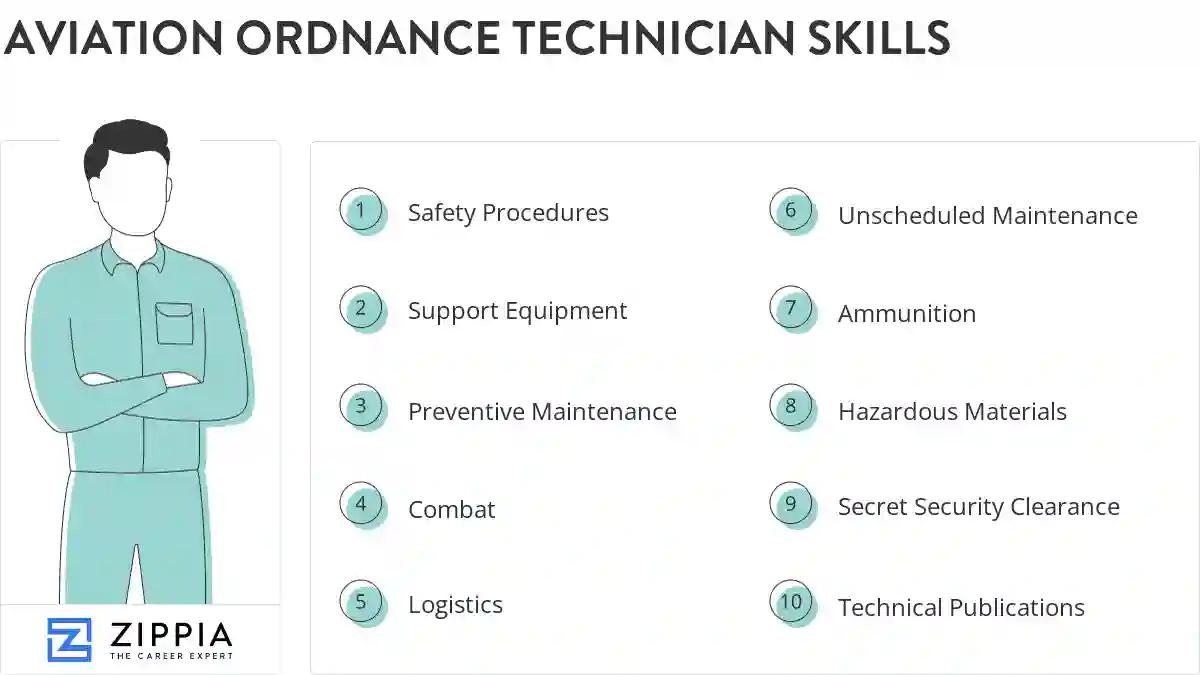
The most important skills for an aviation ordnance technician resume and required skills for an aviation ordnance technician to have include:
- Safety Procedures
- Support Equipment
- Preventive Maintenance
- Combat
- Logistics
- Unscheduled Maintenance
- Ammunition
- Hazardous Materials
- Secret Security Clearance
- Technical Publications
- Maintenance Actions
- Control Systems
- Safety Regulations
- Electrical Components
- Aircraft Maintenance
- CDI
- Corrosion Control
- Security Procedures
- Training Programs
- Explosive Ordnance
- Test Equipment
- Functional Test
- Storage Facilities
- Flight Operations
- CPR
- Flight Schedules
- Gun Systems
- Aviation Maintenance
- PowerPoint
- Management System
- F/A-18
- Repair Aircraft
- NCO
- Terrorism
- Landing Gear
- Military Aircraft
- RSL
Updated January 8, 2025
