
Automatically apply for jobs with Zippia
Upload your resume to get started.
Avionics supervisor skills for your resume and career
15 avionics supervisor skills for your resume and career
1. Safety Procedures
Safety procedures are a set of standardized procedures, that ensures minimal to no risk to people, resources, and the work environment. A company follows the step-by-step safety procedures as it they not only keep the customers and the employees safe, but also help in avoiding legal claims.
- Performed quality assurance inspections to ensure proper maintenance and safety procedures were followed contributing to 7,000+ mishap free flight hours.
- Ensured safety procedures were followed and maintenance procedures were correctly documented.
2. FAA
FAA (Federal Aviation Administration) is an aviation regulatory body in the USA.
- Ensured work was being performed per FAA regulations and manufacturer instructions, as well as PEMCO own Repair Station Manual.
- Create FAA 8130's and Strip reports for units being release back to service.
3. Airframe
Airframes are a type of mechanical structure used for an aircraft. This part usually consists of the wings, tail assembly, fuselage, undercarriage, and landing gear. It has a monolithic component in it that has ribs, frames, stringers, bulkheads and others. The Airframe is created, designed, and used to endure all the air force every time the aircraft takes off. It helps withstand the aerodynamics as well the pressure of the payload, crew, and the fuel.
- Ensured the proper implementation of all Technical Directives, Airframe Changes, and Software Changes.
- Inspected and repaired aircraft engines and airframes as an Aircraft Mechanic.
4. Direct Supervision
Direct supervision is a term used to indicate that a person is supervising a certain task or a certain person while being physically present or in close proximity. It refers to the presence of a person and the availability of their supervision in something if it is needed.
- Provided direct supervision of reserve and active duty Marines.
- Perform regular performance evaluations on personnel under my direct supervision.
5. Avionics Systems
- Conducted flight operations necessary to support project evaluations and operational tests on state-of-the-art avionics systems prior to release to naval fleet.
- Supervised 25 technicians performing scheduled and unscheduled maintenance on over 20 integrated avionics systems in 11 aircraft.
6. Engineering Drawings
Engineering drawings are technical drawings that tell about the requirements for engineering components or equipment. Such drawings have standardized languages and symbols. There are multiple types of engineering drawings such as isometric drawing, orthographic or multiview drawing, schematic drawings, one view, and two view drawings, etc.
- Installed wiring and components for Boeing 777 and Airbus A340 VIP/Head of State modification per engineering drawings.
- Verify all installs are in compliance with engineering drawings and procedures.
7. Ground Support Equipment
Ground support equipment provides passenger and baggage handling, aircraft handling, and docking at an airport.
- Certified the appropriate training and qualifications on Ground Support Equipment were met throughout the Avionics Division.
- Performed maintenance on common and special tools, as well as ground support equipment.
8. Electrical Components
- Worked hand in hand with U.S. Air Force pilots and sensor operators to fine tune sensitive avionics/electrical components.
- Designed and built avionics/electrical components in accordance with schematics and engineering specifications to support advanced R&D activities.
9. Maintenance Actions
- Supervised 134 safety personnel responsible for 1,020 corrective maintenance actions.
- Completed over 800 scheduled and unscheduled maintenance actions.
10. Countermeasure
- Qualified Safe-for-Flight on MH-53E aircraft and Safe-for-Mission for Anti Mine Countermeasures equipment.
- Maintained MH-53 helicopters and mine countermeasure equipment.
11. GPS
GPS stands from Global Positioning System. It is a navigation system comprising of satellites that helps in determining the location, velocity, and synchronize time data for different modes of travel like air, sea, or land.
- Train Bolivian Air Force Pilots on operating new systems such as GPS, Mode S ATC and SATCOM.
- Maintained GPS navigation, autopilot, and all avionics/engine instrumentation systems.
12. Troubleshot
- Tested, maintained, and troubleshot Avionics and Electrical System equipment to system, module, and component level.
- Established Technician: Troubleshot, analyzed, and repaired avionic systems at the component level.
13. Radar
Radar is a system designed for detecting the presence, distance, direction, and speed of objects, by sending out pulses of radio waves that get reflected off the object back to the source. This technology is used by meteorologists, weather department, the marine and armed forces of a country.
- Repaired electronics specific to anti-submarine warfare systems, radar, and survival radios.
- Maintained the avionics Guidance and Control Systems, Doppler Radar, Inertial Navigation Systems and Malfunction Detection Systems on various aircraft.
14. Technical Manuals
Technical Manuals are informative pieces of writing, often including diagrams and images, which educate the person who is using it and assist them in learning how to control, build, fix, or otherwise handle the product or products which it speaks of. A technical manual is also known more commonly as a user manual and it typically comes with most products, especially items such as furniture, electronics, appliances, software, machinery, and even medication and medical devices.
- Identified and corrected technical manual deficiency resulting in an annual savings of in excess of $37 million and 186 man-hours.
- Integrated Electrical Technical Manual) and part ordering requirements.
15. Unscheduled Maintenance
- Lead and supervised avionics technicians in the rapid completion of scheduled and unscheduled maintenance on assigned aircraft electronic systems.
- Supervised eight personnel in performing scheduled and unscheduled maintenance on the KC-135 aircraft.

What skills help Avionics Supervisors find jobs?
Tell us what job you are looking for, we’ll show you what skills employers want.
List of avionics supervisor skills to add to your resume
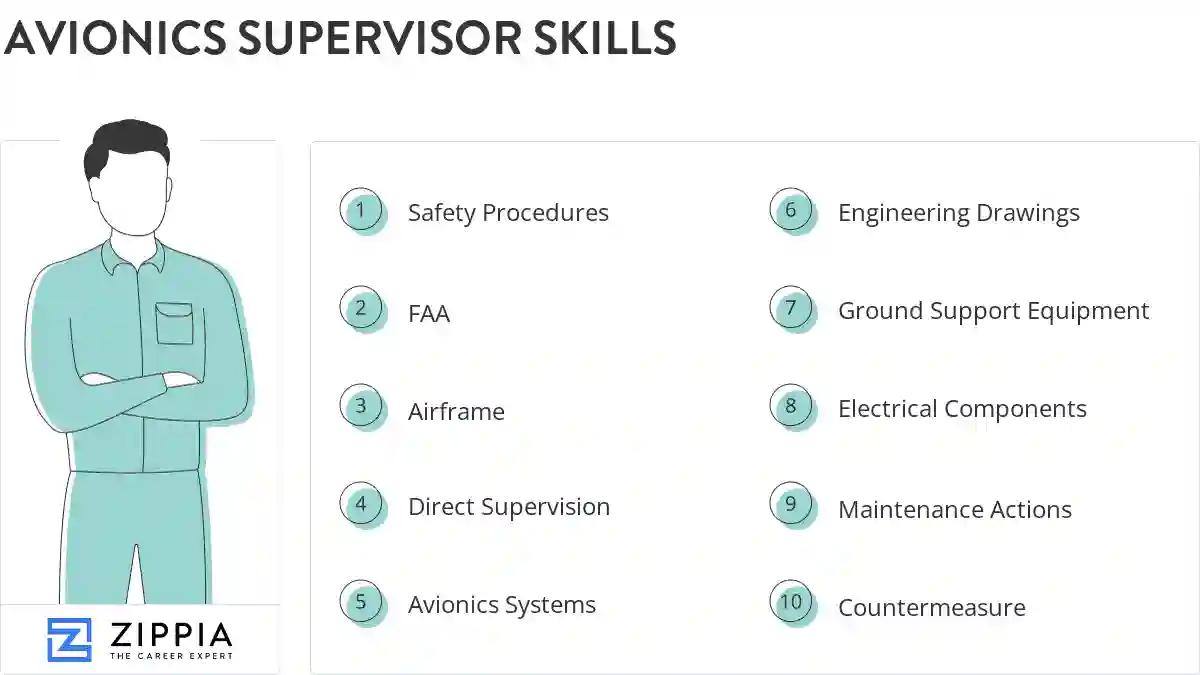
The most important skills for an avionics supervisor resume and required skills for an avionics supervisor to have include:
- Safety Procedures
- FAA
- Airframe
- Direct Supervision
- Avionics Systems
- Engineering Drawings
- Ground Support Equipment
- Electrical Components
- Maintenance Actions
- Countermeasure
- GPS
- Troubleshot
- Radar
- Technical Manuals
- Unscheduled Maintenance
- Technical Publications
- Aviation Maintenance
- Technical Training
- Flight Control Systems
- Technical Guidance
- Technical Data
- Production Control
- Maintenance Manuals
- Maintenance Operations
- Operational Checks
- A/C
Updated January 8, 2025
