
Automatically apply for jobs with Zippia
Upload your resume to get started.
Bacteriologist skills for your resume and career
15 bacteriologist skills for your resume and career
1. Proficiency Testing
- Perform patient testing, proficiency testing and all required quality control of all reagents and equipment as determined by each department.
- Participated in Federal & State clinical inspections including quarterly proficiency testing and Health Department sponsored MRSA case control study.
2. Environmental Monitoring
Environmental monitoring is a method to manage and assess a particular environmental condition or situation. It plays an essential role in society as it affects how people can work and implement regulations and guidelines on protecting and conserving the environment to prevent further impact or damage. Other can assessment, monitoring also needs a support policy for and concrete plan for a long term effect.
- Conduct environmental monitoring on manufacturing facility.
- Supported and prepared Protocol for Start-up and annual environmental monitoring for new facilities Environmental, testing and disposition of microbial samples.
3. Molecular Biology Techniques
- Performed molecular biology techniques to diagnose different genetic diseases.
4. Clinical Chemistry
- Skilled testing and reporting in all departments including Clinical Chemistry, Hematology, Coagulation, Immunology, Serology, and Urinalysis.
- Carried the role of clinical laboratory scientist supervisor in clinical chemistry laboratory.
5. Lab Equipment
- Complete and document daily, weekly and monthly lab equipment audits & calibrations.
- Managed the lab; organized, maintained and kept clean all lab equipment, Worked with Leishmanissis and malaria patients
6. Laboratory Procedures
- Followed laboratory procedures for specimen handling and processing, test analyses, reporting and maintaining patient records.
- Train laboratory personnel and others in laboratory procedures.
Choose from 10+ customizable bacteriologist resume templates
Build a professional bacteriologist resume in minutes. Our AI resume writing assistant will guide you through every step of the process, and you can choose from 10+ resume templates to create your bacteriologist resume.7. Body Fluids
Body fluid can be described as any fluid produced by a living organism e.g. human body. In the human body, the fluid can be classified into two major types according to their location: the intracellular fluid and the extracellular fluid. The extracellular fluid is located outside the cell(s) while the intracellular fluid is located within the cell(s).
- Count cells and look for abnormal cells in blood and body fluids.
- Prepare specimens and analyze the chemical content of body fluids.
8. Environmental Samples
- Participated in processing of environmental samples, isolation/identification of Bacillus anthracis during the anthrax crisis of 2001.
- Performed molecular diagnostic screening of environmental samples in a BSL2+/BSL3 biothreat laboratory.
9. PCR
PCR stands for Polymerase Chain Reaction, a tool to make millions of copies of a target part of DNA. Polymerase chain reaction involves the process of heating and cooling. The process takes place using a machine, which helps in heating and cooling off the substances. The purpose of heating exists to separate the DNA into two single strands.
- Performed Morphological, Biochemical and Molecular Diagnostics (PCR) tests to identify bacterial and fungal pathogens of veterinary origin.
- Screen samples using various PCR platforms including GDS and BAX.
10. Biosafety
- Received advanced training in Biosafety level 3 facility to deal with bioterrorism events and handle highly infectious microorganisms.
11. DNA
Deoxyribonucleic acid, or only DNA, which is considered the king of molecules, is a macromolecule that contains the main component of chromosomes. Shaped like a double helix, DNA is usually found in the nucleus of a cell. It is a type of material that transports characteristics in many forms, developed in nucleotides around one another.
- Completed routine culture and sensitivity testing to identify gram negative/positive bacteria and chlamydia and gonorrhea by DNA amplification.
- Performed high-throughput DNA extraction and purification, qPCR, multiplex assays, and utilized aseptic technique on all samples.
12. Elisa
An enzyme-linked immunosorbent assay or ELISA is an examination or test to measure and detect a person's specific antigen, antibodies, and protein. This type of test will identify if the sample component is infected with a relative disease or condition such as HIV infection, anemia, Zika Virus, and Lyme disease with just a single experiment.
- Conducted ELISA on allergens (Casein, soy and others) between different batches of production.
- Assessed two rapid screening methods for Salmonella (ELISA) resulting in 10% savings.
13. Reference Laboratory
- Isolated and identified bacterial pathogens in the Special Pathogens Reference Laboratory.
- Prepare specimens for outside reference laboratory testing and arranges transportation of these specimens to the laboratory.
14. Blood Bank
A blood bank is a place where blood is gathered, stored, and preserved for later use for blood transfusion. A blood bank is also referred to a department of a hospital where blood and plasma are stored after testing it. It is also responsible for separating blood components like platelets, red blood cells and plasma from that blood and returning the remaining components to the donor.
- Perform testing in Bacteriology, Serology, Blood Bank, Hematology, Chemistry, Urinalysis, and Coagulation.
- Performed clinical laboratory test in chemistry, molecular biology and blood bank, Performed quality control in laboratory equipment.
15. Salmonella
- Tested all the equipment for Salmonella on a weekly basis via Vidas machine.
- Tested all the dog food for Salmonella via Vidas machine.
5 Bacteriologist resume examples
Build a professional bacteriologist resume in minutes. Browse through our resume examples to identify the best way to word your resume. Then choose from 5+ resume templates to create your bacteriologist resume.

What skills help Bacteriologists find jobs?
Tell us what job you are looking for, we’ll show you what skills employers want.
List of bacteriologist skills to add to your resume
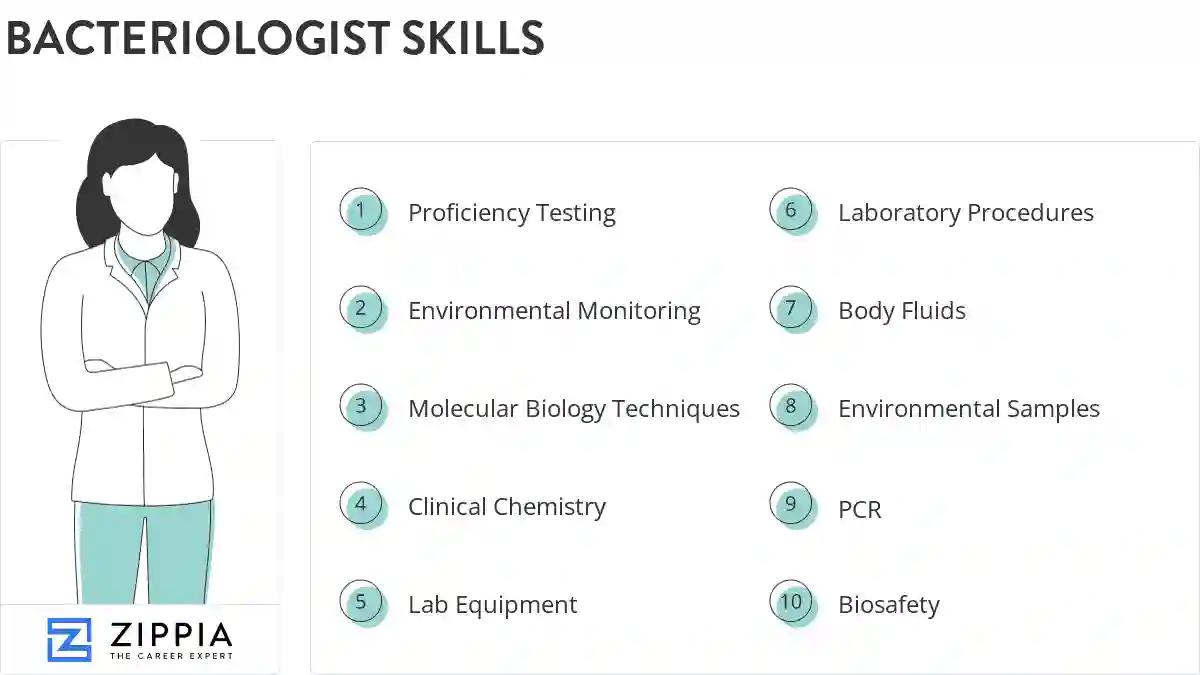
The most important skills for a bacteriologist resume and required skills for a bacteriologist to have include:
- Proficiency Testing
- Environmental Monitoring
- Molecular Biology Techniques
- Clinical Chemistry
- Lab Equipment
- Laboratory Procedures
- Body Fluids
- Environmental Samples
- PCR
- Biosafety
- DNA
- Elisa
- Reference Laboratory
- Blood Bank
- Salmonella
- Microorganisms
- Sops
Updated January 8, 2025
