
Automatically apply for jobs with Zippia
Upload your resume to get started.
Balance clerk skills for your resume and career
15 balance clerk skills for your resume and career
1. Data Entry
Data entry means entering data into a company's system with the help of a keyboard. A person responsible for entering data may also be asked to verify the authenticity of the data being entered. A person doing data entry must pay great attention to tiny details.
- Back office banking procedures regarding Check Processing Investigator in Travelers Check Fraud Department Proved ledgers for several client banks Extensive data entry
- Performed data entry and conducted microfiche research.
2. Bank Deposits
Any money that a customer chooses to leave with their bank account is a deposit. Deposits can vary in amounts and different banks have limits on the deposits their customers can have as a minimum. Banks charge customers for deposits especially when a teller is used by the customer to deposit money into their account.
- Prepared bank deposits as necessary and periodically reconciled various account receivable accounts as needed.
- Reconciled payments with bank deposits ensuring correct deposits were received and recorded.
3. Check Images
- Verify maker's signature on the check images by using net query systems.
- Verify signatures on checks and check images.
4. Credit Balances
- Prepared a credit balance report; deal with all types of insurance companies; investigate billing transactions and correct errors.
- Reviewed medical billing accounts, mainly focusing on credit balances; research medical and insurance billing records through computers and archive.
5. Customer Accounts
- Balanced customer accounts utilizing computer software under strict banking guidelines Completed daily operational reports Performed other tasks as needed
- Make necessary adjustments to customer accounts by keying information from transaction correction record.
6. Financial Institutions
Financial Institutions come in all sizes, forms, and are meant for all sorts of purposes. Some only keep money, some only trade it, some focus on extending loans, some work with only other financial corporations or regular business and companies, and some are built to be useful and multi-purpose. A central bank, for example, is a banking institution meant to keep an eye on other banks and ensure that no laws or rules are broken or bent.
- Prepared Checks for sorter, corrected rejects and repairs.Balanced Deposits for Financial Institutions.
- Perform operational duties associated with check processing and investigating inquiries received from financial institutions and other Federal Reserve offices.
Choose from 10+ customizable balance clerk resume templates
Build a professional balance clerk resume in minutes. Our AI resume writing assistant will guide you through every step of the process, and you can choose from 10+ resume templates to create your balance clerk resume.7. ATM
ATM (Automated Teller Machine) refers to an electronic banking system that enables the customers to initiate and complete transactions without queuing for aid from the teller within the branch.
- Balanced Retail ATM sheets from local and outside vendors, such as Loomis Fargo, Armored Transport and Brinks armored trucks.
- Balanced ATM machines reports Pull report and it had to match with the computer report Any differences were researched
8. Journal Entries
Journal entries can be defined as an act of keeping or making records of any transactions either economic or non-economic. The journal entries are made in the accounting systems of an organization. The entries are filled with two main fields; debit and credit. The debit and credit must be equal at the end of a journal entry else it is not considered correct. The journal entries also keep the date of transactions and the names of the accounts that were affected by the transactions.
- Prepare journal entries as well as keying rest of departments journal entries in system.
- Performed journal entries and reconciliations to ensure general ledger accuracy.
9. Computer System
- Excelled in bank's training course for new computer system.
- Trained new employees on the new computer system
10. Encode
- PROOF CORRECTIONS CLERK Encode correct amount and prepare transaction correction record, if an error is found.
- Reconciled Reports Balance and encode incoming work Perform other related duties as requested or assigned
11. EOB
EOB stands for explanation of benefits. This is a common outline provided as part of many health insurance plans to explain what services were completed, the co-pay required for each appointment, and how much of your payment is covered by health insurance. EOB is an indication that your insurance claim has already been processed.
- Review all explanation of benefit's (EOB'S).
- Post payments daily into QSI system Read and analyze EOB's and make proper adjustments according to PDS claims processing criteria.
12. Account Numbers
- Utilized a 10-key proof and encoding machine to add coded information & account numbers.
- Performed amount entry and reject tasks ensuring account numbers, amounts, and routing numbers were recorded for each item.
13. Lockbox
- Researched/posted payments not processed by Lockbox and prepared nightly deposits.
- Prepared and processed loans, routed supplies to other branches and assisted in Lockbox Processing with taxes and daily work detail.
14. PowerPoint
- Developed innovative PowerPoint presentation used by the Commanding Officer to accurately inform the unit of its operational tempo.
- Prepared PowerPoint Presentation for monthly meetings with management.
15. Customer Inquiries
- Answered customer inquiries concerning account statements and offered account resolutions.
- Adjudicated customer inquiries for retail/wholesale supplier.
5 Balance Clerk resume examples
Build a professional balance clerk resume in minutes. Browse through our resume examples to identify the best way to word your resume. Then choose from 5+ resume templates to create your balance clerk resume.

What skills help Balance Clerks find jobs?
Tell us what job you are looking for, we’ll show you what skills employers want.
List of balance clerk skills to add to your resume
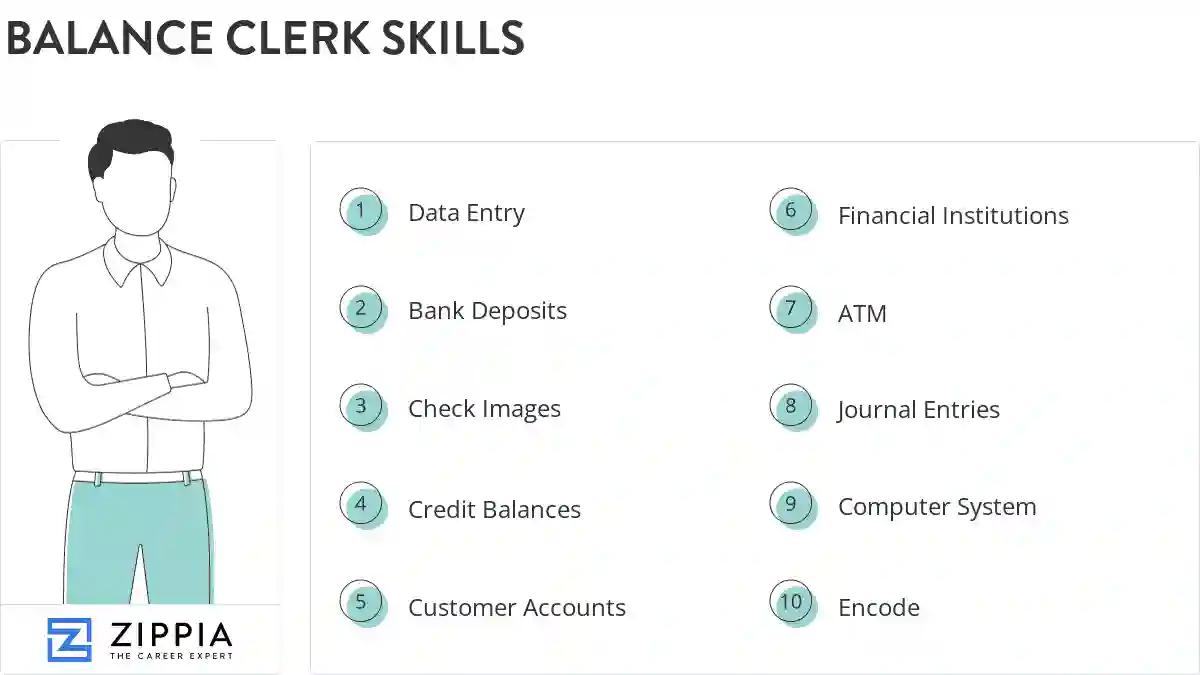
The most important skills for a balance clerk resume and required skills for a balance clerk to have include:
- Data Entry
- Bank Deposits
- Check Images
- Credit Balances
- Customer Accounts
- Financial Institutions
- ATM
- Journal Entries
- Computer System
- Encode
- EOB
- Account Numbers
- Lockbox
- PowerPoint
- Customer Inquiries
Updated January 8, 2025
