
Automatically apply for jobs with Zippia
Upload your resume to get started.
Batter-out skills for your resume and career
14 batter-out skills for your resume and career
1. Food Products
Food products are the types of various food items that are created and processed to be sold as a product. These products are consumed by humans for nourishment and are mostly processed and created in a huge factory. Tinned goods, milk, meat, etc are the most common food products, and they are not limited to any specific kind except tobacco, beers, and alcohol as they are not considered food products.
- Stocked sufficient levels of food products at line stations to assure a smooth service period.
- Prepared food products according to Popeye's standard portion sizing and recipe specifications.
2. Measure Materials
- Weigh or measure materials, ingredients, or products to ensure conformance to requirements.
3. Safety Standards
- Maintain sanitation, health, and safety standards in work areas.
4. Project Specifications
A Project Specification is a document that details the plan of a project and how its execution is going to look down to its specifics. It explains how the project will be managed by outlining its features, objectives, budget, goals, roles, descriptions, and timeline for delivery. A project specification is necessary for any project to be successful since it's a comprehensive document with everything needed by the user.
- Framed new construction of single-family homes and town homes Examined buildings and project specifications to determine measurements and dimensions.
- Examined buildings and project specifications to determine measurements and dimensions.
5. Approvals
- Secured all required permit approvals prior to starting projects.Installed cabinets, base cabinets and crown molding.
- Secured all required permit approvals prior to starting projects.
6. Planers
- Operated power saws, planers, jointers, routers and pneumatic equipment.
7. Customer Orders
- Operate a milling machine to dimension material to customer orders.
- Train new operators to accomplish company and customer orders.
8. Jointers
- Installed floor jointers, trusses and rafter.
9. Product Qualities
- Stop mixing or blending machines when specified product qualities are obtained and open valves and start pumps to transfer mixtures.
10. Fryers
- Operate large-volume cooking equipment such as grills, deep-fat fryers, or griddles Measure ingredients required for specific food items being prepared
- Operate large-volume cooking equipment such as grills, deep-fat fryers, or griddles.
11. RAN
RAN stands for "revenue anticipation note," which refers to a practice where an organization (often the government) borrows money to support a specific project. When these funds are then repaid, the money given to the lenders comes from the profits generated by the business originally funded.
- Digitized templates for custom tops and ran C and C machine.
12. Assembly Line
Assembly line is a process used in industries to ensure the production of products in a cost effective manner by dividing up the responsibilities of each labor. Assembly lines enabled industries to hire more workers, therefore providing more employment opportunities to labors. This is possible because in this process the burden of all the tasks related to production are not laid on a single person, they are divided into small baby steps for each labor.
- Monitored machines for pile- ups and any other malfunctions on assembly line and did basic maintenance on machinery.
- Tend assembly lines, performing a few of the many cuts needed to process a carcass.
13. PPE
Personal protective equipment is an item of protective clothing such as goggles, helmets, or other garments meant to protect the body from injury.
- Identified and requested any and all PPE necessary to perform tasks.
14. Commercial Buildings
- Cut and installed tile and linoleum flooring for residential and commercial buildings.

What skills help Batters-Out find jobs?
Tell us what job you are looking for, we’ll show you what skills employers want.
List of batter-out skills to add to your resume
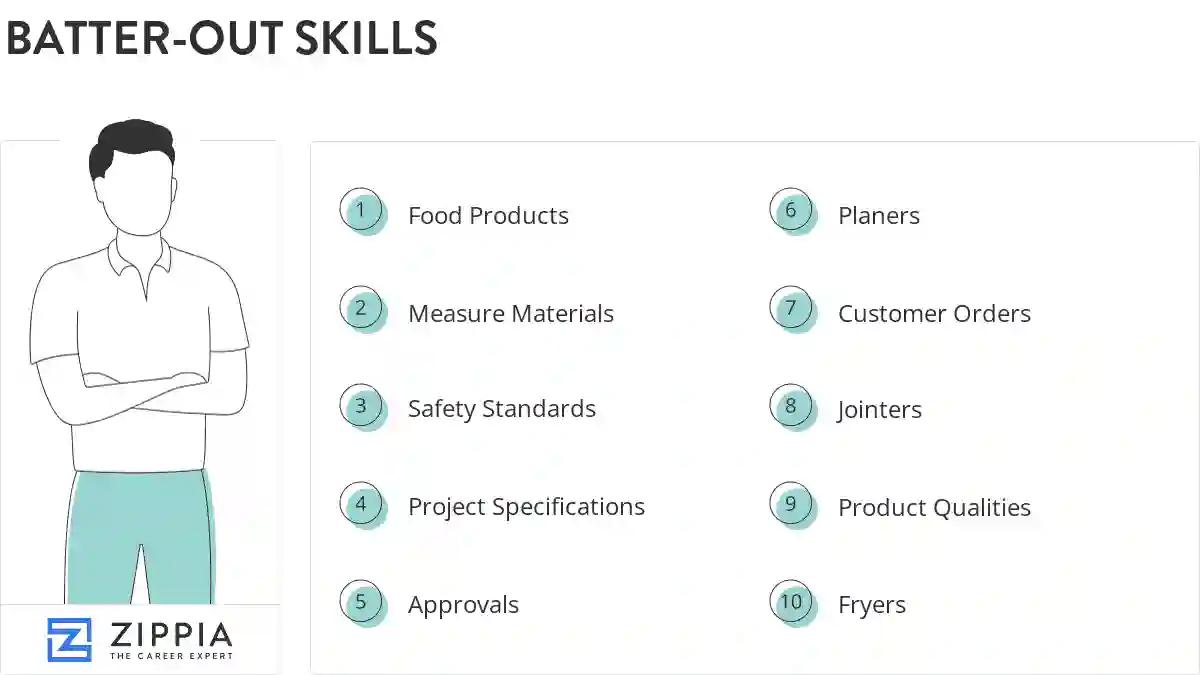
The most important skills for a batter-out resume and required skills for a batter-out to have include:
- Food Products
- Measure Materials
- Safety Standards
- Project Specifications
- Approvals
- Planers
- Customer Orders
- Jointers
- Product Qualities
- Fryers
- RAN
- Assembly Line
- PPE
- Commercial Buildings
Updated January 8, 2025
