
Automatically apply for jobs with Zippia
Upload your resume to get started.
Behavioral sciences instructor skills for your resume and career
15 behavioral sciences instructor skills for your resume and career
1. Autism
- Implemented behavioral intervention programs to various individuals who have been diagnosed with autism or any other mental health disorder.
- Provide behavioral services for children and adults with autism spectrum disorders and other developmental disabilities based on individual needs.
2. ABA
ABA, an abbreviation for applied behavioral analysis, is a scientific behavior study.
- Provided individualized, 1:1 ABA treatment in the child's home, school, and/or community setting.
- Provide direct therapeutic services to consumers using Applied Behavior Analysis (ABA).
3. Applied Behavior Analysis
- Implemented applied behavior analysis treatment plans to young children and adolescents diagnosed with a pervasive developmental disorder.
- Instructed autistic children with communicative, developmental and social skills using Applied Behavior Analysis.
4. Developmental Disabilities
- Provide behavior management, social skills, applied behavioral analysis and parent education to families with developmental disabilities.
- Provide in-home behavior modification services to children with developmental disabilities.
5. Independent Living
- Provided assistance with social skills, community integration, independent living and self-advocacy.
- Educate patients on a curriculum of skills in social, self-help independent living, and academic areas.
6. Behavior Management
- Worked one on one with Clients in a Residential Treatment Facility on behavior management techniques and mental health issues.
- Presented behavior programs to the Human Rights and Behavior Management Committees and actively participated in Team meetings and Psychology Department meetings.
Choose from 10+ customizable behavioral sciences instructor resume templates
Build a professional behavioral sciences instructor resume in minutes. Our AI resume writing assistant will guide you through every step of the process, and you can choose from 10+ resume templates to create your behavioral sciences instructor resume.7. Autism Spectrum Disorder
- Provide behavior therapy to children and young adults diagnosed with Autism Spectrum Disorder and related developmental delays in their natural setting.
- Implemented individualized program utilizing a Discrete Trial Instruction methodology to address behavior goals for young children diagnosed with Autism Spectrum Disorder.
8. Data Collection
Data collection means to analyze and collect all the necessary information. It helps in carrying out research and in storing important and necessary information. The most important goal of data collection is to gather the information that is rich and accurate for statistical analysis.
- Maintained data collection, noted behavioral observations, submitted weekly written reports for students.
- Provided training in data collection and in the use of positive behavior support and intervention techniques and instructional methodologies to educational staff
9. CPI
CPI Consumer Price Index is a monthly comprehensive measurement of the prices of goods and services representing the economy's consumption expenditure. This presents the inflation or rising of prices and deflation or falling prices. CPI keeps track of the costs of around 700 goods and services utilized by a typical household, and CPI shows how their price change each month. The changes in CPI are used to assess price changes related to the cost of living.
- Certified in CPR, First Aid, and CPI holds.
- Communicated effectively with families concerning behavioral target skills Discussed patient care issues with treatment team as they arise CPR and CPI certified
10. CPR
Cardiopulmonary resuscitation or CPR is a medical procedure that involves chest compression to help a patient breathe. This artificial ventilation helps in keeping the brain function in place and regulates blood throughout the body. CPR is a lifesaving procedure that is used in emergencies.
- Maintained CPR certification/training, participated in monthly behavioral program meetings and communicated client progress with supervisor on a weekly basis.
- Maintain certification through the Maine DOE-certified Educational Technician III, and certification in CPR.
11. Family Teaching
- Conducted and introduced daily planned teachings using the Family Teaching Model promoting positive, goal-reaching activities and rewards.
- Maintain positive behaviors between juveniles using Crisis Prevention Intervention and the Family Teaching model.
12. at-Risk Youth
A child who is unlikely to transition successfully into adulthood is considered an at-risk youth. Success can mean job readiness, academic success, or competence to be financially independent. It may also refer to the ability to avoid a life of crime by becoming a positive representative of society. At-risk students may show/have to show indifference for academics, low educational performance, absenteeism, disconnect from the school, emotional, and behavioral problems.
- Worked with at-risk youth with special needs.
13. Behavior Data
- Collected and analyzed skill acquisition and behavior data.
- Collected and analyzedskill acquisition and behavior data.
14. Behavioral Issues
Behavioral issues are the tendencies of individuals displaying unpleasant behavior as a result of sickness or addiction.
- Provided assistance to adolescents that have a variety of mental and behavioral issues in a residential independent living program.
- Worked with teenagers with emotional and behavioral issues providing behavioral support assisting them in changing their negative behaviors.
15. Parent Education
- Provide parent education and training.
- Conducted 1:1 specialized behavior intervention to children and parent education according to treatment plan.
5 Behavioral Sciences Instructor resume examples
Build a professional behavioral sciences instructor resume in minutes. Browse through our resume examples to identify the best way to word your resume. Then choose from 5+ resume templates to create your behavioral sciences instructor resume.

What skills help Behavioral Sciences Instructors find jobs?
Tell us what job you are looking for, we’ll show you what skills employers want.
What type of skills will young behavioral sciences instructors need?
Ye Chen Ph.D.
Assistant Professor, University of West Georgia
- Instructional design skills for analyzing instructional needs and designing & developing effective instructional solutions.
- Technical skills in utilizing technology to develop and implement instruction. At the same time, they are expected to understand how to integrate technology into instructional settings in a pedagogically meaningful way.
- Communication skills are essential as their work roles heavily rely on effective communication with content experts, clients, trainees/students, etc. throughout the instructional design process
List of behavioral sciences instructor skills to add to your resume
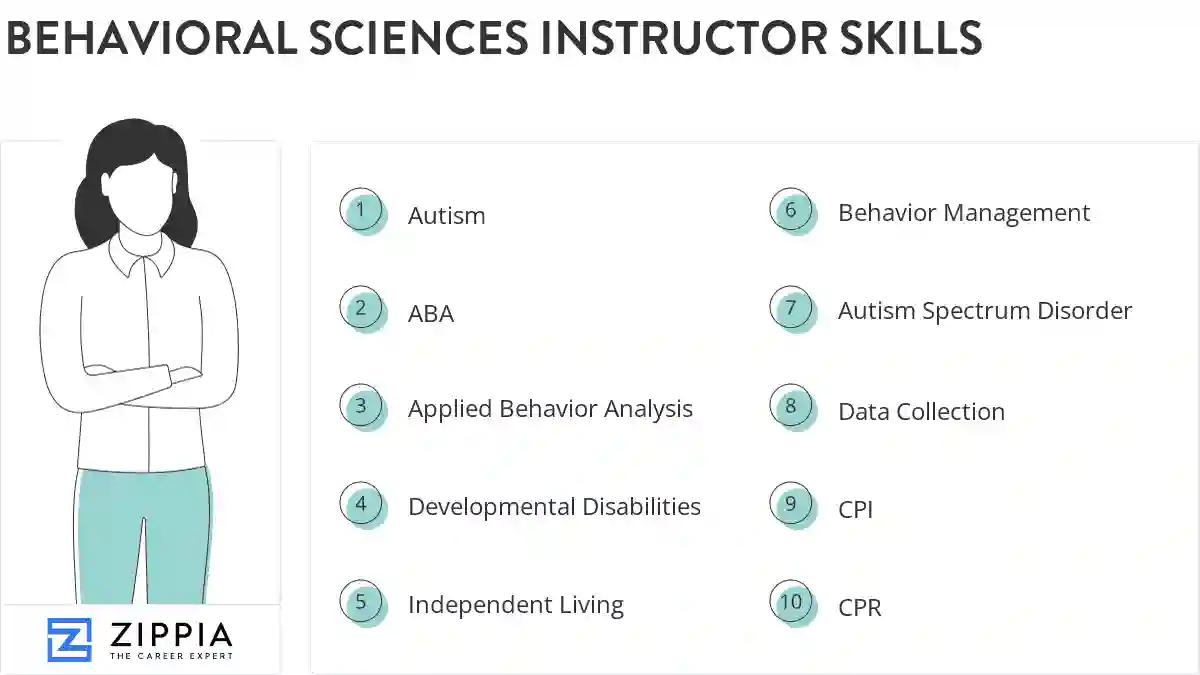
The most important skills for a behavioral sciences instructor resume and required skills for a behavioral sciences instructor to have include:
- Autism
- ABA
- Applied Behavior Analysis
- Developmental Disabilities
- Independent Living
- Behavior Management
- Autism Spectrum Disorder
- Data Collection
- CPI
- CPR
- Family Teaching
- at-Risk Youth
- Behavior Data
- Behavioral Issues
- Parent Education
- Prevention Intervention
- Discrete Trial Training
- Patient Intake
- Behavioral Strategies
- Self-Help
- Academic Assistance
- Adaptive
- IEP
- Analyze Data
- Early Intervention
- Developmental Disorders
- Graphing
- BCBA
- Behavioral Problems
- RTC
- Parent Training
- Medicaid
- Physical Training
- Individual Clients
- Consultation Services
Updated January 8, 2025
