
Automatically apply for jobs with Zippia
Upload your resume to get started.
Binder operator skills for your resume and career
15 binder operator skills for your resume and career
1. Hand Tools
- Repair, restore, or rebind old, rare, or damaged books, using hand tools.
2. Machine Operation
- Operated and monitored equipment/line, removing or shifting materials and finished product as necessary to facilitate proper flow and machine operation.
- Fluctuate between packing and machine operation, operate high speed technologically advanced manufacturing equipment and troubleshooting and basic repair.
3. Collating
- Use of various machines including Cheshire labeling machine, 3 knife trimmer, Harris binder, glue binding, paper collating
- Assisted with assembling commercial print jobs which includes: copying, binding, and collating Assisted with maintaining the billing ledger
4. Stitching
- Assisted in preparing and operating a stitching machine
- Maintained and operated Muller Martini stitching machine
5. Inkjet
- Trained on Inkjet operation to ensure quality is maintained.
- Used trimmer, stitcher, label machine, inkjet, strapper, shrink wrapper to produces books to customer requirements.
6. RAN
RAN stands for "revenue anticipation note," which refers to a practice where an organization (often the government) borrows money to support a specific project. When these funds are then repaid, the money given to the lenders comes from the profits generated by the business originally funded.
- Set up and ran Perfect Binder Was let go by owner Start: $15.75 hr.
- Performed quality control checks on all product ran on bindery machinery
Choose from 10+ customizable binder operator resume templates
Build a professional binder operator resume in minutes. Our AI resume writing assistant will guide you through every step of the process, and you can choose from 10+ resume templates to create your binder operator resume.7. Quality Checks
Quality checks are a component of quality control aimed at ensuring that quality requirements are met. Internally, quality checks provide assurance to managers, and externally, it provides assurance to clients, federal departments, authorities, and certifiers.
- Perform quality checks on a random bases.
- Calibrate machinery every two hours and complete paperwork and self-quality check every hour.
8. Troubleshoot
Troubleshooting is the process of analyzing and fixing any kind of problem in a system or a machine. Troubleshooting is the detailed yet quick search in the system for the main source of an issue and solving it.
- Employed root cause analysis to troubleshoot equipment and process issues.
- Run, troubleshoot, and operate film and foil laminator machine.
9. Bind Books
- Operated pressing machine Bind books, manuals and publications Performed general cleaning duties to keep work area neat
- Bind books and other publications or finish printed products by machine Set up/control operations of binding machines
10. Mechanical Problems
Mechanical problems are used to describe issues that occurred to something involving a machine or tools. For instance, a mechanical problem at the workplace might mean the copier has broken down again. Other examples of mechanical problems in a car include faulty brakes, tire blowouts, etc.
- Required knowledge of how to operate different types of bindery equipment and fix simple mechanical problems such as jamming or stalling.
11. Assembly Line
Assembly line is a process used in industries to ensure the production of products in a cost effective manner by dividing up the responsibilities of each labor. Assembly lines enabled industries to hire more workers, therefore providing more employment opportunities to labors. This is possible because in this process the burden of all the tasks related to production are not laid on a single person, they are divided into small baby steps for each labor.
- Run an assembly line that produces books Field of Interests Warehouse Restaurants Back of house
- Earned recognition for producing equally impressive results both independently and as a team member within assembly line setting.
12. Stackers
- Managed mail heads, stackers and print pockets and trained crew members on same.
- Set up of reflex 2 stitcher heads, Ht20 trimmer, sitma mail table and various stackers and R-PAKs.
13. Product Orders
- Count finished products to determine if product orders are complete.
14. Project Specifications
A Project Specification is a document that details the plan of a project and how its execution is going to look down to its specifics. It explains how the project will be managed by outlining its features, objectives, budget, goals, roles, descriptions, and timeline for delivery. A project specification is necessary for any project to be successful since it's a comprehensive document with everything needed by the user.
- Read work orders and set up equipment according to project specifications.
15. Customer-Service
- Provide technical support to Customer-Service Representatives and Quality Control analysts.
5 Binder Operator resume examples
Build a professional binder operator resume in minutes. Browse through our resume examples to identify the best way to word your resume. Then choose from 5+ resume templates to create your binder operator resume.

What skills help Binder Operators find jobs?
Tell us what job you are looking for, we’ll show you what skills employers want.
List of binder operator skills to add to your resume
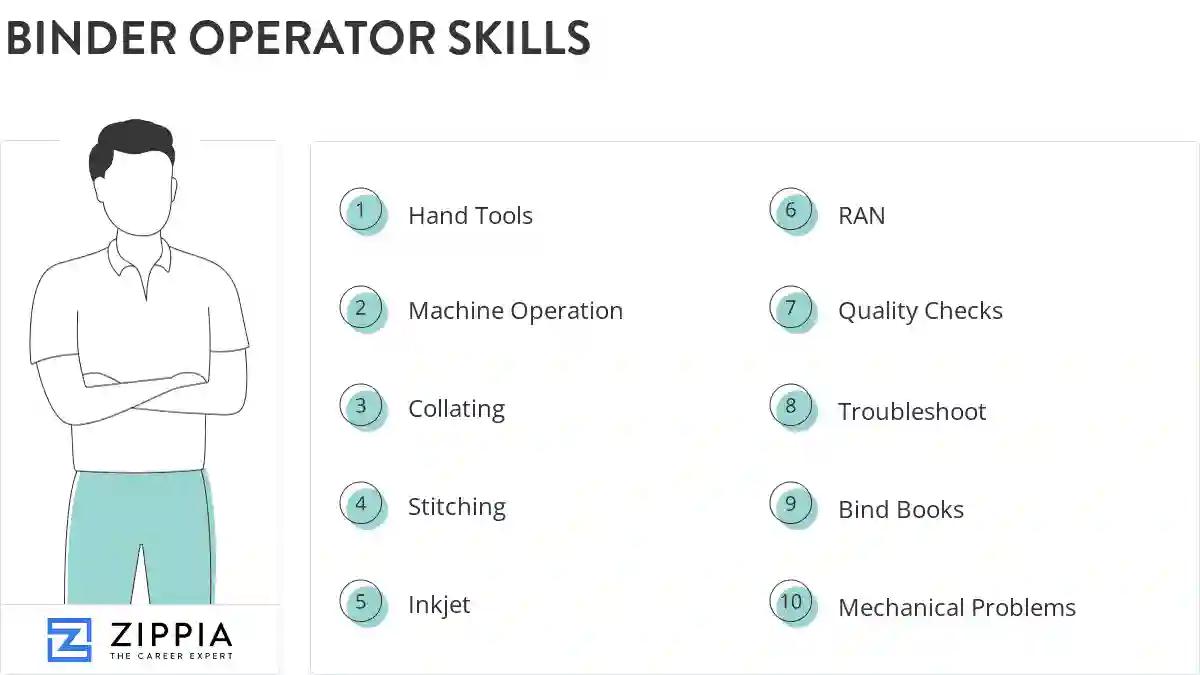
The most important skills for a binder operator resume and required skills for a binder operator to have include:
- Hand Tools
- Machine Operation
- Collating
- Stitching
- Inkjet
- RAN
- Quality Checks
- Troubleshoot
- Bind Books
- Mechanical Problems
- Assembly Line
- Stackers
- Product Orders
- Project Specifications
- Customer-Service
Updated January 8, 2025
