
Automatically apply for jobs with Zippia
Upload your resume to get started.
Bioinformatician skills for your resume and career
15 bioinformatician skills for your resume and career
1. Python
Python is a widely-known programming language. It is an object-oriented and all-purpose, coding language that can be used for software development as well as web development.
- Write SQL queries, Perl and Python scripts to aid with data extraction, processing, analysis and reporting.
- Created a Python script to read in protein data from multiple files and put them into a database.
2. Data Analysis
- Performed Exploratory Data Analysis regarding characterizing the main characteristics of data.
- Interacted with faculty to provide them sequencing data analysis services available only in our group.
3. Next-Generation Sequencing
- Build up infra-structure for next-generation sequencing data analysis.
- Optimized a probabilistic algorithm for aligning next-generation sequencing data.
4. Java
Java is a widely-known programming language that was invented in 1995 and is owned by Oracle. It is a server-side language that was created to let app developers "write once, run anywhere". It is easy and simple to learn and use and is powerful, fast, and secure. This object-oriented programming language lets the code be reused that automatically lowers the development cost. Java is specially used for android apps, web and application servers, games, database connections, etc. This programming language is closely related to C++ making it easier for the users to switch between the two.
- Designed client server database applications, based on Java and MySQL.
- Developed Java based parsing utility for different data types from different experiments from panomics studies.
5. Visualization
- Performed data, results visualization, full SDLC
- Provided a diversity of data visualization tools.
6. NGS
- Identified single nucleotide variants from NGS data.
- Identified differentially expressed genes among different populations using NGS RNAseq data from TCGA.
7. RNA-seq
- Learned and adapted accepted RNA-seq pipeline to analyze data generated by lab members.
- Performed comparison of RNA-seq and 3'-Tag Digital Gene Expression data to evaluate optimal choice for a study involving human gene expression
8. Linux
Linux is a Unix-like operating system. Just like Windows, Mac OS, and IOS, Linux is an operating system used by millions across the globe. Android itself is powered by the Linux operating system. Linux manages all the hardware resources that are associated with your computer. The software is famous because of the protection it grants from viruses, malware, and crashes. The Linux operating system is entirely free and is an open-source software meaning it can be altered by those equipped with the knowledge to code.
- Performed Linux cluster administration and ensured efficient use of measurement resources throughout facility.
- Administered and Maintained Linux system/server.
9. Perl
A Practical Extraction and Report Language, or simply PERL, is a programming language used for a script intended for syntax. You can see this when a particular web programmer or a junior developer creates a script for servers. It is used to manipulate text and utilize tasks such as web development, programming, and system administration.
- Conducted Fisher exact test followed by B-H correction to determine gene ontology enrichment (R and Perl).
- Developed numerous Perl programs to analyze the rice genomic data and a paper was published in Plant Cell.
10. Unix
UNIX is a computer operating system that was first created in the 1960s and has been constantly updated since then. The operating system refers to the set of programs that enable a machine to function. It is a multi-user, multi-tasking device that works on computers, laptops, and servers. UNIX systems also have a graphical user interface (GUI), similar to Microsoft Windows, that makes it simple to use.
- Developed UNIX shell script, PERL and AWK program and applied TECPLOT software macro files to automate data processing and report.
- Work in both windows and unix environments
11. Data Management
The administrative process that involves collecting and keeping the data safely and cost-effectively is called data management. Data management is a growing field as companies rely on it to store their intangible assets securely to create value. Efficient data management helps a company use the data to make better business decisions.
- Participate in conference calls and data management meetings as needed.
- Standardized incoming patient data management in strict HIPAA environment; worked closely with CROs to generate clinical expression data statistics.
12. C++
C++ is a general-purpose programming language that is used to create high-performing applications. It was invented as an extension to the C language. C++ lets the programmer have a high level of domination over memory and system resources. C++ is an object-oriented language that helps you implement real-time issues based on different data functions
- Developed a variant-calling pipeline in C++ using SeqAn's library and assumption of Poisson distributuion of variants.
- Designed and wrote code for parallelizing algorithms on a blade farm using an LSF scheduler using C++ on Linux.
13. DNA
Deoxyribonucleic acid, or only DNA, which is considered the king of molecules, is a macromolecule that contains the main component of chromosomes. Shaped like a double helix, DNA is usually found in the nucleus of a cell. It is a type of material that transports characteristics in many forms, developed in nucleotides around one another.
- Assess feasibility of various DNA sequencing methodologies for HLA typing through DNA sequence analysis and modeling.
- Designed experiments to understand DNA damage response pathway dynamics in order to find drug combinations for MM-398 and MM-302 teams.
14. Data Processing
Data processing refers to the manipulation and collection of data to generate meaningful information by a computer. It may include the transfer of raw data to a machine-legible form, managing the flow of data through the CPU or any memory to an output device, and conversion of output. Any utilization of computers to perform specific functions on data can be incorporated under data processing.
- Design and implementation of systems architecture for data processing (high performance computing) analysis and presentation.
15. BWA
- Executed alignment and annotated, recalibrated and visualized variants using BWA, SAMtools, GATK, ANNOVAR and IGV.

What skills help Bioinformaticians find jobs?
Tell us what job you are looking for, we’ll show you what skills employers want.
What bioinformatician skills would you recommend for someone trying to advance their career?
Josh Kaplan Ph.D.
Associate Professor, Western Washington University
List of bioinformatician skills to add to your resume
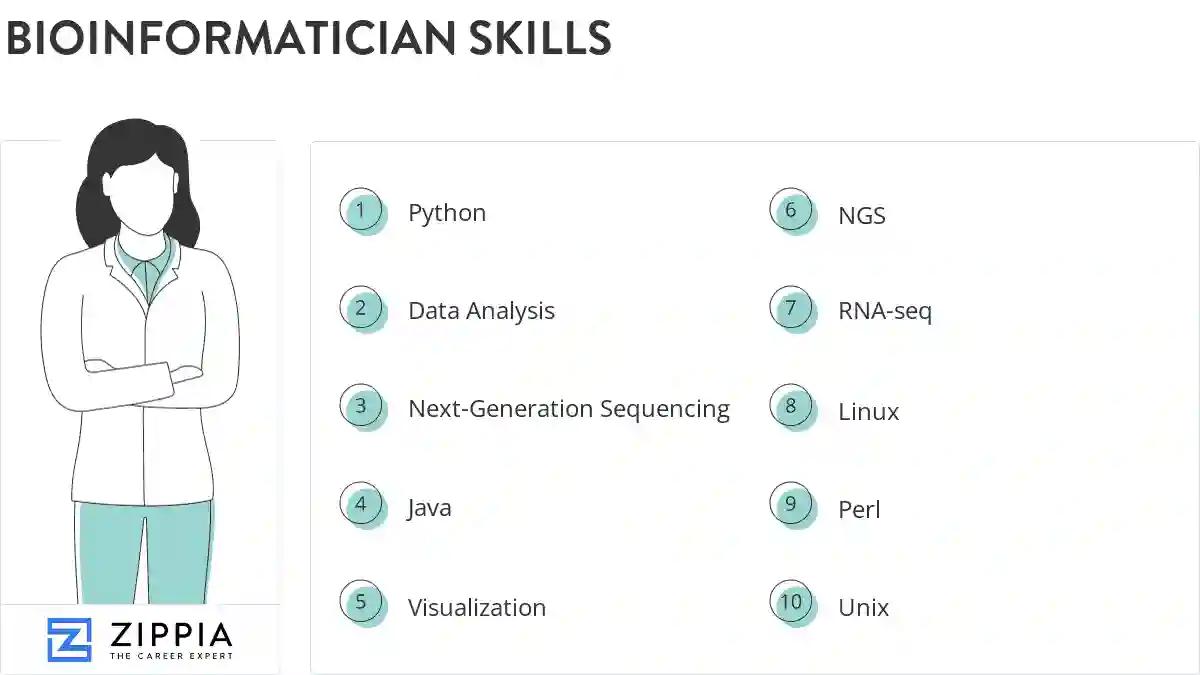
The most important skills for a bioinformatician resume and required skills for a bioinformatician to have include:
- Python
- Data Analysis
- Next-Generation Sequencing
- Java
- Visualization
- NGS
- RNA-seq
- Linux
- Perl
- Unix
- Data Management
- C++
- DNA
- Data Processing
- BWA
- Software Development
- HPC
- Picard
- Profiling
- Clinical Data
- SNP
- Genotyping
- QC
- Sequence Data
- HTML
- Gwas
- Regression
- Web Application
- Scientific Publications
- Computational Pipelines
- Pathway Analysis
- PHP
- Gene Expression Data
- Application Development
Updated January 8, 2025
