
Automatically apply for jobs with Zippia
Upload your resume to get started.
Bioinformaticist skills for your resume and career
10 bioinformaticist skills for your resume and career
1. Python
Python is a widely-known programming language. It is an object-oriented and all-purpose, coding language that can be used for software development as well as web development.
- Developed big data analysis pipelines using Python and Makefiles.
- Write SQL queries, Perl and Python scripts to aid with data extraction, processing, analysis and reporting.
2. Unix
UNIX is a computer operating system that was first created in the 1960s and has been constantly updated since then. The operating system refers to the set of programs that enable a machine to function. It is a multi-user, multi-tasking device that works on computers, laptops, and servers. UNIX systems also have a graphical user interface (GUI), similar to Microsoft Windows, that makes it simple to use.
- Developed UNIX shell script, PERL and AWK program and applied TECPLOT software macro files to automate data processing and report.
- Work in both windows and unix environments
3. Perl
A Practical Extraction and Report Language, or simply PERL, is a programming language used for a script intended for syntax. You can see this when a particular web programmer or a junior developer creates a script for servers. It is used to manipulate text and utilize tasks such as web development, programming, and system administration.
- Assumed responsibility for programming, using Perl and CGI and shell scripting.
- Conducted Fisher exact test followed by B-H correction to determine gene ontology enrichment (R and Perl).
4. NGS
- Developed best practice documentation for NGS analysis to enable transparent and reproducible data analysis.
- Coordinate various computational projects and supervise computational biologists for NGS data analysis.
5. HPC
- Applied HT sequencing software on local Penguin HPC clusters and at TACC.
- Customized proprietary software for implementation on TACC HPC clusters.
6. Biological Data
Biological Data refers to the information gathered from a living organism. This may be regarding the organism's genetic code, the products made from the organism, or the environment where the organism was found. This information is added to a biological database, which can then be accessed by biologists to review previously gathered data and genetic code.
- Managed all of the biological data for the division on DEC VAX and PC computer systems.
7. HTML
- Developed skills in web page building tools and web frame work, such as HTML, Catalyst, and Wiki.
- Updated and modernized company's Website using HTML.
8. MATLAB
- Developed FORTRAN 90/95 code and many MATLAB scripts.
9. SNP
- Managed selection of 4000 human SNP targets from 150,000 for AB Linkage Mapping Set whole genome product.
- Analyzed SNP data from the Human Genome Project.
10. R
R is a free software environment and a language used by programmers for statistical computing. The R programming language is famously used for data analysis by data scientists.
- Developed and performed statistical analyses and reported tools in R/Bioconductor.
- Programmed in R to statistically analyze neuroblastoma microarray data, elucidating drug targets.

What skills help Bioinformaticists find jobs?
Tell us what job you are looking for, we’ll show you what skills employers want.
List of bioinformaticist skills to add to your resume
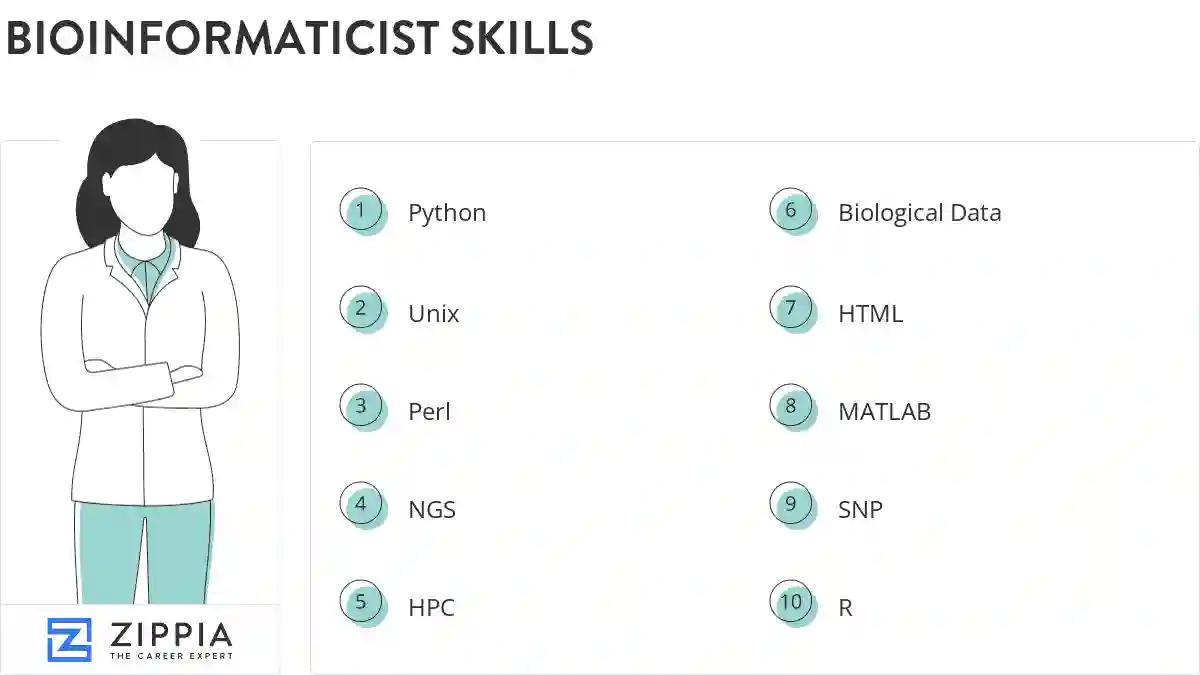
The most important skills for a bioinformaticist resume and required skills for a bioinformaticist to have include:
- Python
- Unix
- Perl
- NGS
- HPC
- Biological Data
- HTML
- MATLAB
- SNP
- R
Updated January 8, 2025
