
Automatically apply for jobs with Zippia
Upload your resume to get started.
Bioinformatics associate skills for your resume and career
10 bioinformatics associate skills for your resume and career
1. Python
Python is a widely-known programming language. It is an object-oriented and all-purpose, coding language that can be used for software development as well as web development.
- Collaborate with lab team to analyze genomic sequencing data, and extend current analysis pipeline using Python modules, eg.
- Translated and optimize previously written Perl code for use in Python.
2. Perl
A Practical Extraction and Report Language, or simply PERL, is a programming language used for a script intended for syntax. You can see this when a particular web programmer or a junior developer creates a script for servers. It is used to manipulate text and utilize tasks such as web development, programming, and system administration.
- Verified Oracle database updating and exporting of sequence data using software tools includ- ing Perl and SQL.
- Designed and developed Perl applications to measure quantity of STAT5 in genomes from the Virginia-Maryland Regional College of Veterinary Medicine.
3. Computational Biology
- Develop, validate and implement novel algorithms and provide computational biology and biostatistics support for various projects; 3.
4. SQL
- Manage and query large, complex, relational genetic databases using MySQL and Microsoft SQL Server.
- Developed a web application using JSP, HTML, CSS, SQL procedures.
5. Next-Generation Sequencing
- Optimized a probabilistic algorithm for aligning next-generation sequencing data.
- Performed SNP detection and analysis of Next-Generation Sequencing (NGS) data and bioinformatics services for various studies.
6. QC
Quality control is a set of instructions or procedures to ensure a manufactured product or a service is up to the highest quality standards. This set of quality control criteria are either defined by the clients or the company itself.
- Implemented soft- ware QC checks for overall data as well as looked at individual SNPs for verification.
- Developed various QC methods and tools to assess quality, yield, duplication of 454 sequencing.
7. DNA
Deoxyribonucleic acid, or only DNA, which is considered the king of molecules, is a macromolecule that contains the main component of chromosomes. Shaped like a double helix, DNA is usually found in the nucleus of a cell. It is a type of material that transports characteristics in many forms, developed in nucleotides around one another.
- Completed the breakdown and analysis on DNA strands from multiple Citrus samples Skills Used.
- Researched known cancer genes DNA sequence, and if g-complexes contribute to cancer development.
8. NGS
- Developed tools to automatically validate VCF files generated in clinical NGS pipelines.
- Design training modules, internal and external documentation for Analysis Edition of NGS (GeneSifter).
9. Sequence Data
- Performed primary analysis of sequence data including quality control and handling of multiplexed samples, and provide feedback to experimental biologists.
- Developed/administered sequence databases used for mutation screening in prostate cancer, obesity and pharmacogenomics projects.
10. R
R is a free software environment and a language used by programmers for statistical computing. The R programming language is famously used for data analysis by data scientists.
- Develop R packages, e.g.
- Developed and performed statistical analyses and reported tools in R/Bioconductor.

What skills help Bioinformatics Associates find jobs?
Tell us what job you are looking for, we’ll show you what skills employers want.
List of bioinformatics associate skills to add to your resume
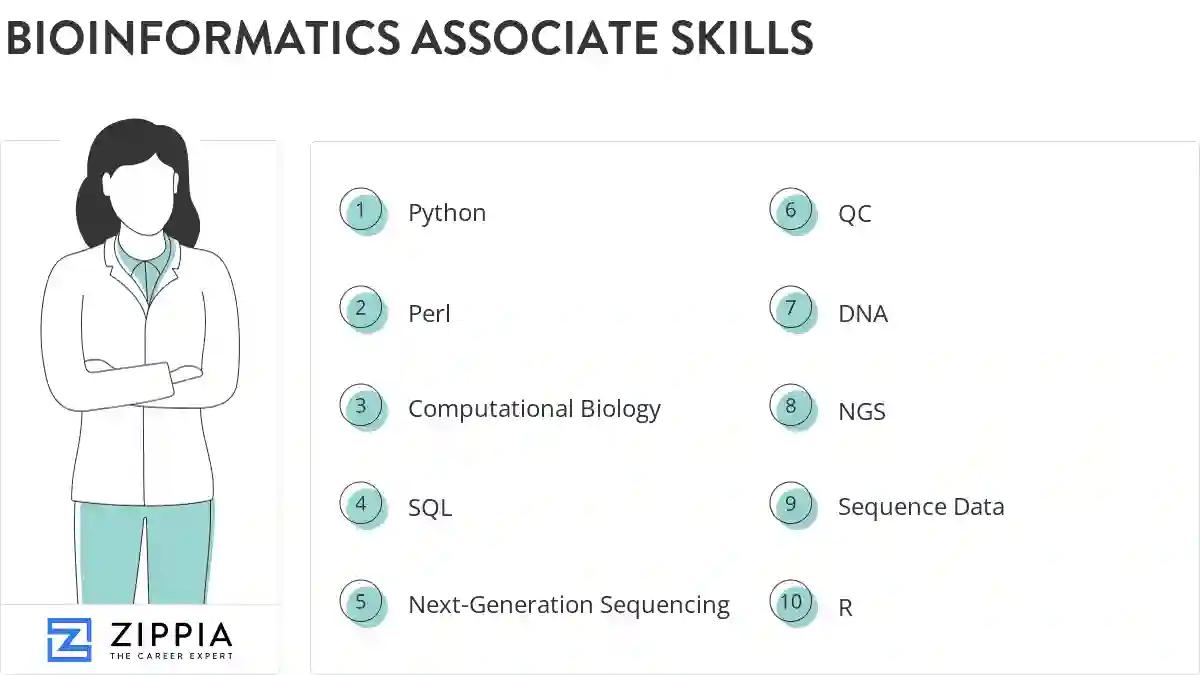
The most important skills for a bioinformatics associate resume and required skills for a bioinformatics associate to have include:
- Python
- Perl
- Computational Biology
- SQL
- Next-Generation Sequencing
- QC
- DNA
- NGS
- Sequence Data
- R
Updated January 8, 2025
