
Automatically apply for jobs with Zippia
Upload your resume to get started.
Biological sciences instructor skills for your resume and career
15 biological sciences instructor skills for your resume and career
1. Biological Sciences
- Coordinate and teach laboratories for the Immunology and Biological Sciences courses for undergraduate students.
- Job Description: To teach biological science laboratories to Biology major students.
2. Introductory Biology
- Serve to teach introductory biology to students at the North West Campus of the College.
- Teach Introductory Biology to McNair Scholar Students.
3. Anatomy
Anatomy is the comprehensive study of the internal structure and functions of a thing (living or nonliving). In the body, it's referred to as human anatomy which is the study of the body's internal structure and how they function with one another. There's also plant anatomy and animal anatomy for studying the structures of both.
- Instructed the following courses: Anatomy & Physiology, Introduction to Microbiology, Biology 100
- Teach Anatomy, Physiology, and Clinical Medicine
4. Physiology
Physiology is a branch of biology focused on studying living things, other parts, and the functions of these parts. It studies the functions of living things, especially the human body, and the effects of different processes and actions on the well-being of the body.
- Tutored college-level athletes in courses including statistics, psychology, anatomy, physiology, genetics, and microbiology.
- Planned and provided human anatomy and physiology course instruction and laboratory activities for students in the nursing program.
5. Syllabus
- Developed syllabus, overall course structure, laboratory component relative to instructional level, and internal assessments and administered all grades.
- Created and administered quiz and examination questions that were based upon performance objectives identified in the syllabus and their expected outcomes.
6. Ecology
- Conducted a hands-on biology laboratory including some ecology, microbiology, virology
- Instruct evening course- Bio 4: Global Ecology (lecture and lab)
Choose from 10+ customizable biological sciences instructor resume templates
Build a professional biological sciences instructor resume in minutes. Our AI resume writing assistant will guide you through every step of the process, and you can choose from 10+ resume templates to create your biological sciences instructor resume.7. General Biology
- Instructed lecture and laboratory for General Biology
- Instructed two sections of General Biology for summer session.
8. Molecular Biology
- Prepare and deliver lectures to undergraduate students on topics such as molecular biology, marine biology, and botany.
- Instructed students in microbiology, molecular biology, marine biology, basic biology and research techniques.
9. Curriculum Development
- Participated in communications curriculum development.
- Demonstrate proper technique in curriculum development, in accordance to Heritage Institutes policy and procedure with effective communication of subject matter.
10. Laboratory Experiments
A laboratory experiment is an experiment that is carried out in a dedicated room or set of rooms under strictly controlled conditions where precise measurements are possible. Laboratory experiments allow detailed examination of a wide range of parameters and flows and offer a cost-effective way to quantify processes and verify the bounds of validity of the theory.
- Provided classroom instruction through lecture and laboratory experiments in the field of biological science.
11. Laboratory Materials
- Developed laboratory curriculum, purchased and maintained laboratory materials.
12. Classroom Management
- Acquired additional hours of professional development in classroom management, curriculum development, and information related to gifted & talented students.
- Address challenges related to classroom management and student learning immediately Monitor student progress and report on daily session summaries.
13. Student Performance
- Evaluate student performance and keep records 5.
- Conducted conference/demonstration/practical exercises, administers written/practical examinations; evaluated student performance
14. Science Courses
- Designed online Environmental Science course with laboratory.
- Recognized as the first in the institute to develop and teach a hybrid science course in both classroom and online formats.
15. Cell Biology
- Instructed and graded 10 senior BMB students in Cell Biology Lab with emphases on extensive writing.
5 Biological Sciences Instructor resume examples
Build a professional biological sciences instructor resume in minutes. Browse through our resume examples to identify the best way to word your resume. Then choose from 5+ resume templates to create your biological sciences instructor resume.

What skills help Biological Sciences Instructors find jobs?
Tell us what job you are looking for, we’ll show you what skills employers want.
What skills stand out on biological sciences instructor resumes?
Jason Andrus Ph.D.
Professor and Department Head of Biological Sciences, Meredith College
Moreover, the more varied the courses that a candidate has taught, the more flexibility that candidate could bring to our organization. As a smaller department with a lot of courses to offer, being able to have faculty to teach multiple courses provides us with opportunities to make our curriculum not just meet the needs of our students but also offers flexibility to work with our faculty to help meet their professional goals as well.
One thing that can HURT your resume is emphasizing the wrong things. It is important to know the school where you are applying to and what their teaching/research load is. At a primary teaching institution, highlighting your vast research and funding record can actually work against you. Ultimately, we want to provide faculty with challenging and rewarding work; and while your stellar publication and funding record is fantastic, at a teaching institution, the opportunities to engage in research are more limited than at a research institution, and the search committee might conclude that the position would not be of interest to you or even a good fit! Each school that you apply to will have different expectations, so know the school culture and expectations when you apply. You can learn a lot about this by reading the school's mission statement, faculty pages, and (if available) the faculty handbook - especially the section on the faculty role model.
What hard/technical skills are most important for biological sciences instructors?
Jason Andrus Ph.D.
Professor and Department Head of Biological Sciences, Meredith College
What soft skills should all biological sciences instructors possess?
Kristen Platt Ph.D.
Assistant Professor, University of Kentucky College of Medicine
What biological sciences instructor skills would you recommend for someone trying to advance their career?
Helen Callus
Professor of Viola, Northwestern University
What type of skills will young biological sciences instructors need?
Dr. Lori Gray
Associate Professor: Director of Music Education, Boise State University
I would add that graduates need a strong work ethic, an understanding of professionalism and respect in the workplace, and self-awareness and an understanding of personal needs and limitations both at work and in their personal lives. In these current living conditions during a global pandemic (COVID-19), graduates also need resilience, perseverance, adaptability, and flexibility. These are all skills I would want for our Music Education majors to cultivate, as the climate in K-12 Education is ever-changing. However, I believe these are all skills that would be useful in any new career path.
List of biological sciences instructor skills to add to your resume
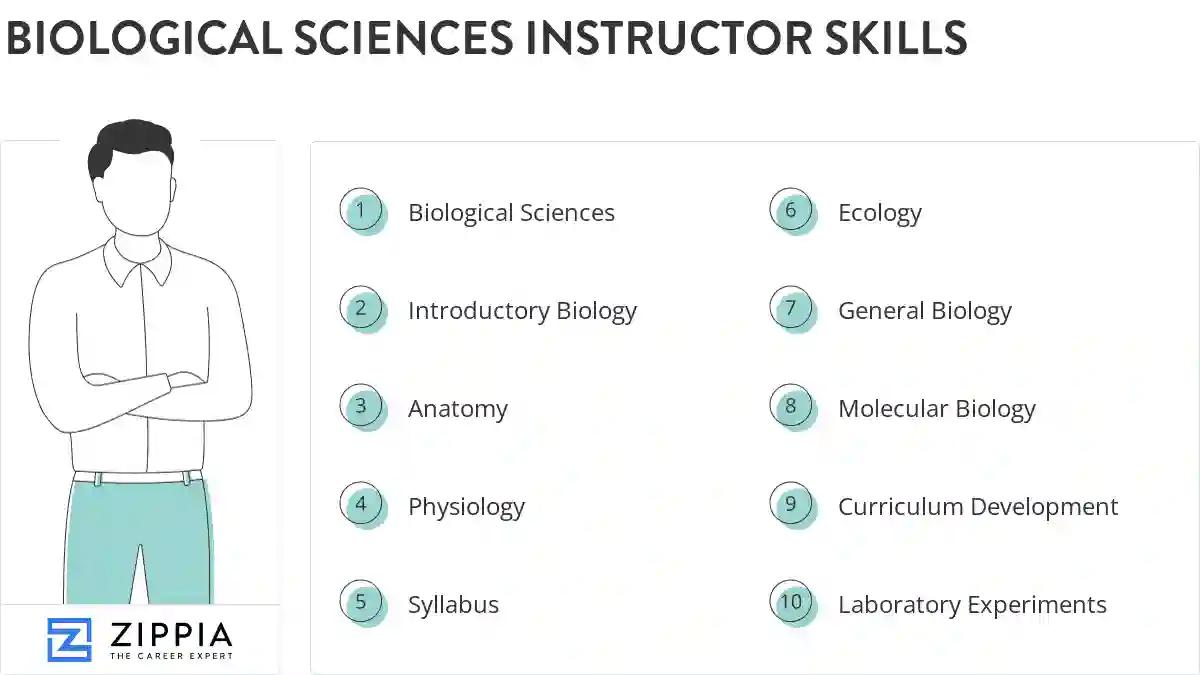
The most important skills for a biological sciences instructor resume and required skills for a biological sciences instructor to have include:
- Biological Sciences
- Introductory Biology
- Anatomy
- Physiology
- Syllabus
- Ecology
- General Biology
- Molecular Biology
- Curriculum Development
- Laboratory Experiments
- Laboratory Materials
- Classroom Management
- Student Performance
- Science Courses
- Cell Biology
- Chemistry
Updated January 8, 2025
