
Automatically apply for jobs with Zippia
Upload your resume to get started.
Biology research assistant skills for your resume and career
15 biology research assistant skills for your resume and career
1. Laboratory Equipment
- Operated laboratory equipment, including chemical reagents and provided animal care through feeding and cleaning.
- Manage laboratory equipment, inventory, and grant information.
2. Laboratory Techniques
- Ensured policy and procedure adherence when working with those learning laboratory techniques.
- Analyzed biology samples and reported results through laboratory techniques and procedures.
3. Cell Culture
- Performed cell culture with proper sterile technique and various assays on numerous cell lines
- Trained in BSL-2 tissue processing and aseptic cell culture.
4. Analyze Data
Analyze data or data analysis refers to the practice of studying, organizing, and transforming data to make it more useful. It also includes the cleansing of non-useful information which helps in better decision making regarding any particular matter. Analyze data is a practice that is used widely in the field of business, social sciences, and science.
- Retrieve, organize and analyze data.
- Analyze data using Excel, Access, and SPSS.
5. Data Collection
Data collection means to analyze and collect all the necessary information. It helps in carrying out research and in storing important and necessary information. The most important goal of data collection is to gather the information that is rich and accurate for statistical analysis.
- Developed spreadsheet for data collection and analysis using Microsoft Excel.
- Assisted in experimental design, set-up, data collection and analysis
6. Animal Handling
- Experience with live animal handling and care with rats.
- Performed marineanimal handling, restraint, feeding, physical exams, clinical treatment, and necropsy.
Choose from 10+ customizable biology research assistant resume templates
Build a professional biology research assistant resume in minutes. Our AI resume writing assistant will guide you through every step of the process, and you can choose from 10+ resume templates to create your biology research assistant resume.7. Research Projects
- Managed tissue culture projects, assisted post-doctoral fellows with specified research projects, managed daily laboratory activities and supply requirements.
- Worked to develop independent research projects, conduct pilot experiments, and alter experiments according to data collected.
8. Tissue Culture
- Designed and constructed new tissue culture room.
- Performed tissue culture, DNA gel electrophoresis, Southern transfer procedure, preparation of radioactive DNA probes for gel hybridization
9. Lab Equipment
- Assembled graphs/presentations of data collected and operated lab equipment such as imaging machines and fluorescent imaging machines.
- Trained in the use of lab equipment, sample collection, slide preparation, dissecting and light microscopy.
10. Laboratory Procedures
- Maintained an organized notebook with documented laboratory procedures and observations.
- Maintained and updated laboratory procedures and notebooks as needed.
11. Data Analysis
- Prepared weekly written reports, compiled data analysis, and formulated conclusions.
- Provided data analysis in tabular and spreadsheet formats.
12. PowerPoint
- Worked in designing and developing advanced experiments using PowerPoint and Excel.
- Created Georgia Southern University Biological Science display using Microsoft PowerPoint.
13. Lab Notebook
- Recorded results in lab notebook for reporting to lab supervisor.
- Develop protocols, ordering, maintain Lab notebooks and records.
14. DNA
Deoxyribonucleic acid, or only DNA, which is considered the king of molecules, is a macromolecule that contains the main component of chromosomes. Shaped like a double helix, DNA is usually found in the nucleus of a cell. It is a type of material that transports characteristics in many forms, developed in nucleotides around one another.
- Performed lab assistant activities including preparing solutions, DNA extraction, DNA sequencing preparation
- Gained experience in molecular biology including PCR and DNA sequencing
15. Extraction
- Helped train in new volunteers, undergrad researchers and graduate students on extraction and PCR techniques.
- Performed protein extraction on larvae.
5 Biology Research Assistant resume examples
Build a professional biology research assistant resume in minutes. Browse through our resume examples to identify the best way to word your resume. Then choose from 5+ resume templates to create your biology research assistant resume.

What skills help Biology Research Assistants find jobs?
Tell us what job you are looking for, we’ll show you what skills employers want.
What skills stand out on biology research assistant resumes?
Katina Lillios
Professor, Department Chair, The University of Iowa
What soft skills should all biology research assistants possess?
Srinivas Sonne Ph.D.
Assistant Professor of Biology, Paine College
What hard/technical skills are most important for biology research assistants?
Srinivas Sonne Ph.D.
Assistant Professor of Biology, Paine College
What biology research assistant skills would you recommend for someone trying to advance their career?
Christopher Herren Ph.D.
Teaching Assistant Professor, Kansas State University
What type of skills will young biology research assistants need?
Scott Cooper Ph.D.
Professor of Biology and Director of Undergraduate Research and Creativity, University of Wisconsin-La Crosse
What technical skills for a biology research assistant stand out to employers?
Tawnya Cary Ph.D.
Assistant Professor of Biology, Beloit College
List of biology research assistant skills to add to your resume
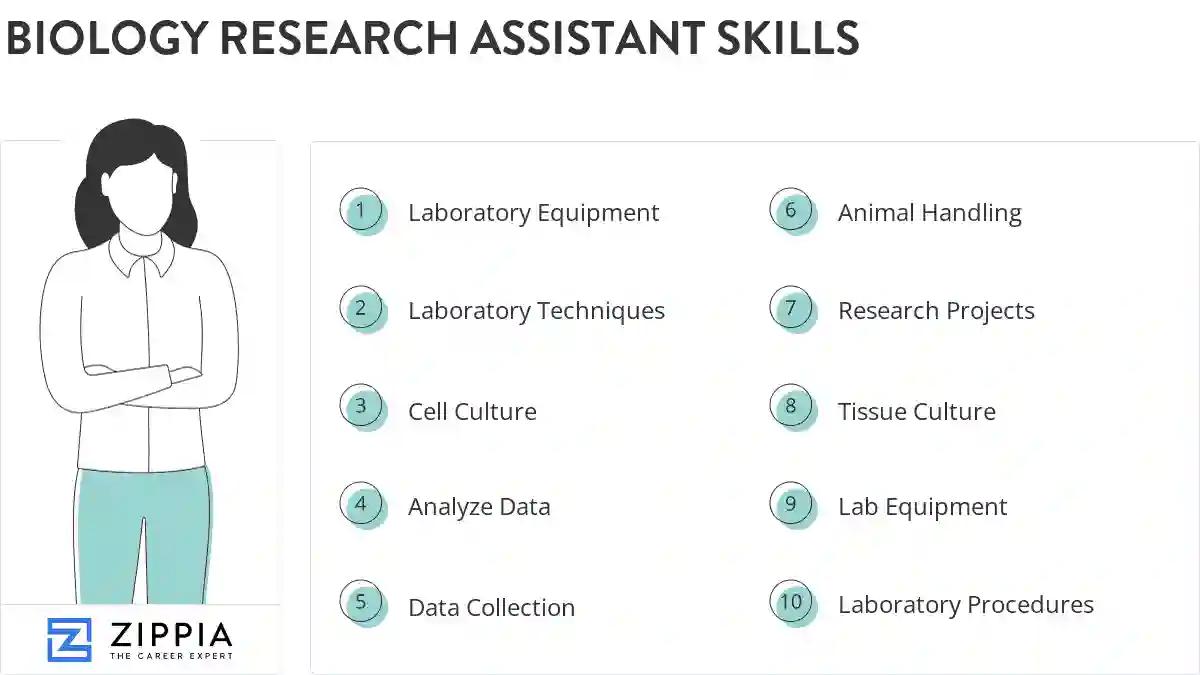
The most important skills for a biology research assistant resume and required skills for a biology research assistant to have include:
- Laboratory Equipment
- Laboratory Techniques
- Cell Culture
- Analyze Data
- Data Collection
- Animal Handling
- Research Projects
- Tissue Culture
- Lab Equipment
- Laboratory Procedures
- Data Analysis
- PowerPoint
- Lab Notebook
- DNA
- Extraction
- Statistical Analysis
- RNA
- Chemistry
- Cell Biology
- Genotyping
- GEL Electrophoresis
- Protein Expression
- PI
- RT-PCR
- Molecular Biology Techniques
- Electrophoresis
- Biological Research
- Tissue Samples
- Elisa
- Experimental Data
- CRISPR
- Western Blotting
- Cell-Based Assays
- R
- Experimental Design
- Rna Extraction
- Independent Research
- Cell Lines
- Zebrafish
- Next-Generation Sequencing
- Research Support
- HPLC
- GPS
- SDS-PAGE
- Centrifuges
- Stem Cells
- Drosophila
- Quantitative Pcr
Updated January 8, 2025
